Archeobotany: Why We Do It, What it Tells Us
This
webpage explains the methods and techniques of archeobotanical analysis
and interpretation, with emphasis on the importance of archeobotanical
studies to Maryland archaeology.
Archeobotany,
or Paleoethnobotany is the study of plant remains recovered from
archaeological excavations. Archeobotanists
analyze this evidence to interpret how people in the past used and
interacted with plants. Just
as pottery and other objects found by archaeologists allow them
to understand a site’s history, plant remains from archaeological
deposits are, in fact, “artifacts” that reflect past relationships
between people and plants.
Understanding these
relationships is rarely simple, as we must base our interpretations
on fragmentary evidence. For example:
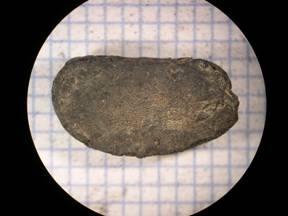
From a fragment of a
burned bean seed we hope to understand the people that bred, planted,
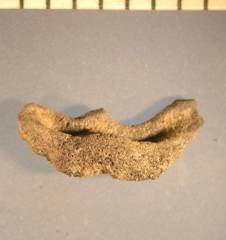
cared for and depended upon this food. From tiny fragments of corn we try to understand
the variety, culture and importance of horticulture to Indians living
in the Chesapeake region.
| 
|
|
|
| A bean cotyledon
from Idlewild Farm (18AN1257):
Gibb 2006. |
|
Maize cupule from
the Winslow Site (18MO9): McKnight 2005 |
|
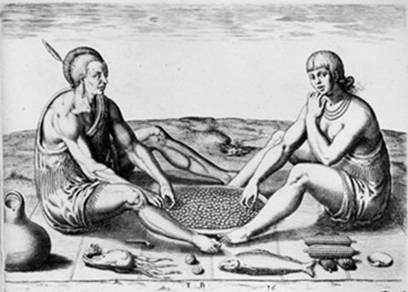
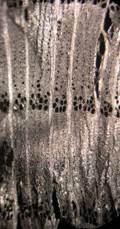
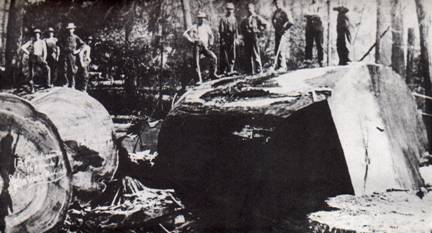
And from a fragment of oak wood charcoal we hope
to understand the composition and scale of America’s Native
forests and the cultural choices which lead to their decimation.
|
|
 |
| Red oak wood charcoal
viewed beneath the microscope. |
|
An oak tree felled
in the Monogahela forest ca. 1913. (Fig 11 in Tumult on the
Mountains by Roy Clarkson 1964, “photo courtesy of Ruth
M. Barrho.” |
Areas of specialty within the field of Archeobotany
include pollen, starch, and phytolith studies as well as the
most widely applied archeobotanical approach: the analysis of plant
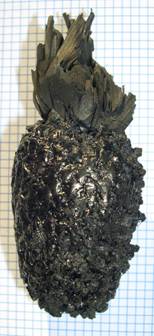
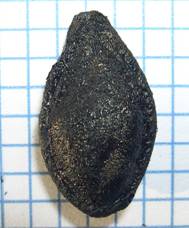
macro-remains. These are plant materials (usually carbonized) visible
to the naked eye and large enough to be identified under low-power
(10x to 40x) magnification. Macro-remains include such things as
 |
 |
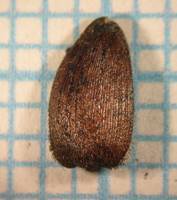 |
| Carbonized maize cob,
burned pumpkin seed and a sunflower achene. (scale 2mm grid). |
Plant macro-remains are collected using various
techniques, including the recovery by hand of carbon concentrations
found during archaeological excavation, water-screening of cultural
fill (where water pressure is used to clear artifacts and durable
plant remains such as pits and nutshells), dry screening of sediment,
and water flotation. One of the most important
archeobotanical methods is soil flotation. Flotation is a recovery
technique that separates organic matter from the soil using water.
This technique greatly enhances the quality and the range of archeobotanical
| |
|
|
| |
|
|
|
Soil flotation
for the collection archeobotanical material. |
Flotation systems vary from simple to complex,
but the process involves dumping a sample of archaeological soil
into a tank of water. In the tank the heavy material (rocks, shell
and cultural artifacts like pottery, lithics, bone, beads and pins)
sinks and is captured on a screen. Organic material (wood charcoal,
seeds, etc.) floats and is captured in a strainer. Finally, the
sediment is washed away, allowing the archaeobotanist to recover
plant remains for analysis.
Most plant remains recovered from archaeological
sites in Maryland have been preserved through carbonization (burning).
Typically, organic materials quickly decompose under normal conditions
(imagine your compost heap). However, burning of plant material
in a low-oxygen environment can preserve plant artifacts and keep
key morphological features intact for millennium.
In unusual conditions such as historic wells and privies, or prehistoric
bog and cave environments, non-carbonized plant material can persist
in the archaeological record.
The products of flotation are dried and the plant
artifacts are sent to an archeobotanist for study. Materials are
sorted into categories (nut, wood, seed, cultivated plant part)
and measurements such as count and weight are recorded. The archeobotanist
uses published texts, dichotomous keys and a reference collection of plant materials to identify
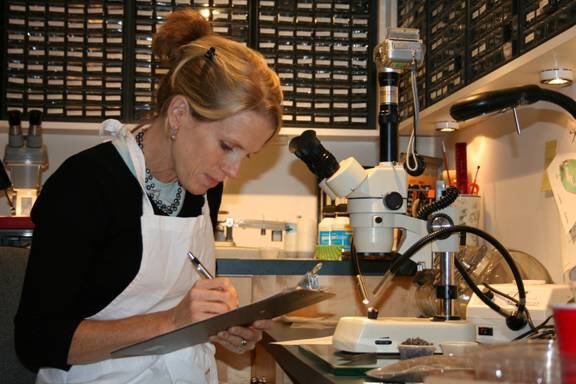 An Archeobotanist at work in her laboratory.
The kinds of macro-botanical remains commonly
identified from archaeological sites in Maryland include nutshells,
wood charcoal, seeds and fruit pits, tree bark, grass fibers,
fungi and rinds or husks. Identification of the particular plants
present in an archaeological context can help us to understand
past vegetation and landscape ecology, seasonality of site occupation,
subsistence practices, diet, trade and plant domestication. All
existing macro-botanical evidence from Maryland archaeological
sites has been organized in the Maryland
Archeobotanical Database.
Suggestions for Further Reading on Archeobotany:
| Pearsall, Deborah |
| 2001 |
Paleoethnobotany: A Handbook of Procedures. Second Edition. Academic Press, New York. |
| |
| Smith, Bruce D. |
| 1992 |
Rivers of Change. Essays on Early Agricutlure in
Eastern North America. Smithsonian Institution Press,
Washington
D.C. |