How To Read A Pollen Diagram
Palynology is the science that studies fossil
pollen and other palynomorphs (tiny organic-walled micro-fossils).
Archeological palynology examines human use of plants in the past.
Pollen analysts study pollen grains preserved in soil sediments,
peat bogs, on rocks and even on artifacts. By studying fossil
pollen we can correlate climatic change and archaeological evidence
to help us to understand Maryland’s environmental history.
Fossil pollen grains are extracted/isolated using
various chemical treatments, and mounted on a microscope slide
and examined using a light microscope (link to glossary) or a
scanning electron microscope (link to glossary). Under magnification,
the pollen analyst will identify pollen types and count the number
of pollen grains present. This information is used to produce
a pollen diagram.
It is helpful to be able interpret the results
of palynology by “reading” a stratigraphic pollen
diagram. Although they tend to look quite intimidating, pollen
diagrams (also called profiles) are just a series of graphs arranged
side-by-side.
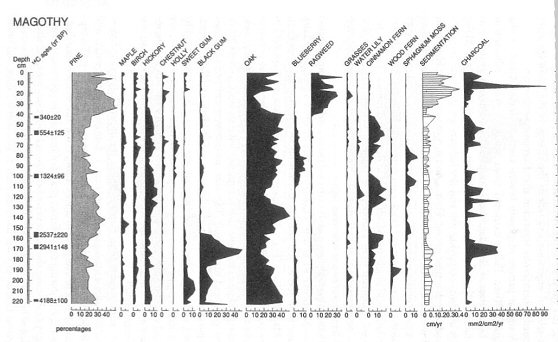
A 4,000-year pollen
profile of the major forest taxa in the Magothy River (from Brush
2001)
The graph’s Y axis (running top to bottom)
shows the depth of the sample, which usually corresponds to time,
with the deepest and oldest deposits at the bottom, and the most
shallow or recent deposits at the top. The age of different layers
of sediment are determined by measuring the decomposition of carbon
through a process called radiocarbon dating (link).
The graph’s X axis (running left to right)
plots the percentage of plant pollen types. The greater the height
of the graph, the larger the percentage of a given pollen type
present. The pollen diagram allows us to see changes through soil
depth and time.
For example, in the graph above the percentage
of pine pollen comprises about 15% of the sample collected from
1000 centimeters below the surface. The same depth produced a
radiocarbon date of 1324 bp +/-96. Radiocarbon dates are reported
in years before present. Since “present” is set at
1950 to keep things simple, 1324 bp +/- 96 is approximately A.D.
626.
It is important to understand that the pollen
percentages expressed in a pollen diagram are not exactly the
same as the percentage of each plant as it existed in a past landscape.
This is because not all plants produce the same amount of pollen
(an oak tree produces a lot of pollen, while a beet plant produces
very little).
Palynologists usually use Latin or scientific
names (link) to refer to plants. Groups of related plants often
have very similar pollen, and scientific nomenclature allows for
greater specificity. Sometimes pollen is identified to a “group”
or “type” to reflect a broader range of possible classifications.
 |
|
 |
|
 |
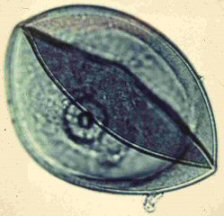
| A grain of maize pollen
(from Cornel U website, NEED PERMISSSION) |
|
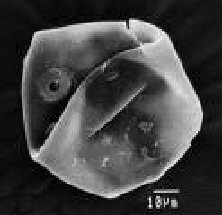
A grain of maize pollen
http://www.southalabama.edu/
geography/fearn/images/
crnpolb.jpg (NEED PERMISSION) |
|
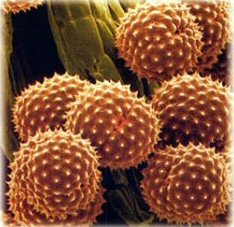
Ragweed pollen viewed beneath a
scanning electron microscope. (from http://flickr.com/photos/
90717134@N00/462176889/
NEED PERMISSION) |
Studying trends in the pollen record can help
us to reconstruct past environments and to identify changes to
vegetative landscapes over time. Archaeological palynologists
examine pollen data in order to detect cultural activities against
a background of naturally occurring pollen “rain”.
These specialists try and understand how environmental change
affected human groups, and what economic and social factors influenced
how people changed their lives to cope with new conditions. Archaeological
pollen profiles are particularly useful in this effort as they
record ways that human beings have shaped landscape history.
Suggestions for Further Reading on Palynology:
Brush, Grace S.
2001 Forests Before and After the Colonial Encounter.
In Discovering the Chesapeake. Edited by P. Curtin, G.
Brush and
G.
Fisher. Pp. 40-51. John Hopkins University Press, Baltimore.
Bryant, Vaughn M., and Richard G. Holloway
1983 The Role of Palynology in Archaeology. In Advances
in Archaeolgoical Method and Theory (Vol. 6.), edited by
M.S.
Schiffer, pp 191-223. Academic Press, New York.
Pearsall, Deborah
2001 Paleoethnobotany: A Handbook of Procedures.
Second Edition. Academic Press, New York.