This unusual cowrie shell was recovered in June 2005 from the Smith's St. Leonard site, in Calvert
County, Maryland. Two cowrie shells were found about 15 feet apart in the plowzone adjacent to the
main house of this large plantation which was occupied during the first half of the 18th century.
One of the shells is a typical find, with the top or dorsal surface removed. The shell pictured
here, however, is different. The shell is intact and molten lead had been poured into the back
aperture. A copper alloy eyelet was then inserted into the lead. It is not clear if this cowrie
was used as a button or pendant, or had some other special function, however, the metal was added
to the shell in a crude fashion, so it does not appear to be the work of a jeweler or master
craftsman.
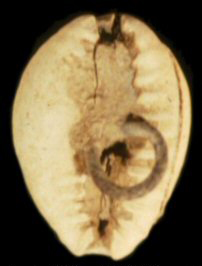 Cowrie shell from Smith's St. Leonard site, showing copper alloy eyelet and
lead filling.
Cowrie shell from Smith's St. Leonard site, showing copper alloy eyelet and
lead filling.
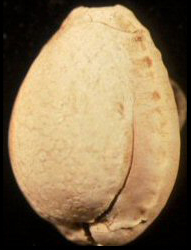 Dorsal side of Smith's St. Leonard site cowrie. The copper alloy eyelet is just visible along
the right side of the shell.
Dorsal side of Smith's St. Leonard site cowrie. The copper alloy eyelet is just visible along
the right side of the shell.
This shell has been identified as a money cowrie (Cyprea moneta), one of approximately two hundred
recognized species of cowrie. Cowries occur in warm and shallow lagoons and basins of the Indian
and Pacific Oceans, although the Maldive Islands were the source of most Cyprea moneta entering the
world trade (Hogendorn and Johnson 1986:7).
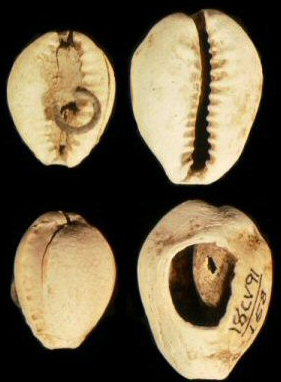 Dorsal and ventral sides of both Smith’s St. Leonard site cowries.
Cowries have been found in small quantities on archaeological sites occupied by European Americans,
African Americans and Native Americans in the eastern U. S. (Pearce 1992). It is not clear who
owned or used the cowries from the Smith's St. Leonard site. Their rough appearance might suggest
that they were not used as jewelry by the wealthy white landowners, and a quarter for enslaved Africans
was located just a couple of hundred feet from the find site. However, there is good evidence that
someone living on the plantation in the 18th century was collecting prehistoric Indian artifacts,
so it is possible that the cowries were curios. Future excavations at the site will perhaps clarify this.
For centuries, cowrie shells have served many functions. Cowries have played decorative and religious
roles in a number of cultures. They have been recovered from Early Iron Age burials in Italy and England,
were worn as amulets by women to promote fertility, and carried in various European cultures as good
luck amulets (Hildburg 1942). The use of cowries for ornamentation and decoration in parts of West Africa
can be traced back as far as the 11th century (Ogundiran 2002:438). Sewn onto clothing, made into jewelry,
and woven into the hair, cowries not only served as adornment, but also as symbols of status and wealth
(Pearce 1992). A small hole pierced in the anterior or posterior end of the shell would allow it to be
suspended from a cord and worn as a pendant.
Cowries are perhaps most widely known for their use as currency in Africa, where they figured prominently
in the economy of the slave trade. The use of cowries as currency in West Africa was firmly in place
by the initial period of European contact (Hogendorn and Johnson 1986:18). Because it was impossible to
mint coins with as low a value as a single cowrie, they were particularly well-suited for small
transactions like local market purchases (Hogendorn and Johnson 1986:2). Cowries also served ritual and
religious functions in West Africa, serving as divination tools and incorporated as components of sacred
objects and shrines (Ogundiran 2002).
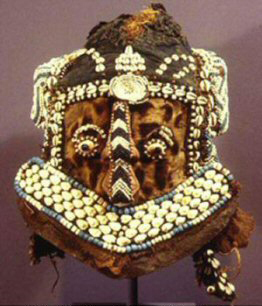 Mask of the Founder King, Kuba Kingdom, Democratic Republick of Congo.
The mask is adorned with cowrie shells and beads.
Mask of the Founder King, Kuba Kingdom, Democratic Republick of Congo.
The mask is adorned with cowrie shells and beads.
While it is typical to find complete pierced with small holes or missing part of the dorsal surface,
the lead-filled Smith's St. Leonard shell is very unusual. If anyone has seen a similar shell, or might
have ideas or suggestions about this object, please contact the Maryland Archaeological
Conservation Laboratory.
References Cited
Hildburgh, W.L.
1942 Cowrie Shells as Amulets in Europe. Folklore. Volume
53, No. 4:178-195.
Hogendorn, Jan, and Marion Johnson
1986 The Shell Money of the Slave Trade. Cambridge
University Press, New York.
Ogundiran, Akinwumi
2002 Of Small Things Remembered: Beads, Cowries, and Cultural
Translations of the Atlantic Experience in Yorubaland. International Journal of African Historical
Studies. Volume 35, Nos. 2-3:427-457.
Pearce, Laurie E.
1992 The Cowrie Shell in Virginia; a Critical Evaluation of
Potential Archaeological Significance. Master's thesis, Anthropology Department, College of William
and Mary, Williamsburg, Virginia.