Relief molded jugs, like the example shown here, gained popularity in the early Victorian period.
Produced primarily in England, these jugs were decorated with complex designs often depicting sentimental,
gothic, biblical, or patriotic themes (Hughes 1985:9). These inexpensive but lively vessels were
manufactured for the middle classes, beginning around 1830 and continuing through the 1870s
(Hildyard 2005:184; Hughes 1985:vi). Relief molded jugs were most often produced in tan, buff,
blue, or light green stoneware or in parian. Parian, first appearing in the 1840s (Hughes 1985:12),
was translucent cream colored stoneware developed to imitate marble.
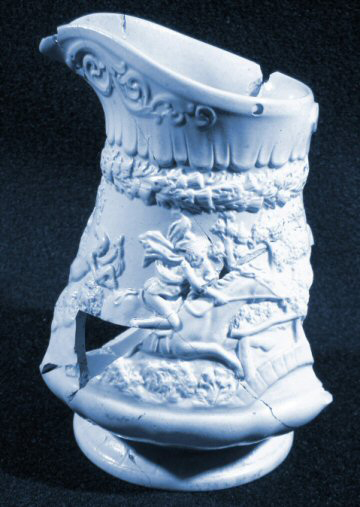
This jug is press molded in the Tam O'Shanter pattern, based on a popular narrative poem published
in 1791 by Scottish poet Robert Burns. In this poem, a farmer dallies at the local pub on market
day, thus delaying his trip home. On his midnight ride home, he encounters a group of witches
dancing in undergarments. Spying him watching, they give chase, with one witch gaining a hold on
his unfortunate horse's tail. The jug depicts the lively tavern scene on one side, and the ghostly
pursuit on the other.
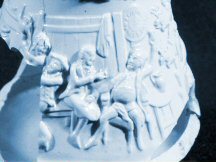 Detail of Tavern Scene.
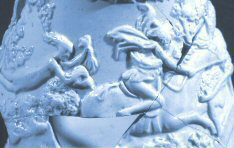 Detail of Ghosty Pursuit.
Impressed in the base of the jug are the words "Published by W. Ridgway & Co., Hanley, October 1st, 1835."
The bases of relief molded jugs were often marked with the manufacturer’s name and a date to
register the design. Registry marks can be dated using tables found in a number of ceramic reference
books, including Geoffrey Godden's Encyclopaedia of British Pottery and Porcelain Marks.
The 12 cm tall jug is missing its elaborately molded handle. Two small holes along the rim suggest
that this vessel once had a hinged metal top.
This vessel was recovered from 18BC27, the site of the Federal Reserve Bank in Baltimore. It had been
deposited in a circular brick-lined privy along with a number of other ceramic and glass vessels that
suggested the privy had been filled sometime between 1835 and 1870. Rarely do archaeologists find vessels
that as are close to complete as this one, but privies allow for exceptional ceramic finds because
artifacts thrown in a privy were generally in a confined area where they weren't exposed to
foot traffic or plowing.
References
Godden, Geoffrey
1964 Encyclopaedia of British Pottery and Porcelain Marks.
Herbert Jenkins, London (revised and reprinted, 1993).
Hildyard, Robin
2005 English Pottery, 1620-1840. V & A
Publications, London.
Hughes, Kathy
1985 A Collector’s Guide to Nineteenth-Century Jugs.
Routledge & Kegan Paul, London.