The Charles' Gift archaeological site was discovered in 1999, during U.S. Navy-sponsored excavations conducted
aboard the Naval Air Station, Patuxent River (Hornum et al. 2001). Archaeologists identified two different
houses; one that appears to have been inhabited from c. 1676-1694, and another that was presumably built as
a replacement around 1694. Between the two structures was a large borrow pit where builders dug up clay
to make brick for the foundations of the 1690s structure. This pit was later filled with debris from the
destruction of the earlier house. Among the debris in the pit was a bodkin, inscribed with the initials "SS."
A bodkin is like a large, slightly blunted needle with a rectangular hole to accommodate ribbons and laces. In
the 17th and 18th centuries, bodkins were important personal items for women. They were primarily used to
lace decorative trims, corsets, and drawstrings, but sometimes women also displayed bodkins like jewelry by
wearing them in their caps (Figure 1). Many women of high status owned inscribed silver bodkins, often pierced
with a second hole to string on a decorative bauble.
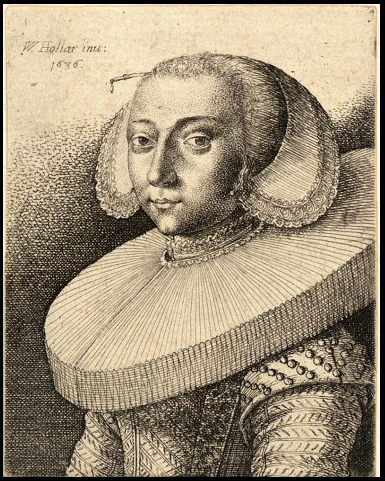 Figure 1: Wenceslaus Hollar's 1636 etching titled "The same woman, with a ruff" depects a woman with
her bodkin tucked into her cap. Courtesy of the Thomas Fisher Rare Book Library, University of
Toronto.
Figure 1: Wenceslaus Hollar's 1636 etching titled "The same woman, with a ruff" depects a woman with
her bodkin tucked into her cap. Courtesy of the Thomas Fisher Rare Book Library, University of
Toronto.
Historical research suggests that the Charles' Gift structures had been occupied by Nicholas and Susanna Sewall
and their family, because Nicholas Sewall would have come of age and inherited the parcel of land in 1676.
The discovery of a bodkin with the initials "SS" inscribed on it helps confirm this interpretation by acting
as a poignant connection to Susanna Sewall (Figure 2).
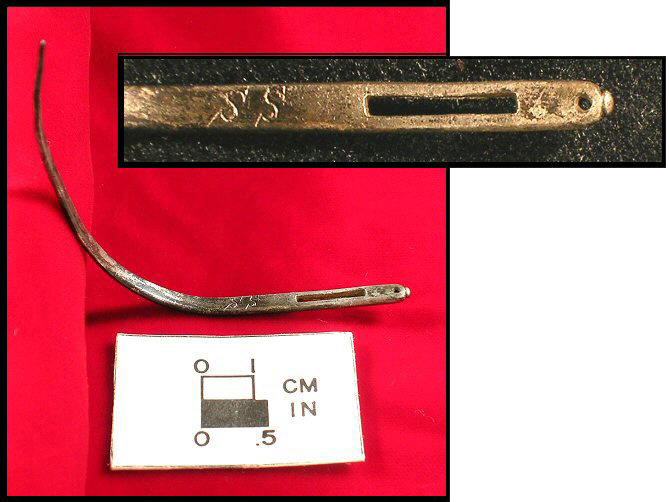 Figure 2: The Charles' Gift bodkin, with inscribed "SS" initals, a rectangular hole for ribbons
and laces, and an extra hole for a decorative bauble. Most bodkins found archaeologically are bent, as
is the "SS" bodkin but it is unclear if the curve served a utilitarian function or if it represents
damage. Courtesy Naval District Washington, Naval Air Station Patuxent River.
Figure 2: The Charles' Gift bodkin, with inscribed "SS" initals, a rectangular hole for ribbons
and laces, and an extra hole for a decorative bauble. Most bodkins found archaeologically are bent, as
is the "SS" bodkin but it is unclear if the curve served a utilitarian function or if it represents
damage. Courtesy Naval District Washington, Naval Air Station Patuxent River.
Nicholas and Susanna Sewall were part of Maryland’s elite in the 1670s and 1680s. Nicholas' stepfather was
Charles Calvert, governor of Maryland who became the Third Lord Baltimore in 1676. The family fell on
hard times in 1689, however, because Protestants overthrew the Catholic Calvert proprietary that year,
raiding Charles Calvert's home and forcing Nicholas to flee to Virginia. Susanna Sewall's bodkin may
reflect this hardship because elite women generally had professionally inscribed silver bodkins,
but Susanna’s bodkin was copper alloy with silver or tin plating, and her initials appear to be
chiseled rather than neatly inscribed. It is possible that Susanna had to trim the budget on her personal
items while still keeping up appearances (Beaudry 2006).
References
Beaudry, Mary C.
2006 Findings: The Material Culture of Needlework and Sewing.
Yale University Press, New Haven and London.
Hornum, Michael B., Andrew D. Madsen, Christian Davenport, John Clarke,
Kathleen M. Child, and Martha Williams
2001 Phase III Archaeological Data Recovery at Site 18ST704,
Naval Air Station Patuxent River, St. Mary’s County, Maryland. Report Prepared for Tams
Consultants, Inc., Arlington, Virginia.