In 1999, Jefferson Patterson Park & Museum archaeologists conducted a Phase I shovel test
pit survey around a small tidal inlet known as Goose Creek, located aboard the Naval
Air Station Patuxent River in St. Mary's County. A number of prehistoric and historic
sites were discovered during this survey. One of the sites, 18ST727, appears to have
been a seasonally-occupied Late Woodland period camp. Artifacts found at the site were
typical of the period, and included 13 Townsend Series pottery sherds and a triangular
Potomac projectile point (Sperling 2000). However, there was one unusual find there: a
triangular bit tobacco pipe fragment.
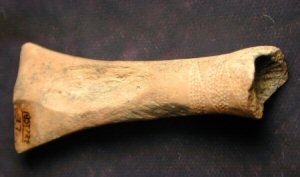
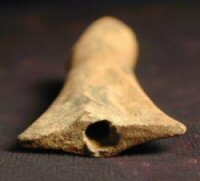
The pipe is 5.69 cm (2.24 in.) long, although much of the bowl is missing. The bit
(mouth end) is 2.3 cm (0.9 in.) wide and 0.66 cm (0.26 in.) high at its thickest point,
and has a round bore that is approximately 0.4 cm (0.16 in.) in diameter. This bore
hole was probably made with a small stick or reed. The bit was carefully crafted and
flared, and appears as an elongated diamond in cross section. Although the bowl is
largely missing, similar pipes generally have bowls that extend at an obtuse angle
to the stem. Sometimes the angle is very slight, which may have been the case with
the Goose Creek pipe.
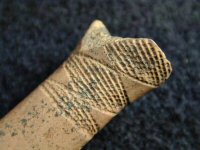
The pipe is made of untempered red clay, is burnished, and is decorated with a series
of dentate-impressed geometric designs at the bowl end. These designs, consisting of
at least two-and-a-half diamonds, occur on both the top and bottom surfaces of the
pipestem. The diamond patterns are carefully positioned along the centerlines of the
pipe, and wrap around the stem, where they meet the ends of the diamond decorations
from the opposite side. This type of decoration was in use by at least the thirteenth
century AD in Virginia (Potter 1993:226).
Triangular bit pipes are seldom found in lower Southern Maryland, and seem to be
generally rare throughout the Middle Atlantic region. However, specimens have been
found at sites like Potomac Creek (44ST2) in Virginia and Accokeek Creek (18PR8) in
Maryland (Schmitt 1965; Stephenson and Ferguson 1963; Stewart 1992), as well as
elsewhere. All known examples of triangular bit pipes have been recovered from Late
Woodland components. The care with which they were crafted makes them some of the
finest examples of the Indian pipemaker’s art in the Chesapeake region.
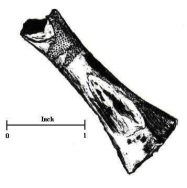
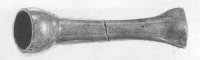 Pipe from 44St2, similar to the Goose Creek example. Reproduced from Stewart
1992.
Pipe from 44St2, similar to the Goose Creek example. Reproduced from Stewart
1992.
References
Potter, Stephen R.
1993 Commoners, Tribute, and Chiefs: The
Development of Algonquian Culture in the Potomac Valley. University Press of
Virginia, Charlottesville.
Schmitt, Karl Jr.
1965 Patawomeke: An Historic Algonkian
Site. Archaeological Society of Virginia Quarterly Bulletin 20(1):1-36.
Sperling, Christopher
2000 A Phase I Archaeological Survey of
Goose Creek Aboard Naval Air Station Patuxent River. Prepared by the Maryland
Archaeological Conservation Laboratory. Submitted to the Natural and Cultural
Resources Branch, Department of Public Works, Naval Air Station Patuxent River.
Jefferson Patterson Park & Museum Occasional Papers #11. St. Leonard, Maryland.
Stephenson, Robert L., and Alice L.L. Ferguson
1963 The Accokeek Creek Site: A Middle Atlantic
Seaboard Culture Sequence. Anthropological Papers Museum of Anthropology,
University of Michigan #20. Ann Arbor, Michigan.
Stewart, T. Dale
1992 Archaeological Exploration of
Patawomeke: The Indian Town Site (44ST2) Ancestral to the one (44ST1) visited
in 1608 by Captain John Smith. Smithsonian Contributions to Anthropology #36.
Smithsonian Institution Press, Washington, D.C.