In the summers of 1970 and 1971, the Lower Delmarva Chapter of the Archeological Society of
Maryland and the Division of Archeology, Maryland Geological Survey, conducted a joint
research project at the Reeves archaeological site located near Salisbury in Wicomico
County, Maryland. This site dates to the Woodland period (1000 B.C. to A.D. 1600) and
is one of the few excavated Woodland Indian village sites on Maryland's Eastern Shore.
One of the features from the site's Late Woodland component (c. A.D. 1000-1600) yielded
an intricately decorated bone pin unlike any other found in the State of Maryland's
archaeological collections (Figure 1). This bone pin measures 20.75 cm long from head
to tip and tapers to a blunted point. The pin, made from a deer metatarsal or lower leg
bone, is decorated with an incised cross-hatching or checkerboard-like pattern (Figure 2).
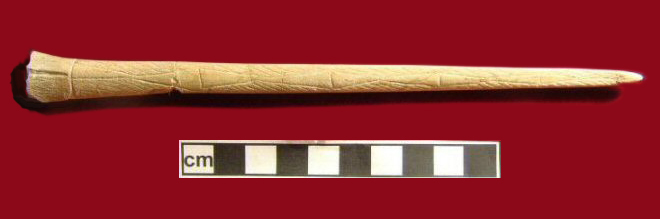 Figure 1: The decorated bone pin from the Reeves site showing intricate
design.
Figure 1: The decorated bone pin from the Reeves site showing intricate
design.
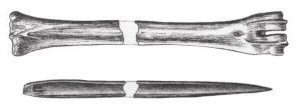 Figure 2: Unaltered deer metatarsal (Top): Awl or pin carved from
deer metatarsal from Wakulla River, Florida (Bottom) (Olsen 1996:137)
Figure 2: Unaltered deer metatarsal (Top): Awl or pin carved from
deer metatarsal from Wakulla River, Florida (Bottom) (Olsen 1996:137)
Because of the fragile nature of bone artifacts, they rarely survive intact in the
archaeological record. There are very few examples of bone pins from archaeological sites
that retain their head, shank and tip (Jeffries 1997: 470). The bone pin from the
Reeves site is no exception. It was discovered in five pieces and had to be mended.
Part of the head of the pin appears to be missing and may have broken off either
before or after this artifact was discarded or lost. It is impossible to know what
the head may have looked like, but it may have had a carved animal or human effigy
or perhaps was incised in the geometric patterning found on the pin's shank (Figure 3).
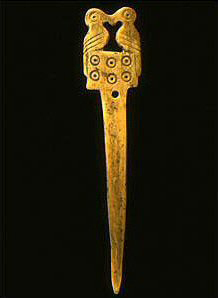 Figure 3: Bone shawl pin with bird effigy from Machu Piccu in Peru.
Originally catalogued as a bone awl, this artifact was more likely used as a pin or
fastener for hair or clothing (Figure 4). Prehistoric peoples used pins for
hairdressing and to fasten clothing or textiles that may have served as cloaks or
other garments (Beaudry 2006:11). Awls tend to be ground and polished to sharp
points and would have been used for piercing and perforating leather and hides
(Brennan 1975: 152). The pin from the Reeves site has a very dull point which would
not lend itself to such work, but would make sense if used for hair or clothing, as
an intentionally dulled tip would prevent accidental injury while being worn. The
pin also shows some insignificant wear to the cross-hatched pattern at its tip
and virtually no wear to the pattern towards the head of the pin, suggesting
that this artifact was not used for perforating rough material. Many archaeologists
believe that pins for hair or clothing would be decorated and
used as ornaments while a more utilitarian object such as an awl would be undecorated.
Considering the majority of awls found at archaeological sites in Maryland are
undecorated, this seems like a reasonable conclusion. Archaeologists working at
the Morhiss site in Texas excavated a fragmentary bone artifact with a cross-hatched
or checkerboard pattern similar to the pin from the Reeves site (Figure 5). They
concluded that such curving, flattish bone artifacts with intricate incised
designs in checkerboard patterns and spirals were most likely
hairpins (University of Texas 2006).
 Figure 4: Woman wearing modern bead-decorated hairpin.
Bone and related materials, such as antler, horn, and turtle shell, was readily
available and a highly useful resource for the native peoples of North America. A
number of methods were used to transform bones and antlers into finished tools.
The simplest technique was to place a leg bone on end, then strike it in the
middle with a stone. This would split the bone into a number of fragments, which
would then be modified into various tools, perhaps incised with a design or patterns,
then polished with a fine-grained grinding stone (Royal Alberta Museum 2005).
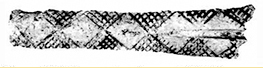 Figure 5: A fragmentary bone artifact from the Morhiss site in Texas with crosshatching
or checkerboard patterning similar to th e bone pin from the Reeves site.
Figure 5: A fragmentary bone artifact from the Morhiss site in Texas with crosshatching
or checkerboard patterning similar to th e bone pin from the Reeves site.
Bone may not survive well in most archaeological environments over hundreds or
thousands of years, but it does have a durability that made it desirable for making
many kinds of implements and utensils for everyday use. Bone was made into arrow
and harpoon points; fishhooks; weaving tools; hide scrapers; pottery-making tools;
pendants; hair and clothing fasteners; gaming pieces; musical instruments; and
various ceremonial objects.
References
Beaudry, Mary C.
2006 Findings: The Material Culture of
Needlework and Sewing. Yale University Press, New Haven and London.
Brennan, Louis A.
1975 Artifacts of Prehistoric
America. Stackpole Books, Harrisburg.
Jefferies, Richard W.
1997 Middle Archaic Bone Pins:
Evidence of Mid-Holocene Regional-Scale Social Groups in the Southern
Midwest. American Antiquity 62 (3): 464-487.
Olson, Stanley J.
1996 Mammal Remains from Archaeological
Sites, Part 1: Southeastern and Southwestern United States. Papers of
the Peabody Museum of Archaeology and Ethnology 56 (1), Harvard
University.
Royal Alberta Museum
2005 Archaeology: Prehistoric
Technology. Electronic document,
http://www.royalalbertamuseum.ca/research/culturalStudies/archaeology/technology.cfm,
accessed May 20, 2008.
Spalding, Tim
2005 Machu Picchu on the Web.
Electronic document, http://www.isidore-of-seville.com/machu/9-2.html, accessed May 21, 2008.
University of Texas
2006 Prehistoric Texas, South Texas
Plains, Artistic Impression. Electronic document,
http://www.texasbeyondhistory.net/st-plains/artistic/index.html, accessed May 21, 2008.