In 2007, the Maryland Archaeological Conservation Laboratory undertook the conservation
of artifacts recovered from the shipwreck of the CSS Alabama, one of the most
well-known Confederate warships. The artifacts included eleven ceramic dishes belonging
to the tableware set used on the ship (Figure 1). Although the dishes were in remarkably
good condition, they required conservation treatment to ensure that they did not deteriorate.
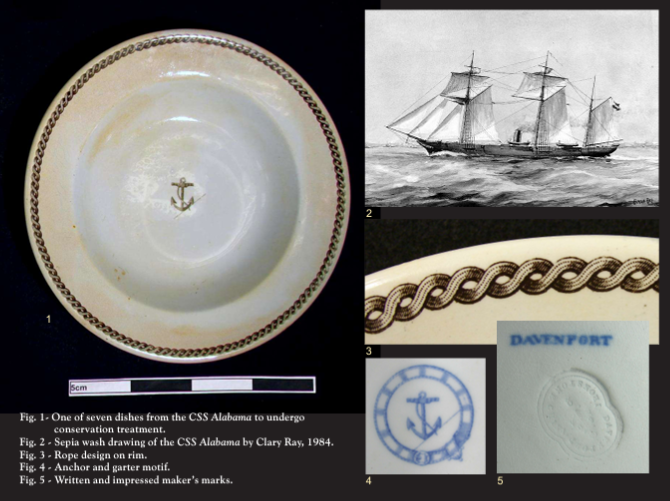 Fig. 1. One of seven dishes from the CSS Alabama to undergo conservation treatment;
Fig. 2. Sepia wash drawing of the CSS Alabama by Clary Ray, 1984; Fig. 3. Rope design on ridge;
Fig. 4. Anchor and garter motif; Fig. 5. Written and impressed maker's marks.
Fig. 1. One of seven dishes from the CSS Alabama to undergo conservation treatment;
Fig. 2. Sepia wash drawing of the CSS Alabama by Clary Ray, 1984; Fig. 3. Rope design on ridge;
Fig. 4. Anchor and garter motif; Fig. 5. Written and impressed maker's marks.
The CSS Alabama (Figure 2) was built in Liverpool, England in 1862 for the Confederate
government, and its main occupation was to cause damage to Union shipping endeavors.
During the ship's nearly two years at sea, the Alabama captured and burned more than
sixty enemy ships, including a dozen New England whalers and eight commerce ships in the
first few months alone (Shomette 1973:227). In June 1864, the Alabama entered the
harbor of Cherbourg, France to make repairs and restock supplies. Meanwhile, the Union's USS
Kearsarge, which had been pursuing the Alabama, began to patrol the mouth
of the Cherbourg harbor and waited for the Confederate ship to emerge. The Alabama
met the Kearsarge on June 19, 1864, and after approximately one hour of battle, the
Alabama was destroyed and sank in about 200 feet of water (Naval Historical Center 2007).
The Alabama wreck was discovered in 1984, and since then it has been jointly investigated
by the U.S. Naval Historical Center and the French Ministry of Culture under the
Franco-American CSS Alabama Scientific Committee (CSS Alabama Association USA 2004).
The eleven dishes that were recovered from the wreck site, and which are currently undergoing
treatment at the MAC Lab, were made by Davenport, a pottery located in Staffordshire, England,
about fifty miles from where the Alabama was built. Davenport was in production from 1793 to
1887 and made a wide range of porcelain, stoneware, earthenware, and glass goods (Godden 1999:226).
A late 19th century advertisement in the Pottery Gazette describes some of their products,
"Davenport… Ironstone ware, plain and decorated… suitablefor barracks, clubs, hotels and ship
uses" (Godden 1971:107). The Alabama dishes are made of "ironstone," a durable, white earthenware
clay, and the nautical theme of the dishes indicate that they were designed specifically
to be used on ships. The rim of each dish is encompassed by an intertwined rope (Figure 3),
and in the center of each dish is an anchor; two of the dishes also have a garter motif
surrounding the anchor (Figure 4). The patterns on two of the dishes are blue and the other
nine are brown. Maker's marks on the underside of the dishes (Figure 5) show that they
were made in 1860.
The Alabama dishes went through several steps during their conservation treatment
(Figures 6-8). First, the conditions of the artifacts were recorded through photographs and
written descriptions. A course of treatment, which included desalination, surface cleaning,
stain removal, and drying was then designed and implemented. Desalination, or removal of
salts, is especially important when working with ceramics, as salts from burial or marine
environments can be absorbed into clay bodies and cause permanent damage when changes in
humidity cause the salts to dissolve, migrate, and recrystallize (Newton and Logan 1997:3).
If this process occurs repeatedly, the glaze or surface of an object can be forced apart.
Since the Alabama dishes were retrieved from a saltwater environment, they
required desalination. This was accomplished by soaking the dishes in baths of deionized
water that were monitored and changed as salt leeched out of the ceramic body until the
solution contained less than five parts per million of salt. The next step, surface
cleaning, removed deposits from the surfaces of the dishes, and was carried out using
various tools and brushes. Stain removal also aimed to remove or lessen deposits,
although from the interior body of the ceramic rather than just the surface. Several
types of chemicals were used to reduce the iron staining that was evident on the
Alabama dishes, including a chelating agent, which contains molecules that
bond with metallic ions (Museum of Fine Arts, Boston 2008) and allow the ions to be
drawn out of the ceramic body. The final step in the conservation treatment was
air-drying. Although this was a simple step, it was imperative that the dishes remain
wet until the stain removal was complete, as drying could have caused the deposits
to become more difficult to remove. From beginning to end, the conservation of
the CSS Alabama ceramic dishes took nearly six months.
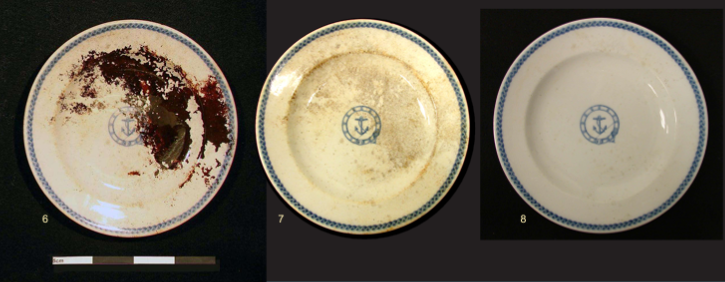 Fig. 6. CSS Alabama dish before conservation; Fig. 7. After surface cleaning; Fig. 8.
After stain removal.
Fig. 6. CSS Alabama dish before conservation; Fig. 7. After surface cleaning; Fig. 8.
After stain removal.
All images courtesy of the U.S. Naval Historical Center
References
CSS Alabama Association USA
2004 Artifact Recovery.
Electronic document, http://www.css-alabama.com/challenge.html, accessed June 10, 2008.
Godden, Geoffrey A.
1971 The Illustrated Guide to
Mason's Patent Ironstone China. Praeger Publishers, London.
Godden, Geoffrey A.
1999 Godden's Guide to Ironstone
Stone and Granite Wares. Antique Collectors' Club Ltd., Woodbridge,
Suffolk, England.
Museum of Fine Arts, Boston
2008 MFA Boston: Material Record.
Electronic document, http://cameo.mfa.org/materials/record.asp?key=2170&subkey=2028,
accessed June 13, 2008.
Naval Historical Center
2007 CSS Alabama.
Electronic document, http://www.history.navy.mil/branches/org12-1.htm, accessed June 10, 2008.
Newton, Charlotte, and Judy Logan
1997 Care of Ceramics and Glass.
Canadian Conservation Institute Notes. 5/1.