We do not know when Rebecca Wilkinson was born, but we do know that she immigrated to Maryland
with her father, Anglican Reverend William Wilkinson, her stepmother Mary Pudden, and
two sisters in 1650. She grew up at Westbury Manor, a 1,250-acre plantation on St. George's
Hundred in St. Mary's County (Carr n.d.). As the daughter of an educated clergyman,
Rebecca probably enjoyed a relatively genteel lifestyle for an early Maryland colonist.
By 1662, Rebecca had married Thomas Dent, a merchant, attorney, and planter who held several offices
in the Maryland government. They had six children together; Thomas, William, Peter, Margaret,
Barbara, and George. Dent owned over a thousand acres of land and had at least six slaves and
eight indentured servants when he died in 1676, dividing his estate between his wife and
children (Carr n.d.).
In 1677, Rebecca remarried John Addison, another merchant and planter who also engaged in a great
deal of trade with Maryland's Indian population (Carr n.d.). It is perhaps this latter occupation
that motivated the Addisons to move up the Potomac River to what would become Prince George's
County. At the time of their move around 1689, the area was on the outskirts of English
settlement in Maryland, and John Addison was tasked with keeping a magazine for the local
militia in case they needed to assemble to protect from Indian attack (McCarthy, et al. 1991).
It was perhaps on the occasion of Rebecca's marriage to Addison that she received a thimble with
the initials "RA" engraved on two hearts. The love theme of the thimble was enhanced by two
cupid figures flanking the hearts. The style of the small, domed thimble helps date it to
the mid- to late-17th century (McConnel 1990). It was intended to look like a silver thimble,
but it may be an alloy of silver and another metal. A similar thimble was found at the
Smith's St. Leonard site in Calvert County Maryland. Its date is later, probably
early- or mid- 18th century, but it shows that the motif was a popular one that
persisted on personalized thimbles.
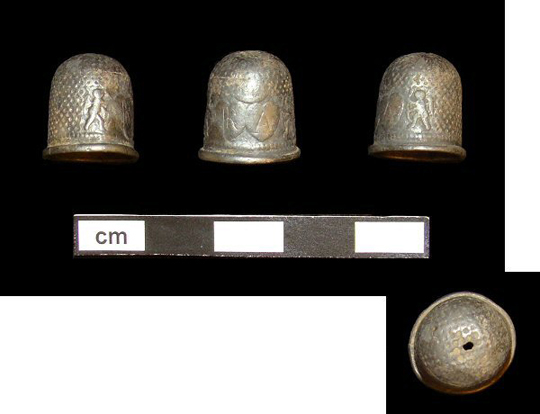 Three views of Rebecca Addison's thimble with her initials inscribed on two
hearts. Right: A view of the top of the thimble where a needle apparently poked a
hole in the worn surface.
Three views of Rebecca Addison's thimble with her initials inscribed on two
hearts. Right: A view of the top of the thimble where a needle apparently poked a
hole in the worn surface.
Rebecca seems to have had plenty of time to use her cupid thimble. As mistress of a significant
number of servants and slaves, she most likely did not have to concern herself with personally
completing the many laborious tasks that would be necessary to run a large plantation. Instead
she had the luxury to engage in the fine needlework and sewing that was considered an appropriate
occupation for an English gentlewoman.
It is clear that the thimble saw many, many hours of use. The diminutive needle pusher is so
worn that a small cartouche over the hearts is almost indecipherable, and the top became so
weak that a needle actually poked a hole in it. The hole would not have rendered the thimble
completely useless, but its indentations are so worn that Rebecca probably had difficulty
catching a needle with it. Despite its special inscription, it may have been deliberately
discarded when it became too difficult to use.
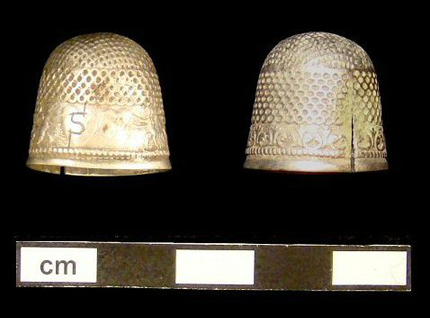 Front and back view of a similar thimble recovered from the Smith's St.
Leonard site. Only one initial is inscribed in the first heart as if an unmarried
woman was hoping her name would change before she committed to the last initial.
The owner of this thimble has not been identified.
Front and back view of a similar thimble recovered from the Smith's St.
Leonard site. Only one initial is inscribed in the first heart as if an unmarried
woman was hoping her name would change before she committed to the last initial.
The owner of this thimble has not been identified.
Rebecca's thimble was recovered in 1988 by archaeologists who excavated the house she and
John Addison built along the Potomac c. 1689. It was in a trash and brick rubble deposit
near the house. Rebecca's son Thomas Addison inherited the property around 1705, but she
may have continued to live with him until her death in 1726. Although we do not know
exactly when she was born, Rebecca must have been at least 77 years old when she died.
References
Carr, Lois Green (n.d.)
Dr. Lois Green Carr's Biographical
Files of 17th and 18th Century Marylanders. http://www.msa.md.gov/msa/speccol/html/carr.html. sc4040-0438-1, sc4040-0438-7,
sc5094-1134-125, sc5094-0021-04.
McCarthy, John P., Jeffrey B. Snyder, and Billy R. Roulette, Jr.
1991 Arms from Addison Plantation and the
Maryland Militia on the Potomac Frontier. Historical Archaeology (25)1: 66-79.
McConnel, Bridget
1990 A Collector's Guide to Thimbles.
Secaucus, New Jersey: Wellfleet Books.