Archaeologists working on historic sites often find fragmented slate pencils once used on
writing slates. It is less typical to recover flat pieces of the slate used as writing
surfaces. Excavations at the site of the Juvenile Justice Center in Baltimore City (18BC139),
however, yielded a slate whose educational function is quite clear.
Recovered from a privy that was filled between 1815 and 1830, this slate was scored front
and back with a grid. Incised within the grid sections were numbers from 1 to 72. The
unworn, cleaner areas along the finished top and side edges of the slate suggest it had
originally been set into a wooden frame. Although fragmentary, the slate's original dimensions
were approximately 4 x 6 inches.
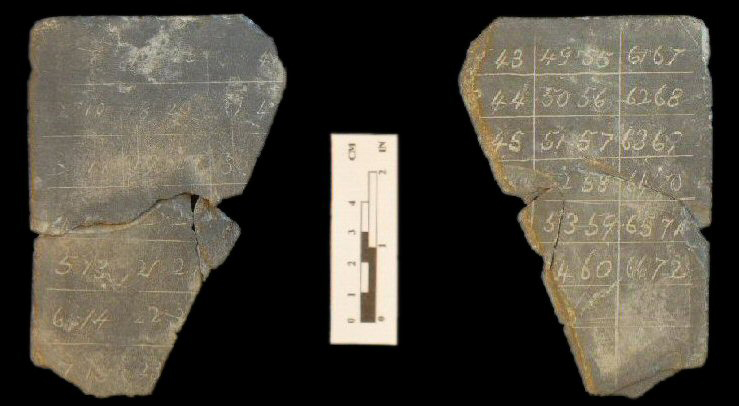 Front and back view of writing slate from the Juvenile
Justice Privy showing numbers 1 to 42 on front, and 43 to 72 on back. (Photo
by Marco de Pompa III)
Front and back view of writing slate from the Juvenile
Justice Privy showing numbers 1 to 42 on front, and 43 to 72 on back. (Photo
by Marco de Pompa III)
Because slate could easily be split into thin sheets, it was well suited as a substitute for
paper. Also more durable and economical than paper, slate could be wiped clean and re-used
indefinitely. Pencils of soft slate, soapstone, pressed clay or chalk were used to write
on slate. Writing slate production was a big industry in Wales in the nineteenth century
and slates were available plain, or with incised lines, grids, or even simple maps. Bound
slate books, made from thin, small (3" x 5") sheets of slate, were sometimes used by
adults in their workplaces.
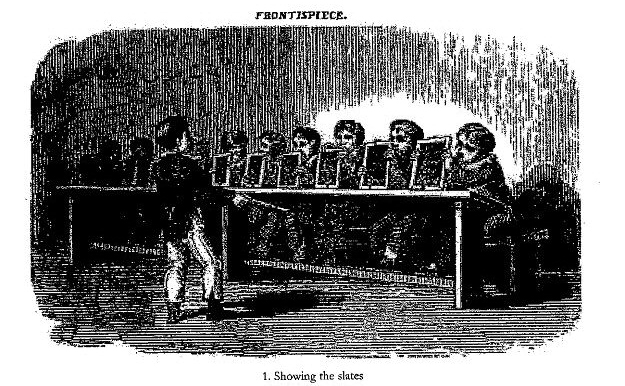 Showing the Slates, from Joseph Lancaster, Improvements in Education;
Abridged, Containing a Complete Epitome of the System of Education, Invented and
Practiced by the Author, London, (1808).
Showing the Slates, from Joseph Lancaster, Improvements in Education;
Abridged, Containing a Complete Epitome of the System of Education, Invented and
Practiced by the Author, London, (1808).
Although the Oxford English Dictionary provides a date in the late fourteenth century as the
first reference to slate as a writing tool, the use of slate in this fashion was not
common until the eighteenth century (Hall n.d.). Stationers were selling slates by the
second half of the eighteenth century, but there is no real evidence to support their
educational use by children until the nineteenth century (Hall n.d.:6). Research
suggests that Joseph Lancaster, an English proponent of mass education, was at least
partly responsible for the widespread development of slate as an educational tool
beginning in the early nineteenth century (Hall n.d.).
References
Hall, Nigel
n.d. The role of the slate in Lancesterian schools as evidenced by their
manuals and handbooks. Available at http://faculty.ed.uiuc.edu/westbury/paradigm/Hall.doc.