In 2003, Jamestown staff members prepared the site for the onslaught of Hurricane Isabel in
accordance with its emergency plan to prevent any type of flooding. Unfortunately, the
combination of the hurricane and its related storm surge brought in waters from the
nearby Pitch and Tar Swamp measuring five feet deep at the National Park Service Visitor
Center. Consequently the artifacts were adversely affected and are undergoing treatment at
the Maryland Archaeological Conservation (MAC) Laboratory in St. Leonard, Maryland.
Approximately 34,000 of those objects were sent for re-treatment as a part of an
agreement between the National Park Service under the Department of Interior and the
MAC lab. The remaining objects were being treated in other major laboratories on
the east coast and at a National Park Service facility near the park.
The Jamestown Project derives from Historic Jamestown, Virginia, where an archaeological assessment
recovered artifacts including many iron and ceramic fragments, a significant number of them being
Colonial period pipe fragments. These excavations, led by noted archaeologists J.C. Harrington and
John Cotter, occurred between the 1930s and the 1950s. Subsequently, they were treated by
Civilian Conservation Corps (CCC) and National Park Service staff.
Artifacts uncovered at Jamestown are from the Colonial period of the early 17th century. When
English colonists settled on the island at the time it was heavily wooded and contained
marshlands. Jamestown was settled in 1607 and served as the capitol of Virginia for 92
years. By the arrival of the 18th century, Jamestown’s infrastructures were soon abandoned by
its inhabitants. Tobacco fields were then cultivated in place of abandoned farmsteads
(Jamestown Archaeological Assessment, 2001:3). Today's Jamestown is a historic site jointly
administered by APVA Preservation Virginia and the National Park Service location where
thousands of objects dating from these periods are in storage facilities and on display
at the park's visitor center for public exhibition.
The MAC Lab found, by Fourier transform infrared spectroscopy (FTIR) testing, that
the iron objects were coated with paraffin wax intended to act as a protective layer
and/or consolidant in some cases as a result of their first treatment in the 1950s.
Although the wax offered some protection, the irons suffered some corrosion due to brackish
water flooding stemming from the hurricane.
Iron artifacts that are exposed to water and oxygen will show a reddish brown
corrosion superficially (Fig.1). At lower relative humidity (RH) levels, corrosion
is probable if the surface has been in contact with salt also known as chlorides
(Canadian Conservation Institute, 2002). As with most of the irons in the project,
rust will appear on the surface layers of the objects if the indoor RH is at 65 percent
or higher. Exposure to chlorides can contribute to the corrosion which is evident from
the loose powdery residue seen on many of the irons from Jamestown.
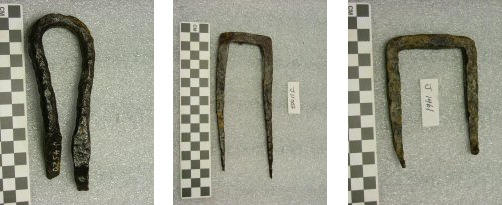 Fig 1, Irons before dewaxing.
The first stage of the re-treatment and stabilization process begins by placing the
objects in a solvent recycling still using a hot xylene vapor for six hours to
remove old paraffin wax layers remaining from the previous treatment. Once they have
been de-waxed they are moved into various storage bins containing reversed osmosis
water (RO) and a small percentage of sodium hydroxide (NaOH) with regard to volume
of RO used. Chloride readings are logged daily by the laboratory's conservators in
order to determine if the levels indicate the removal of soluble salts from
the objects (Fig. 2).
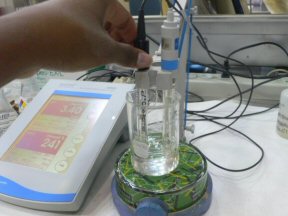 Fig. 2, Measuring chloride levels
The objects are removed from desalination and are immersed in bins containing
deionized water. The bins are placed in a hot wash at a temperature of 140 degrees
Fahrenheit, 65 degrees Celsius for the elimination of any more soluble salts and
to neutralize the objects. The water's pH is measured and changed daily until the
level reaches the neutral standard measurement.
Next, the objects are set to dry in an oven for no more than three days, thereafter
tannic acid is applied. (Fig. 3) Tannic acid is comprised of a group of water and
alcohol soluble products that are effective for the stabilization of iron oxide
and converts it into an iron tannate after application (Matlby, 1998). Jamestown
artifacts may receive between two to three coats of tannic acid depending on the
extent of the object's corrosion. Thereafter, the irons lose their brownish color
and take on a black finish (Canadian Conservation Institute, 2002).
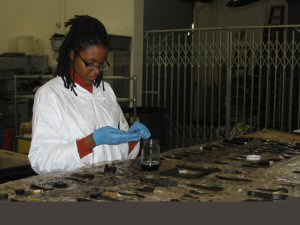 Fig. 3, Tannic acid application
The final phase in treatment includes a protective coating containing Acryloids
B48 and B67 mixed in a solution of acetone and xylene. After the objects are
coated they are labeled and packaged for return to the Jamestown facility (Fig. 4).
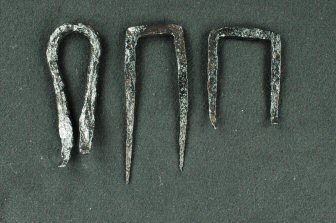 Fig. 4, After tannic acid and coating
Unlike the iron, the treatment cycle for the Colonial pipe fragments does not require
as many steps. The pipe fragments are separated in small nets according to their
conservation accession numbers and set in an acetone solution for a period of one
to two days. The pipes were removed from the solution and then cleaned using a
cotton compress containing acetone (Fig. 5).
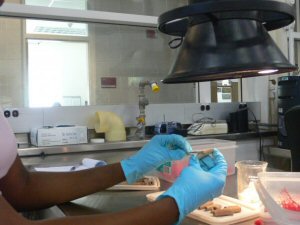 Fig. 5, Cleaning pipe fragments using acetone
Once the cleaning process is finished they are placed again in the nets to soak in
deionized water where daily chloride levels were recorded. PH levels between four
and five are required in order to receive an accurate chloride reading measured in
parts per million (ppm). If the ppm results were below the number five, the
fragments were removed from their nets and put onto a tray to dry for one to
two days. Each fragment is labeled, coated with a mineral oil mixture to protect
the number written, and packaged for return to Jamestown.
Approximately 23,000 ceramic pipe fragments and a number of wood objects have
completed treatment and have been returned to Jamestown's facilities intermittently
throughout the span of the project. There remain over 5,000 objects that are still
undergoing assessment and treatment including iron and ceramic shards. The project
is anticipated to end September 2009.
References
Matlby, Susan
1998 Old House Journal. Rust Converter.
Electronic Document.
http://www.alan.net/prgshoptips/rustconv.html, accessed September 15, 2008.
Canadian Conservation Institute
2002 How to Care for Irons.
Electronic Document. http://www.cci-icc.gc.ca/publications/cidb/view-document_e.aspx?Document_ID=437 –
accessed September 15,2008.
Jamestown Archaeological Assessment
2002 National Park Service, U.S.
Department of Interior. U.S. Library of Congress, Washington DC.