In the fall of 2006, an avocational paleontologist, Brady Hamilton, decided to spend a day walking along
the shores of the Potomac River in Charles County, looking for specimens to collect. He came upon an area
where oyster shells from a prehistoric Indian trash midden were eroding down onto the beach. Among the shells
were large sherds of Indian pottery. He gathered them up and took them home, where he was able to piece
together large sections of two different vessels. Mr. Hamilton then contacted local archaeologists about
his find, and generously agreed to donate his artifacts to the Maryland Archaeological Conservation
Laboratory.
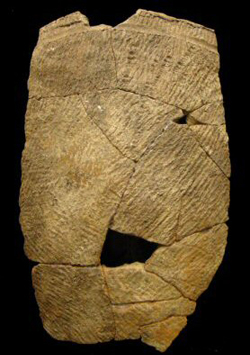 Popes Creek Vessel 1
Archaeologists were eager to accept his donation, because it is rare to find large portions of this
particular type of Indian pottery — known as Popes Creek Ware — which was made from roughly
500 B.C. to 300 A.D. The clay of Popes Creek vessels was generally mixed with lots of sand, and the
pots fired at a low temperature. This meant that they were somewhat fragile, so intact examples are
extremely uncommon. Even finding enough sherds to partially reconstruct a Popes Creek vessel, as
Mr. Hamilton did, is unusual.
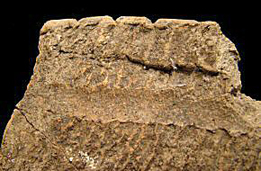 Detail of decoration on Vessel 1
 Interior scoring, Vessel 1
The most complete of the two vessels found by Mr. Hamilton would have been about 16 inches in diameter
when it was intact. Its height is unknown, since only the upper portion (15 inches) of the pot was
recovered. The vessel was cylindrical in shape, and probably tapered to a conical or semi-conical base,
which was typical on Popes Creek Ware. The exterior surface of the pot was covered with impressions
of cords that were stamped vertically or diagonally to the rim. The interior surface was scored with
fine smoothing lines, most running horizontally, although some were vertical or diagonal to the
rim. This vessel was unusual for Popes Creek Ware because it was decorated: a finger-smoothed
band ran approximately one inch below the rim, and the lip of the pot had shallow notches impressed
into it.
The second vessel was less complete, but appears to have been larger, perhaps 18 inches or more in
diameter. Unlike the first pot, its exterior was covered with the impression of a net that was
pressed against the clay before it was fired. The majority of Popes Creek vessels had a net-impressed
surface; the cord-marking seen on the first pot was less common. The interior surface of the second
vessel was scraped like the first, but the orientation of the lines was more haphazard. It too
had a finger-smoothed decorative band just below the rim, and fine lines were scratched into
the lip.
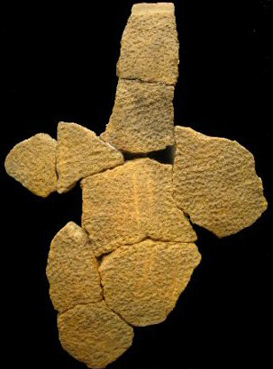 Popes Creek Vessel 2
Finding a large portion of a Popes Creek vessel is unusual; finding two such pots at the same time
is remarkable; finding two decorated examples is practically unheard of. Brady Hamilton's foresight
and generosity has resulted in a special addition to Maryland’s archaeological collection, which
is why it is this month's Curator's Choice selection.
For more information, go to:
https://apps.jefpat.maryland.gov/diagnostic/PrehistoricCeramics/PrehistoricWareDescriptions/PopesCreek.htm