According to a newspaper account, this Civil War bayonet was found by construction workers
digging between W. Patrick Street and Court Street in the town of Frederick, Maryland during
the Carroll Creek project. Frederick's status as a major crossroads put it at the center
of campaigns during the Civil War, and saw both Union and Confederate troops march through
the city. The Monacacy battlefield lies just outside the city's limits.
 Bayonet after treatment.
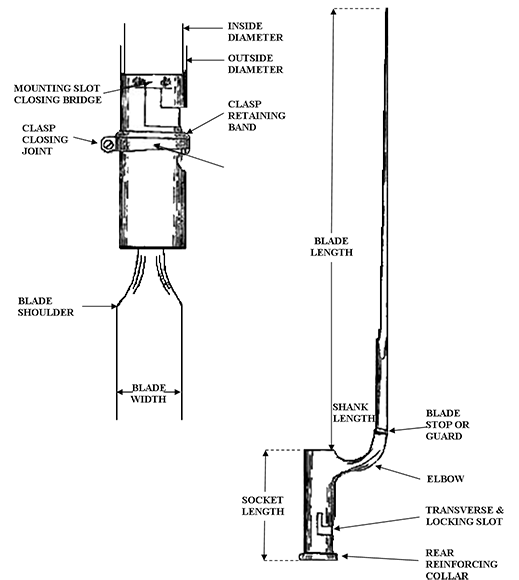
The physical dimensions of the diagnostic features on this bayonet, such as blade length,
width, socket length and shank length, identify it as a model 1855 bayonet. These features
remained standard on many successive models up until 1873 (Webster 1964). In fact the Model
1855 bayonets are virtually identical in appearance to the US Model 1873. This bayonet is
typical of the period and was originally produced for the Model 1855 Springfield rifle
(Shuey 1999). It is offset, meaning it has a cylindrical socket which fits around a musket
barrel and the shank is at right angles to the socket. The mounting slot closing bridge
greatly strengthens the socket cylinder. The bayonet also features an L-shaped transverse
and locking slot, locking clasp, closing joint and clasp retaining band.
This particular bayonet was found in fairly good condition, except that six inches of the
blade tip is broken off and missing, not uncommon for a weapon that probably saw
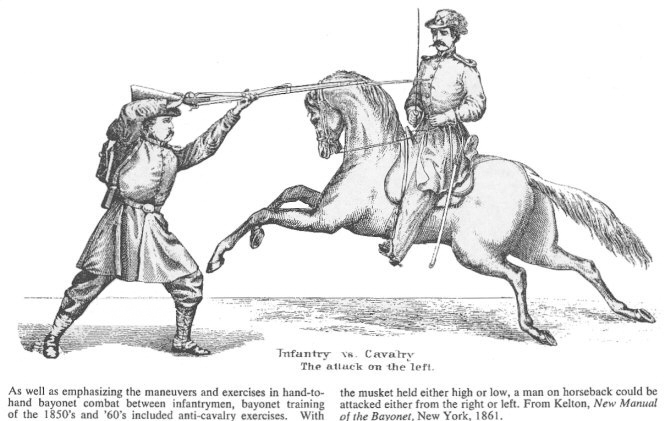
considerable action. Even though every soldier during the Civil War was issued a
bayonet for his musket, the weapon was rarely used in combat. The improvement in rifle
accuracy in the 1860s meant that soldiers seldom engaged one another up close. Many
relics found at battlefield sites indicate that some bayonets were altered with the help
of the company's blacksmith to be used as tent pegs, picket pins, candlesticks, pot
hooks, entrenching tools, pry bars and even can openers (Shuey 1999).
In initial inspection of the bayonet, it was noted that some of the iron edges of its
triangular blade were missing and there was some delamination and surface pitting due
to corrosion. When first brought to the MAC Lab, the bayonet was still encased in
burial dirt.
A treatment was proposed that is fairly standard for iron in relatively good condition;
it was placed for a short time in electrolytic reduction in a sodium carbonate solution
at low amperage, followed by manual removal of corrosion, encrustation and soil. Next,
hot wash baths in de-ionized water and chloride tests determined when it was ready for
coating with tannic acid, a corrosion inhibitor, and finally the surface was coated
with microcrystalline wax in order to prevent further corrosion and degradation.
References
Shuey, R.W.
1999 Socket Bayonets of the Great Powers:
A Collector's Guide. Excalibur Publications. Tucson, AZ.
Webster, D.B.
1964 American Socket Bayonets 1717-1873.
Historical Arms Series. No.3.