In 1976, excavations took place at the Horne site located on the south bank
of the Choptank River in Dorchester County, Maryland. Archaeologists discovered a
dwelling not previously on record, but found to belong to a family of landed
gentry, which occupied the area during the late 17th and 18th centuries. The
house burned around 1770 and was never rebuilt, thus preserving the contents of
the home in layers of charcoal and plaster (Jull 1980). Among the artifacts
recovered from the site were a copper alloy tea set, thimbles and buttons, glass
and ceramic vessel fragments, iron keys and tools, and fragments of a cast
iron fireback.
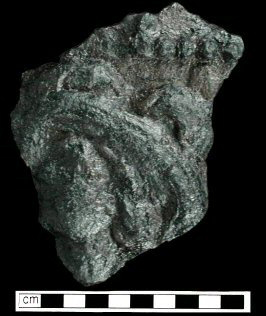 Fragment of head from cast iron fireback found at Horne Point.
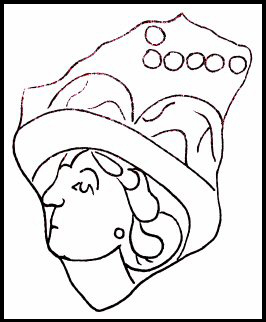 Line drawing depciting head image of the cast iron fragment shown
in Figure 1.
Line drawing depciting head image of the cast iron fragment shown
in Figure 1.
Iron firebacks are a common historic feature in many homes across Europe and North
America. Traditionally, many fireplaces were constructed of stone and mortar that
can be easily damaged by the intense heat generated by the burning of logs and peat.
This is particularly relevant to the masonry located at the rear of the fireplace,
towards which the greater portion of heat is directed. In order to preserve the
integrity of the fireplace, a fireback functions to reduce the damage to the rear
wall masonry by presenting a physical barrier. Firebacks also have the added function
of reflecting both light and heat into the living area, thus maximizing the
functionality of the fireplace.
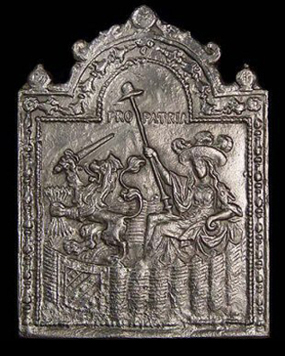 Cast iron fireback in low relief.
Decorative themes on the firebacks from the 18th century tend to incorporate coats
of arms or allegorical stories. In the case of the Horne Point fireback, the scene
depicts the Maid of Dort (Dordrecht), the national symbol for Holland, and the Lion
of the Provinces sitting within a palisade. The Maid holds a hat on the point of a
spear while the Lion holds a sword and seven arrows representing the seven Provinces
(Kammen 1996:93-94). This image symbolizes Holland, "surrounded by her fortified
frontiers, maintaining liberty by the force of arms" (Churchill 1985:44). Both
the sword and pomegranates along the border (symbols of the unity of many under
one authority) allude to the struggle for unification of the Provinces (Westland
London). The scene is topped by the motto Pro Patria, 'for the fatherland.' Dutch
themes were not out of place in North America. After all, New York City was a
Dutch colony and called New Amsterdam until 1674. This motif is a legacy of
the colonists' European heritage.
The Horne Point iron fireback currently exists in a fragmented state due to the
intense heat experienced during the fiery destruction of the home. Cast iron
is a commonly chosen material for firebacks for two reasons. First, the physical
properties of iron, primarily its comparatively high melting point, make it an
ideal material for withstanding the heat generated by a normal hearth fire.
Secondly, it can be melted and cast into a mold to produce attractive designs.
Unfortunately, some iron may contain defective qualities. Unlike wrought iron,
in which impurities are beaten out of the material as it is worked, cast iron
is dependent upon the smelting process to remove impurities and contaminates.
If these impurities are not removed, the physical properties of the material
can be affected (Cronyn 1990:176). In the case of the Horne Point fireback,
it appears likely that excess sulfur was not removed before the artifact was
cast. Sulfur-rich iron will have sufficient strength when cold, but cracks
at red heat.
…it seems this fireback just couldn't take the heat.
References
Churchill, W.A.
1985 Watermarks in Paper in Holland,
England, France etc., in the XVII and XVIII Centuries and Their Interconnection.
1935 authorized reprint, Amsterdam:DeGraaf.
Cronyn, J.M.
1990 The Elements of Archaeological
Conservation. London and New York: Routledge.
Jull, J.
1980 "Preliminary Report of Excavations
at Horne." The Archeolog Spring 1980, Vol. 32, No. 1.
Kammen, M.G.
1996 Colonial New York. New
York: Oxford University Press.
Westland London
2009 Antique Firebacks. http://www.westlandlondon.com/stock/firegrates/firebacks/item/9449/image2.htm