The Posey site is a circa 1650 to 1680 settlement that was probably the year-round
home of a few American Indian families (Harmon 1999). Although not a large village,
the Posey site affords archaeologists the opportunity to study how interaction with
European colonists changed the material culture of Maryland's Indians in the
17th century.
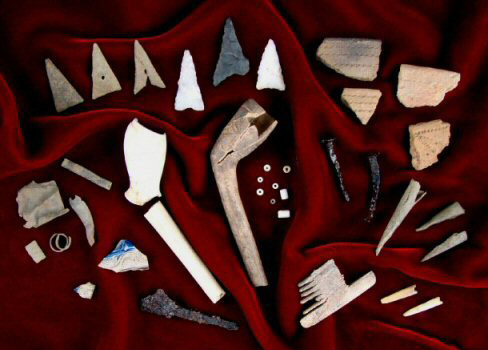 Artifacts from the Posey site show the presence of European items,
traditional Indian goods, and artifacts that were made by Indians using materials
from Europe. Top row: Copper points, stone points and ceramic rim sherds made by
Posey's inhabitants. Middle row: Copper scraps, imported white clay pipes, locally
made pipe, shell beads, nails, and copper cones. Bottom row: German stoneware
ceramics, iron knife fragment, European-style bone comb, and two bone needles
or awls.
Artifacts from the Posey site show the presence of European items,
traditional Indian goods, and artifacts that were made by Indians using materials
from Europe. Top row: Copper points, stone points and ceramic rim sherds made by
Posey's inhabitants. Middle row: Copper scraps, imported white clay pipes, locally
made pipe, shell beads, nails, and copper cones. Bottom row: German stoneware
ceramics, iron knife fragment, European-style bone comb, and two bone needles
or awls.
Artifacts recovered at the Posey site indicate that pottery and shell beads were
being made there for personal use, and possibly also as goods for trade with the
Europeans who lived in the surrounding area. The families who lived at the Posey site
had access to a global trade network when interacting with the colonists. Stoneware
ceramics from Germany, glass beads from Italy, tin-glazed ceramics from the Netherlands,
and utilitarian ceramics from England were regularly shipped to Maryland by the 1650s,
and these types of artifacts were recovered at the Posey site. Though Posey's
inhabitants certainly did not abandon their traditional practices of pottery-making,
shell bead work, and stone-tool usage, the introduction of European goods expanded
the range of materials they could incorporate into these practices. For example,
metal tools could be used to drill the tiny holes needed for shell beads, and decorations
might be applied to clay pipes with metal stamps (Harmon 1999).
The most striking example of material culture change at Posey, however, is the
appearance of projectile points made from copper as opposed to stone. Chesapeake
Indians had access to natural copper traded from areas such as the Great Lakes and
western North Carolina long before they could obtain it from Europeans, but the
amount of copper that could be obtained was limited, and it was generally reserved
for the adornment of society elites (Mallios and Emmett 2004). The special status of
copper made it very desirable as a trade item, and Europeans quickly realized that
they could trade their old copper kettles and scrap copper for furs, food, and
hospitality. As copper became more readily available, its special status with the
Chesapeake Indians diminished, and its use for making utilitarian tools such as
points increased.
The variety of copper point types recovered at the Posey site indicates that there was
some experimentation going on in terms of how best to make copper sheets or scraps
into points. In one case, two scrap fragments were folded over each other to make a
barbed point. Other points were made by snipping sheet copper into isosceles triangles
or small equilateral triangles. Some of the points have holes in them while others do
not. Archaeological examples from Pennsylvania indicate that once completed, these
copper points were probably attached to hardwood arrow foreshafts with fine sinew
and glue, though the possibility that they were used to decorate clothing or other
goods cannot be ruled out (Kent 1984). It is unclear whether hafted points were
strictly utilitarian and available to all, or if they carried on the tradition of
special status afforded to copper, and were used pirmarily by elites for certain
purposes. What is clear, is that these points rose in popularity in the 17th
century and have been found at numerous sites that date into the 18th century
(Curry n.d.; Kent 1984).
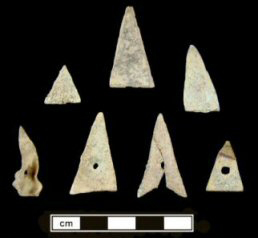 The copper points recovered by archaeologists at the Posey site show
that the people who lived there experimented with different point shapes
and styles.
The copper points recovered by archaeologists at the Posey site show
that the people who lived there experimented with different point shapes
and styles.
For 12,000 years, Maryland's inhabitants had made tools from various kinds of stone,
but the use of certain stone tools such as points and knives decreased as metal
tools gradually replaced them after European contact. The new trade goods marked
the decline of one technological era in Maryland and the beginning of another. As
interaction between Maryland's Indians and European colonists continued in the late
17th and 18th century, another hunting tool increased in popularity among the
Indian population at Posey and elsewhere; the firearm. But that is a story for
another Curator's Choice…
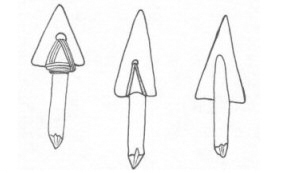 At least two sites in Pennsylvania yielded points that were still
hafted to hardwood foreshafts. This sketch illustrates three different styles
of attachments. Drawing after Kent (1984: 190).
At least two sites in Pennsylvania yielded points that were still
hafted to hardwood foreshafts. This sketch illustrates three different styles
of attachments. Drawing after Kent (1984: 190).
Photos Courtesy of Naval District Washington, Indian Head.
References
Curry, Dennis C.
n.d. "We have been with the Emperor of
Piscataway, at his fort:" Archaeological Investigation of the Heater's Island
Site (18FR72). Draft manuscript (in preparation), Maryland HIstorical Trust,
Crownsville, Maryland.
Kent, Barry C.
1984 Susquehanna's Indians.
Anthropological Series Number 6. Harrisburg, Pennsylvania: Commonwealth of
Pennsylvania Historical and Museum Commission.
Harmon, James M.
1999 Archaeological Investigations at
the Posey Site (18CH281) and 18CH282, Indian Head Division, Naval Surface
Warfare Center, Charles County, Maryland. Draft manuscript on file, Maryland
Archaeological Conservation Laboratory, Jefferson Patterson Park and Museum,
St. Leonard.
Mallios, Seth, and Shane Emmett
2004 Demand, Supply, and Elasticity
in the Copper Trade at Early Jamestown. The Journal of the Jamestown
Rediscovery Center, Vol. 2.