Alex Glass, MAC Lab Public Archaeology Asst.
In 1999, during a project to stabilize shoreline erosion at Jefferson Patterson Park and Museum,
an archaeologist monitoring the construction noticed artifacts being pushed to the surface
after large trucks drove along the edge of the Smith's St. Leonard archaeological site. Smith's
St. Leonard is the location of an early to mid-eighteenth century tobacco plantation, owned by
Richard Smith, Jr. and his sons.
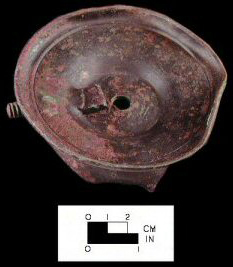 Smith's St. Leonard chafing dish. Base view.
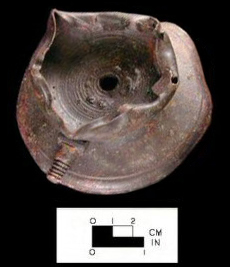 Smith's St. Leonard chafing dish. Top view.
In 2002, archaeologists began to excavate the area where the artifacts had appeared on the
surface. They uncovered a trash pit that the inhabitants of the Smith's St. Leonard site may
have filled near the end of the site's occupation around 1754 (Grow 2006: 37). Many
interesting artifacts were recovered from this excavation, including the base of a copper
alloy chafing dish. Described by Randall Holmes in 1688, a chafing dish "is a kind of round
pan, set on feet, with a handle to move it from place to place; it’s office is to hold
hot coales of fire in, and to set dish meates theron, to keep them warm, til the time
of serving up to the table, or to heate a cold dish of meate on the table" (cited
in Fennimore 1996:100). While some chafing dishes were made of ceramic, a majority
were manufactured from metals such as copper, iron, or brass (Fennimore 1996: 100,
Pearce 1992: 21).
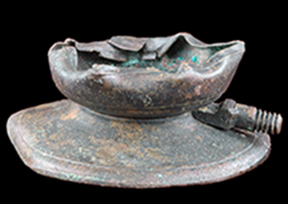 Side view of Smith's St. Leonard chafing dish.
A chafing dish like the one found at Smith's St. Leonard could have been used by the
Smiths to reheat a food dish as it cooled, since the kitchen was kept separate from
the main house and dining area. Until the early 1800s it was more common to use chafing
dishes that required the use of hot coals to keep food warm (Fennimore 1996:101). The
dish found in the trash pit, however, used a different technology. Composed of three
pieces, this copper alloy chafing dish would have had a top plate which unscrewed
from the base and enclosed an iron ring (Fennimore 1996:100). The iron ring would
be placed in a fire until it was hot, and then set between the top plate and the
base of the dish (Fennimore 1996:100). The entire dish was made movable by an
attached wooden handle located on the side of the base. Unlike the coal and
ember-holding chafing dishes, the chafing dish found at Smith's St. Leonard would
have eliminated the unpleasant smoke and smell of burning wood (Fennimore 1996:101).
The Smith's St. Leonard chafing dish is nearly identical to one in the collections at
Winterthur, which was probably produced in Germany between 1710 and 1760, although
it could also have been made in either Sweden or the Netherlands (Fennimore 1996:101).
Based on other artifacts found with the Smith's St. Leonard chafing dish, it appears
that it was discarded around the 1750s. Although the excavated chafing dish would
have had three parts, the top plate and iron heating ring have not yet been found.
The wooden handle is also missing, and most likely decomposed. It is possible that
the chafing dish was discarded due to its broken or missing components.
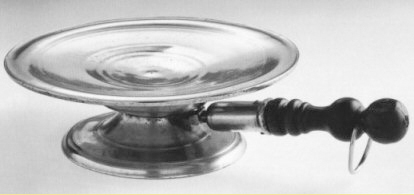 The Smith's St. Leonard chafing dish would have been almost identical to this
18th century chafing dish from the Winterthur Museum Collection (Fennimore 1996:101).
The Smith's St. Leonard chafing dish would have been almost identical to this
18th century chafing dish from the Winterthur Museum Collection (Fennimore 1996:101).
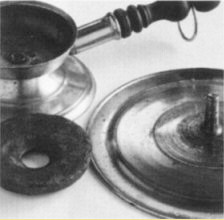 The three parts of the Winterthur chafing dish: base, iron heating
ring and top round plate.
The three parts of the Winterthur chafing dish: base, iron heating
ring and top round plate.
References
Fennimore, Donald L.
1996 Metalwork in Early America: Copper
and its Alloys. Winterthur Publications, Winterthur, Delaware.
Grow, Jessica L.
2006 Excavations at the Smith's St. Leonard Site
(18CV91). Report prepared for Jefferson Patterson Park & Museum St. Leonard, MD and
University of Maryland Masters of Applied Anthropology Internship.
Pearce, Jacqueline
1992 Border Wares: Post-Medieval Pottery in
London, 1500-1700. HMSO Publications, London.