In January 1983, preceding construction of a wastewater treatment facility, Mid-Atlantic Archaeological
Research, Inc. (MAAR) conducted Phase I and II archaeological investigations at the University of
Maryland Center for Environmental and Estuarine Studies at Horn Point in Dorchester County, Maryland.
One of the sites identified during these excavations was the White Oak site, a tenant house or
possible slave quarter, which dates to the mid-19th to early 20th centuries (Schiek and
Goodley 1984: II-17).
A wine bottle neck (Figure 1) was recovered from a hearth or chimney at the rear of a brick structure
at the White Oak site (Schiek and Goodley 1984: II-4). While wine bottle glass is far from uncommon
on domestic sites, this bottle neck had special significance because, when excavated, it "contained
a portion of a solid stopper into which had been inserted, on both the inside and the outside,
nickel-plated copper straight pins" (Schiek and Thomas 1983: II-3). This collection of objects
indicated archaeologists had found the remains of a "witch bottle."
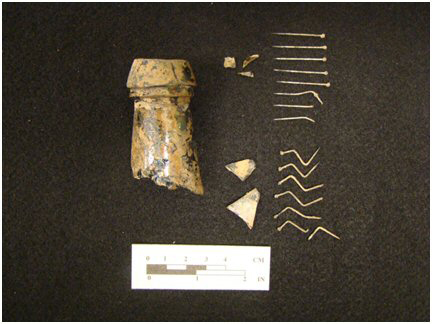 Figure 1. The remains of a witch bottle from the White Oak site.
Originating in Europe several hundred years ago, witch bottles were protective "white magic" charms
used to ward off "black magic" or were used as countermeasures to redirect an evil spell back on
the conjurer. A witch bottle, usually made using a glass bottle or ceramic jug, was filled with
urine and sharp objects, such as pins or nails, and buried inverted at the entrance to a home
or under a hearthstone (Becker 1980: 20-21; Merrifield 1987: 163-175). Urine was the most
important ingredient in witch bottles, as it is the agent with which the spell is turned back
upon the witch (Figure 3). The sharp objects may have been symbolic of the victim's pain, and
inverting the bottle when buried symbolized the reversing of the witch's black
magic (Becker 1980: 20-21).
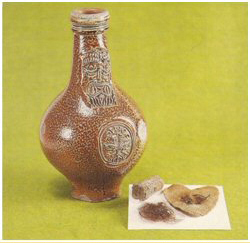 Figure 2. A complete Bellarmine witch bottle with cork, hair, nail clippings, and a felt
heart with pins found in Westminster, England and dating to the 17th century. (Merrifield
1987:cover photo).
Figure 2. A complete Bellarmine witch bottle with cork, hair, nail clippings, and a felt
heart with pins found in Westminster, England and dating to the 17th century. (Merrifield
1987:cover photo).
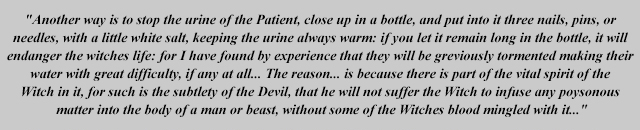 Figure 3: Quote from the Astrological Practice of Physick by Astrologist Joseph Blagrave,
published in London, England in 1671.
Figure 3: Quote from the Astrological Practice of Physick by Astrologist Joseph Blagrave,
published in London, England in 1671.
The witch bottle from the White Oak site (Figure 1) is broken and incomplete. At some point in
the past, the main body and base of the bottle was destroyed, leaving only the bottle's neck
and lip and the pins. Any urine that may have been present in the bottle would have been absorbed
into the surrounding soil when the bottle was broken or it may have slowly leaked from the
bottle as the sealed stopper began to degrade. It was recovered from a layer which also contained
melted green bottle glass, bone, and a horse shoe (Schiek and Thomas 1983: II-3). Some of
the bottle glass may have been part of the original bottle and the bone and horseshoe may
have been associated with the ritual burial, as bone and iron, usually in the form of nails,
have been found with witch bottle burials from the 17th and 18th centuries in both America
and England (Becker 2005: 18). Also, in folk practice, iron in any form holds its
own protective powers.
Witch bottles, like the one from the White Oak site, are evidence that folk magic, deeply
rooted in European traditions, was alive and well, not just in the early years of the
colonies, but well into the 19th and even the 20th centuries. While such efforts may
seem amusing to us in the 21st century, witch bottles represent "the poignant efforts
of a pre-scientific era" to protect itself from what were perceived as very real
threats. (Becker 1980: 23).
References
Becker, Marshall Joseph
1980 An American Witch Bottle.
Archaeology 33 (2): 18-23.
2005 An Update on Colonial Witch Bottles.
Pennsylvania Archaeologist 75 (2): 12-23.
Blagrave, Joseph
1671 Astrological Practice of
Physick. London.
Merrifield, Ralph
1987 The Archaeology of Ritual and
Magic. London: B.T. Batsford Limited.
Schiek, Martha J., and Ronald A. Thomas
1983 Archaeological Study for the Step II
Engineering Services at the University of Maryland Center for Environmental and
Estuarine Studies at Horn Point, Dorchester County, Maryland. Newark, Delaware:
Mid-Atlantic Archaeological Research, Inc.
Schiek, Martha J., and Edward C. Goodley
1984 Archaeological Site Examination:
18DO129, Dorchester County, Maryland. Newark, Delaware: Mid-Atlantic
Archaeological Research, Inc.