There is a famous story about an archaeologist who took an ancient and intact spear point, broke
it in half, and handed it to a shocked student, saying "same information." The point of the story
is that archaeologists should value what artifacts tell us about the past, but not the objects
themselves. While this is true, we would be less than human if we didn't occasionally stop to
admire the aesthetic qualities of certain artifacts. And among the most artistic objects made in
prehistoric Maryland was a type of stone tool called a "bannerstone."
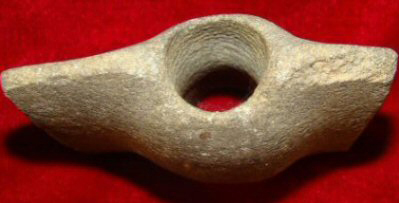
Completed bannerstones were carefully shaped and polished objects, generally symmetrical, with a
perforation hole running longitudinally through the midsection. They came in a wide range of
sizes and shapes, and were made from a variety of hard and soft stones. They are found throughout
eastern North America, and first appeared in the archaeological record around 6000 B.C.,
disappearing sometime after 1000 B.C. Bannerstones are fairly rare finds, which is not
surprising given the hours of labor required to make one. The raw material had to be flaked
and pecked to create the basic shape, then laboriously polished smooth. A hole, sometimes
several inches long, was drilled through the stone using nothing more than sand and a
reed or stick.
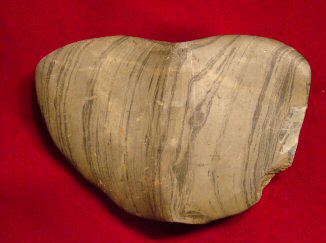 Complete bannerstone.
Early archaeologists thought that bannerstones were ceremonial objects carried on poles, like
banners. This idea changed when bannerstones and similar artifacts were discovered in association
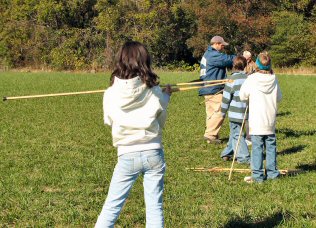
with atlatls, or spear throwers ("atlatl" is the Aztec word for the device). Atlatls are typically
hooked sticks used to improve the velocity and accuracy of a thrown spear or dart. When the end of
the spear is placed into the hook of a hand-held atlatl, the length of the thrower's arm is,
in essence, extended. This means that, when throwing, force is applied to the spear for a
longer period of time, thus increasing the spear's velocity. Skilled use of an atlatl can easily
double the distance of a spear throw, while improving accuracy.
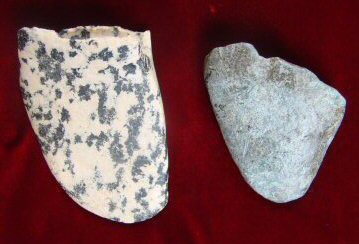 Complete bannerstone.
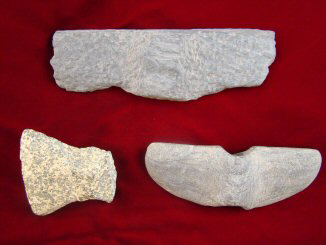 Bannerstone fragments: left- steatite; right - granite.
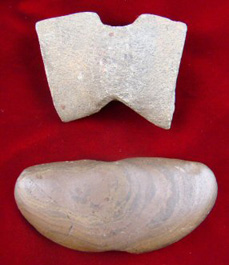
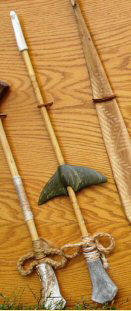
Atlatls were used throughout the world, but only in North America were weights often added to
them. These weights came in a wide variety of shapes and sizes, including the bannerstone style,
which was only used east of the Mississippi. The added mass provided by the weight presumably
allowed a more forceful throw, but experiments have shown that only the smaller weights would
work with all types of atlatls, and they improved force by only a small amount. Larger
weights, including most bannerstones, were only effective if the atlatl had a flexible,
rather than rigid, shaft. The fact that the average bannerstone hole, where it would slide onto
the atlatl, was only about ½ inch in diameter, indicates that they were indeed probably placed
onto flexible shafts.
Given the care with which they were made, bannerstones were probably more than merely
functional. They may have reflected something about the person who made and used them:
social status, family or clan relationships, personal hunting charm, etc. Whatever their
meaning, whatever they can teach us about past behavior, today we can, at the very least,
stand back and admire the artistry and skill of their creators.
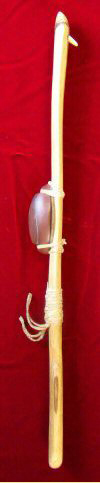 Replica atlatl with bannerstone. From www.worldatlatl.org.
References
Baer, John Leonard
1921 A Preliminary Report on the So-Called Bannerstones.
American Anthropologist 23 (4):445-459.
Howard, Calvin D.
1974 The Atlatl: Function and Performance.
American Antiquity 39(1):102-104.
Hranicky, Wm. Jack
1995 Prehistoric Axes, Celts, Bannerstones, and
Other Large Tools in Virginia and Various States. Archeological Society of Virginia Special
Publication 34, Courtland, VA.
Kwas, Mary L.
1981 Bannerstones as Chronological Markers in the
Southeastern United States. Tennessee Anthropologist 6(2):144-171.
Palter, John L.
1976 A New Approach to the Significance of
the "Weighted" Spear Thrower. American Antiquity 41(4):500-509.