In the early nineteenth century, the area several blocks west of Baltimore's Harbor was a
thriving working class neighborhood, filled with row houses of the type still standing in
many parts of the city. The uniform street-side appearance of these row houses belied the
busy yards behind them. These enclosed yards, used as extensions of home living spaces,
were crowded with work yards, privies, henhouses and other small buildings.
A good look at some of these urban back lots was gained in 1980 during archaeological excavations
conducted by Mid-Atlantic Archaeological Research, Inc. prior to the construction of the
Federal Reserve Bank (18BC27). Excavations revealed a number of wells and privy pits dating
to the first half of the nineteenth century. Abandoned wells and privies often became handy
dumping areas for all manner of household garbage. One privy, Feature 30, was no exception.
In addition to the food bones, broken medicine bottles, buttons, tobacco pipes, peach pits
and other debris, the feature yielded an artifact relevant to the history of the city and
the state.
Approximately one third of a plate printed with a dark blue design was removed from the privy.
The central design, encircled by a border of seashells, was of an early steam locomotive. A
little library research revealed that this pattern was entitled "The Baltimore & Ohio Rail Road"
and was manufactured by the English pottery firm of Enoch Wood & Sons.
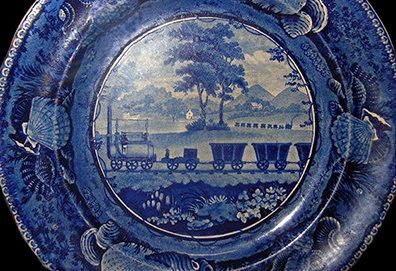 Complete plate showing full detail of printed pattern. (Private collection).
In the 1820s, Baltimore was the nation's third largest city, competing with New York and
Philadelphia for trade to the Midwest. The Baltimore and Ohio Railroad, one of the oldest
railroads in the country, was established to facilitate the movement of trade goods over the
Allegheny Mountains to the Ohio and Mississippi Rivers. The first thirteen mile stretch of
railroad opened in May of 1830 (Wortham 1939). While the first train cars were pulled by
horses,steam locomotives were in use by 1831.
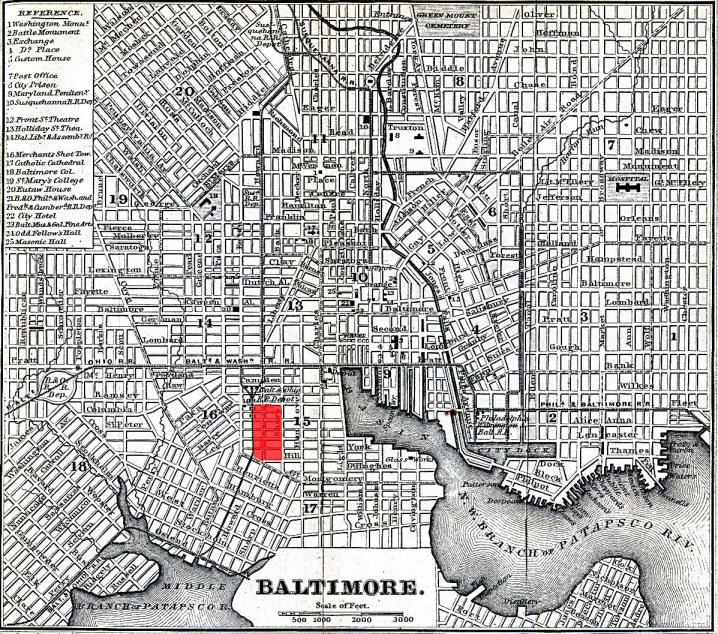 1870 Baltimore Map. The red block represents the Federal Reserve Bank Site area
(18BC27).
1870 Baltimore Map. The red block represents the Federal Reserve Bank Site area
(18BC27).
The "Baltimore and Ohio Rail Road" pattern was probably first produced by potters Enoch
Wood & Sons in the late 1820s or early 1830s, to commemorate the laying of the first rails
or the actual opening of the railroad itself (Halsey, 1899; Snyder 1995). The actual
pattern was based on an engraving of the British Hetton Railroad and first published
in The American Traveller Broadside in 1826 (Dunbar 1915). Between 1815 and
1840, many Staffordshire potters appealed specifically to the American market by producing
pottery depicting American landmarks, such as churches, hotels and resorts, homes, city
vistas, and natural wonders.
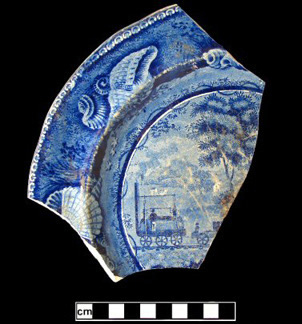 B & O Railroad plate from the Federal Reserve Bank site.
What makes this find particularly poignant is that the row houses whose residents purchased
and used the B&O plate were destroyed in the early twentieth century by the Baltimore and
Ohio Railroad Company in order to expand Camden Yard.
References
Dunbar, Seymour
1915 A History of Travel in America.
Bobbs-Merrill, Indianapolis.
Halsey, R.T. Haines
1899 Pictures of Early New York on Dark Blue
Staffordshire Pottery; Together with Pictures of Boston and New England, Philadelphia,
the South and West. New York.
Wortham, Alvin
1939 Staffordshire and the Baltimore and
Ohio. American Collector. December 1939.
Snyder, Jeffrey B.
1995 Historical Staffordshire; American
Patriots and Views. Schiffer Publishing, Atglen, Pennsylvania.