Annette Cook, MAC Lab Public Archaeology Asst.
Glass etched with the name Rachel RidgelyIn 1968, a homeowner in Anne Arundel County, uncovered a
suspected Colonial-era cellar pit while excavating for the installation of a swimming pool.
Archaeologists were called in, and a salvage operation yielded a collection of artifacts dating to
c. 1750, including ceramics, glass bottles, farm tools, a sword hilt and three pieces of window
glass upon which was engraved the name "Rachel Ridgely" (Figure 1). The site, called Saunders
Point, is known to have been part of a plantation owned by the prominent Saunders family.
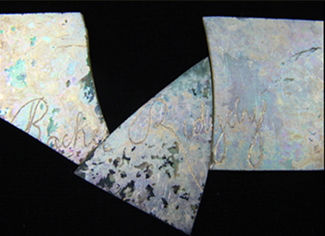 Fig. 1: Rachel Ridgely engraved glass from Saunders Point site.
A quick look into genealogical records finds that there were several ladies named Rachel Ridgely,
either by birth or by marriage, living in the area during the late 17th century and throughout
the 18th century. Any of these, or some other, may have been the one who wrote, or was written of,
in the Saunders Point window.
History shows that the etching of names, and indeed whole verses on window panes, was a common
practice in 16th and 17th century England (Targoff, 2008: 67). The Princess Elizabeth is said
to have inscribed the following words during her captivity at Woodstock in 1554-1555:
"Much is suspected of me/ Nothing proved can be. Quoth ELIZABETH, Prisoner" (Fumerton and
Hunt, 1999: 332; Fleming, 2001: 55-56). Later as queen, the same Elizabeth and Sir Walter
Raleigh shared a bit of conversation inscribed in glass when Raleigh wrote in a window at
court, "Fain would I climb yet fear I to fall." Underneath, Elizabeth inscribed in reply
"If thy heart fails thee, climb not at all" (Fumerton and Hunt, 1999: 333; Fleming, 2001: 56).
Raleigh reportedly used a "writing ring," which was a ring with a pyramid shaped diamond set with
the pointed end up (Figure 2). Such rings were produced by jewelers especially for writing
on glass (Fleming, 2001: 55; Targoff, 2008: 67).
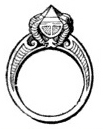 Fig. 2: Walter Raleigh engraving ring from Beadles Monthly. (Fleming, 2001: 55;
Targoff, 2008: 67).
Fig. 2: Walter Raleigh engraving ring from Beadles Monthly. (Fleming, 2001: 55;
Targoff, 2008: 67).
The Maryland Archaeological Conservation Lab collection also includes two pieces of glass from
Angelica Knolls, in Calvert County, with partial words inscribed upon them (Figure 3). The
message will probably never be known, and it will remain a tantalizing bit of historical
graffiti, much like "Rachel Ridgely" will probably remain a mystery person with an unknown purpose.
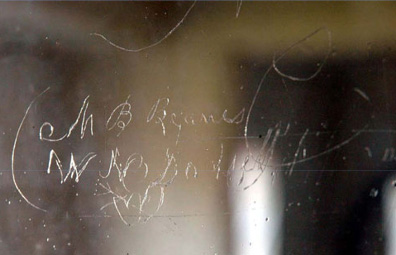 Fig. 3: Mount Calvert Lover's Window - Courtesy of the Maryland-National Capital
Park and Planning Commission.
Fig. 3: Mount Calvert Lover's Window - Courtesy of the Maryland-National Capital
Park and Planning Commission.
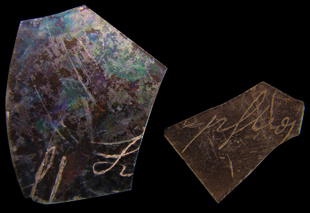 Fig. 4: Glass fragments from Angelica Knolls.
Why would someone take the time to etch their name or other words into glass? Over thirty thousand years
ago people began leaving handprints on cave walls using charcoal dust blown through a straw. Perhaps
then, it is a simple human desire to leave a token of oneself. To set words in something firm
and to tell the world "I existed, I was here."
References
Beadle's Monthly
1867 Beadle's Monthly, Volume 1, page 263,
Courtesy of Don Rittner.
Fleming, Juliet
2001 Graffiti and the Writing Arts of Early
Modern England. Philadelphia, PA: University of Philadelphia Press.
Fumerton, Patricia, and Simon Hunt
1999 Renaissance Culture and the Everyday.
Philadelphia, PA: University of Philadelphia Press.
Montaperto, Kristin
2009 Personal Communication.
Targoff, Ramie
2008 John Donne, Body and Soul.
Chicago, IL: University of Chicago Press.