In late August 2009, a family was visiting Assateague State Park when the 9 year old son found what
appeared to be a silver coin in the sand. The family turned the coin in to Park staff who contacted
the Maryland Historical Trust to examine the find. Earlier that same week, several large timber
fragments of an unknown shipwreck had washed ashore on the Assateague beaches following high winds
and rough seas caused by a hurricane just off the coast. By examining the construction of the timbers,
they are estimated to date from a pre 18th century wreck. Was it coincidence that a coin had been
found in the same area that the timbers washed ashore, the same week after such a large storm?
Upon initial examination, the surface of the coin was
obscured in areas by marine concretions, but what areas were visible showed Spanish markings and
a grey/silver surface. The visible markings on the front of the coin indicated that it was a
Spanish 4-real coin minted in Potosi, Bolivia. The coin was then taken to the Maryland
Archaeological Conservation Laboratory for further investigation. As conservators worked to clean
the coin and reveal its surface, two things became immediately clear; the coin is not silver
but gold plated and a fake!!! Under a microscope, it is apparent that a thin layer of gold
covers a grey, metal core. Now, the question was whether the coin is a modern fake made for
the collecting community or a historic forgery that would have been passed off as currency.
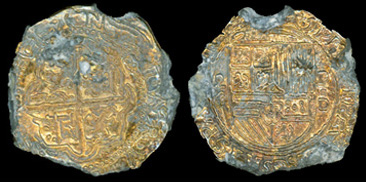 Front and back of fake coin after conservation treatment.
Richard Doty, Curator of the National Numismatic Collection at the Smithsonian and a coin expert,
was able to provide additional information on the coin. He identified it as a copy of a
silver 4-real coin from the reign of Phillip II, 1556-98. However, the cross design on
the reverse is incorrect for this type of coin, regardless of period. The cross on gold coins
from Charles I (1516-56) and later is thicker and has squared-off arms. (email to author,
September 2, 2009) And while the overall design is correct for a silver coin, it is incorrect
on gold coins. The fact that this coin is gold-plated suggests a relatively modern fake rather
than a forgery from the 17th century or earlier. Generally, early forgers knew their prey
well enough to produce an accurate copy.
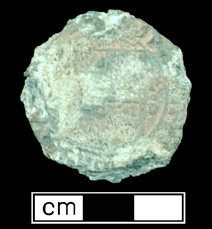 Coin found by 9 year old boy at Assatague State Park shown before treatment.
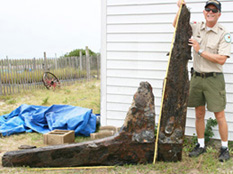 Park Ranger standing next to ship timbers that washed to shore after a
storm. Eowyn/Eowyns/Encheiridion/ScribalTools.html.
Park Ranger standing next to ship timbers that washed to shore after a
storm. Eowyn/Eowyns/Encheiridion/ScribalTools.html.
To determine the possible period of manufacture, the coin was analyzed using X-ray Fluorescence (XRF)
by Richard Lundin of the Wondjina Research Institute. This technique is able to determine
the elemental make up of an object. The results of this analysis report the surface gold plating
to be 18 carat and the metal core a 97% aluminum alloy. Such high amounts of aluminum indicate
modern manufacturing, as 17th century metalworking technologies would not have produced aluminum
in such high concentrations.
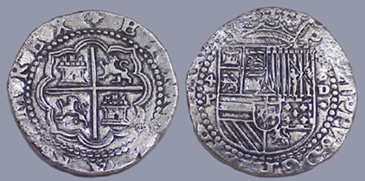 Front and Back image of a silver 4-Real coin from the reign of
Phillip II, 1556-98.
Front and Back image of a silver 4-Real coin from the reign of
Phillip II, 1556-98.
It is unclear how this coin ended up on the Assateague shore and an incredible coincidence that
it would be found the same week as the historic shipwreck timbers. Shipwreck timbers that
remain a mystery.