On April 1st, MAC Lab archaeologists discovered a rare example of a site occupied by the mysterious Easter
Bunny culture. Descriptions of Easter Bunnies abound in oral history and folklore, but they have
often been dismissed as myth. Archaeology has revealed evidence of Easter Bunnies on numerous
occasions, but their material culture is poorly understood because usually only one or two of the
unique ovoid containers that are associated with the culture are found on any given site.
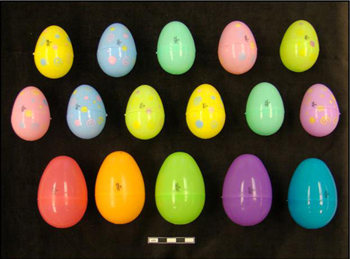 Cache of Easter eggs found at site that vary in color and size.
The recently-discovered Easter Bunny cache is comprised of 16 examples of these distinctive and
brightly-colored containers. "It is rare to find an intact Easter Bunny site," says Ed Chaney,
Deputy Director of the MAC Lab, "they are often looted, especially by small children. That's
what makes this site so exceptional." Archaeologists conducted a systematic surface collection
of the site and are confident that they have identified its boundaries and recovered all of the
artifacts, including one cleverly concealed in the nook of a tree.
Some scholars suggest that these containers are stylized versions of chicken eggs, but others feel
that the color and material of the containers are too different from chicken eggs to support this
assertion. As Chaney points out, "If they are supposed to represent chicken eggs, then oral history
would have remembered these people as the Easter Chicken culture, not the Easter Bunny culture.
There is no logical connection between bunnies and eggs."
Each container is hollowed out to allow storage of some kind. X-radiography revealed that three of
the containers held several coins. One example was carefully opened by MAC Lab conservator Nichole
Doub to reveal five well-preserved United States quarters. Based on the level of patina on the
metal, Doub estimates that the quarters were deposited in the container at least a year ago. The
dates on the coins help with determining the time of deposit by providing a terminus post quem
or "TPQ" for the site, meaning that the cache must have been placed at some point after the
last date on the coins, which appears to be 2007. Archaeologists believe that the money containers
are offerings left by only the wealthiest portion of Easter Bunny society.
Of the remaining 13 containers, seven appear to be empty and six contained only fragments of a
metallic foil. Upon closer inspection, however, a residue was discovered in all 15 containers.
Chemical analysis of the residue has revealed evidence of sugar storage, and the examples with the
foil fragments have trace elements of cocoa as well. Although this evidence might suggest food
storage activity, the practicality of using such small containers to store food is questionable,
and since water may seep in at the center of the container, then sugar placed inside would be at
risk of dissolving. Instead, most archaeologists agree that the containers were spread about the
landscape annually by the Easter Bunny culture as part of some kind of ritual or religious offering
to give thanks to unknown deities for bringing about the end of winter.
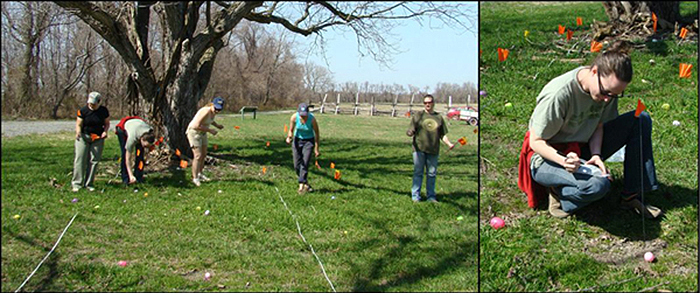 Archaeologists and assistants conducting a systematic surface collection of the
Easter Bunny site.
Archaeologists and assistants conducting a systematic surface collection of the
Easter Bunny site.
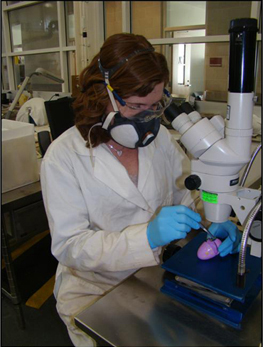 Conservator Nichole Doub working on opening one of the eggs under a
microscope.
Conservator Nichole Doub working on opening one of the eggs under a
microscope.
There is still much that archaeologists have yet to understand about how and why these containers
were deposited at the site. For example, is there significance to the different designs, colors,
and sizes? Statistical analyses are thus far inconclusive because the sample size is too small,
but if more sites are discovered it may be possible to determine if certain sizes or colors are
more likely to contain coins as opposed to sugar or cocoa. Archaeologists also question why
some containers were left out on lawns as if meant to be found, while others were partially
concealed in trees and bumpy landscape features. Despite these nagging questions, the Easter
Bunny cache offers important insights into the complexity of the mysterious culture that created
it. Not only did they have a hierarchical class structure where some individuals left money
and others food offerings, but they also seem to have had elaborate religious rites that were
tied to the seasons. The cache is currently being processed for long-term curation so that
it will be available for research as more sites are found and more questions arise about
the elusive Easter Bunnies.
Happy April Fools!