Dennis C. Curry and Maureen Kavanagh, Maryland Historical Trust
The Rosenstock site (18FR18) is a large Late Woodland village located in Frederick County, Maryland.
Staff from the Maryland Historical Trust's Office of Archeology, in cooperation with the Archeological
Society of Maryland, Inc., carried out exploratory testing at the site in 1979, and undertook more
extensive excavations in 1990-1992. These excavations revealed a circular village pattern typical of
the Montgomery Complex — an open central plaza surrounded by a ring of trash-filled pits
(originally used for storage), which in turn were encircled by a ring of single-family, small,
oval houses (see Curry and Kavanagh 2004). Some Montgomery Complex villages were enclosed by a
palisade, but no evidence for such structure was found at Rosenstock.
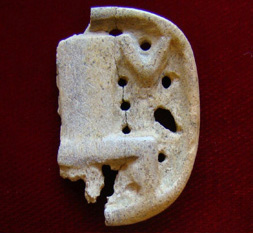 Figure 1: Bone carving from the Rosenstock site.
During the 1979 testing, a small portion of a trash-filled pit
(Feature 5) was uncovered and partially excavated. This trash pit — filled with Shepard ware
(collared ceramics similar to Owasco ware in New York), stone artifacts, and animal bone tools and
waste — ultimately proved to be a deep, double-bottomed feature containing some 12 cubic meters
of fill which required three field seasons to completely excavate. It was during flotation of the
feature fill excavated in 1991 that an unusual bone carving was recovered (Figure 1).
The figure is carved in bas-relief on bone (presumably a deer epiphysis) and appears to represent
a headless human effigy. The artifact is broken along its left side, following the carved
edge of the figure's torso. The perforating holes surrounding the figure are drilled from
both sides, although two (near the figure's "calf") were started only on the carved face and
not completed. It is unclear whether the large hole on the right was intentional, or if it
was an intended small hole that "punched out." It is also unclear whether the holes were
intended as part of the decorative motif, or whether they were drilled in preparation for removal
of background material in filigree fashion.
A charcoal sample from the level at which the bone figure was recovered was radiocarbon-dated
to A.D. 1040±90, or a mean calibrated date of A.D. 1125. Four additional samples from the
double pit produced mean calibrated dates ranging from A.D. 1190 to 1460. The disparity
among dates from this pit is confusing, both in terms of this artifact and the site as a whole.
Based on the predominance of Shepard ceramics at the site, the earlier dates would seem
appropriate, while the 15th century dates are perhaps more likely for this particular artifact.
Intrigued by the unique nature of this artifact, and unable to find comparable specimens in
readily available literature, we sent a sketch and description to several dozen colleagues
in eastern North America, asking for information on similar examples. The answer came from
Robert Funk and George Hamell of the New York State Museum. The squatting figure is termed
a "hocker," and is found throughout the world, including China, Southeast Asia, Oceania,
Mexico, Peru, and the Northwest Coast (Covarrubias 1954) (Figure 2). Hockers are apparently
rare east of the Mississippi River, although they are common in Seneca Iroquois art (especially
on bone combs) during the period from 1670 to 1700 (Wray 1963; Hamell 1979) (Figure 3).
Funk reports that — even at ca. A.D. 1460 — our specimen would represent one of
the earliest hockers ever found in the East. Hamell states that the earliest specimen he
is aware of comes from the Northern Iroquoian region of New York. The specimen consists
of continuous bas-relief hockers (a frog alternating with a headless human) around the
bowl of a ceramic elbow pipe, representative of Canandaigua Phase Owasco, ca. A.D. 1130.
In their study of ancient symbolism, Schuster and Carpenter (1996:82-83) view hockers —
especially when used as part of a repeated design — as an element depicting genealogy.
Each hocker represents an ancestor, and the headless nature of some hockers is seen as
deliberate and symbolic, i.e., ancestors, in general, are dead. They (Schuster and
Carpenter 1996:104, 113) also discuss the use of "excerpts" where a single figure taken
from a genealogical pattern is used as a medallion and, in some societies, assigned the
name of a deceased person.
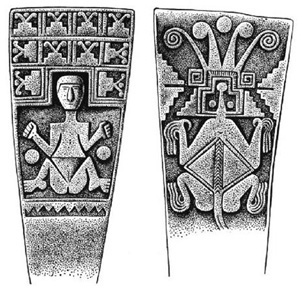 Figure 2: Two examples of “hockers” carved on stone slabs from Manabi,
Ecuador (Covarrubias 1954: Fig. 5).
Figure 2: Two examples of “hockers” carved on stone slabs from Manabi,
Ecuador (Covarrubias 1954: Fig. 5).
Other interpretations were offered as well. It is possible that the raised rim of the
Rosenstock carving represents a metaphorical door of a house, and that the hocker serves
as a "doorkeeper," again an Iroquoian notion (Hamell 1979, personal communication 1992).
Edmund Carpenter (personal communication, 1992) notes that it is possible that the holes
surrounding the figure represent "joint marks" used in divination by cultures in both
Americas.
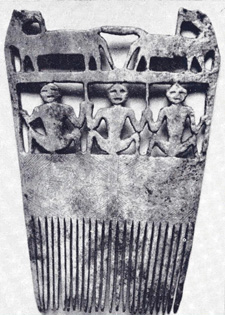 Figure 3: A bone comb with "hockers" from a Seneca Iroquois site (Wray
1963: Plate 3[13]).
Figure 3: A bone comb with "hockers" from a Seneca Iroquois site (Wray
1963: Plate 3[13]).
While the possible social symbolism of the Rosenstock hocker is purely speculative, it
does provide some context for considering its possible function and meaning. In
truth, however, the meaning of this carving may never be known.
References
Covarrubias, Miguel
1954 The Eagle, the Jaguar, and the Serpent:
Indian Art of the Americas. Alfred A. Knopf, NY.
Curry, Dennis C., and Maureen Kavanagh
2004 Excavations at the Rosenstock Village
Site (18FR18), Frederick County, Maryland: A Preliminary Report. Maryland Archeology
40(1):1-38.
Hamell, George R.
1979 Of Hockers, Diamonds and Hourglasses: Some
Interpretations of Seneca Archeological Art. Paper presented at the Annual Conference
on Iroquois Research, October 13-15, 1979, Albany, NY.
Schuster, Carl, and Edmund S. Carpenter
1996 Patterns that Connect: Social Symbolism
in Ancient and Tribal Art. Harry N. Abrams, Inc., NY.
Wray, Charles F.
1963 Ornamental Hair Combs of the Seneca
Iroquois. Pennsylvania Archaeologist 33(1-2):35-50.