Nancy S. Shippen, MAC Lab Conservator
Often overlooked today as an insignificant detail on a jacket, shirt or pair of pants, buttons
can hold important information for archaeologists and historians, even raise questions about
context and meaning on an archaeology site. The buttons of military uniforms can reveal
information about the armies involved, as well as the dates and use of a site. In the early
18th century, the increase in the number of armies in Europe necessitated the assignment of
numerical designations to regiments. The French first applied those numbers to their uniform
buttons in 1762 followed by the British and the Americans (Troiani, 2001: xi). Excavations at
the Washington Memorial Chapel at Valley Forge, Pennsylvania have recovered four pewter
regimental buttons from the Revolutionary War (the winter of 1777-1778). Three of the buttons
are from the 2nd Pennsylvania Regiment and one button is from the 14th Continental Regiment.
These buttons have been conserved at the MAC Lab (Figure 1-3).
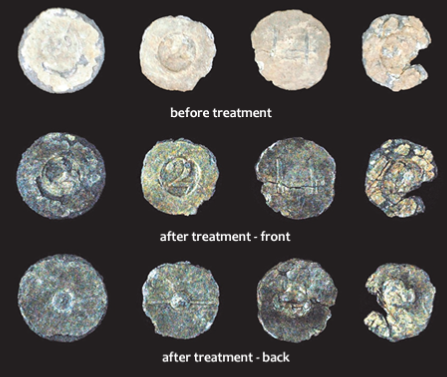 Figure 1. Pewter buttons before conservation treatment.
Most military buttons on the uniforms of enlisted personnel in the American Revolution were cast
of a tin/lead alloy (pewter). Groups of up to twelve buttons could be cast in molds made of
brass, bronze or wood (Tice, 1997: 2). The 2nd PA Regimental buttons from the Valley Forge
excavation are one-piece cast pewter with a recessed center and raised numeral, integral
looped shank and a scissors-type mold mark (Figures 4-6). While the backs of the recovered
buttons are too corroded to determine if they are marked (Figure 3), most buttons from
this regiment were back-marked with "Clarke" in raised letters, believed to refer to a
Philadelphia button manufacturer, Ephraim Clarke of Clarke & Company (Troiani, 2001: 136).
The button from the 14th Continental Regiment (Figure 7) was also cast pewter with
a raised numeral "14" and without a border (Troiani, 2001: 93).
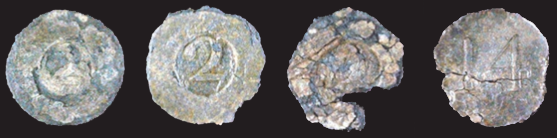 Figures 4-7. Three on left, 2nd PA Regimental buttons from the Valley Forge
excavation; right, 14th Continental Regiment button from Valley Forge.
Figures 4-7. Three on left, 2nd PA Regimental buttons from the Valley Forge
excavation; right, 14th Continental Regiment button from Valley Forge.
No fighting occurred at Valley Forge during the Revolutionary War. After the British captured
Philadelphia, the patriot capital, and as winter approached, Washington withdrew the American
troops to Valley Forge, close enough to maintain pressure on the British without the threat of
a surprise attack. Supplies were not abundant but they were available as the soldiers patrolled,
foraged and defended the camp. The soldiers became a well-trained professional army under the
training of a former Prussian army officer, Baron Friedrich Wilhelm Augustus von Steuben.
The soldiers at Valley Forge spent six months living active lives, waiting for the next move
from the British (http://www.nps.gov/vafo/historyculture/index.htm).
The excavations at the Washington Memorial Chapel at Valley Forge have been conducted since
2007, seeking to understand the landscape and the story of the Americans encamped during the
winter of 1777-1778. By studying the objects uncovered, the archaeologists reveal the daily
lives of the Continental soldiers (Bloom, 2010: pers comm.). The buttons were discovered in
the excavation of the units determined to be the camp kitchen (Shirley,
2009: http://vafowmc.blogspot.com).
One of the primary questions the archaeologists are seeking to answer is the identification
of the regiments encamped at Valley Forge at the Chapel. While the three buttons from the
2nd PA Regiment would normally be an indication of encampment, the 2nd PA Regiment should
have been camping on the opposite end from the Chapel site, in an area presently known as
Wayne’s Woods, under the command of General Anthony Wayne (Shirley, 2009:
http://vafowmc.blogspot.com). Thus, the pewter
buttons present many new questions as to
where the 2nd PA Regiment was actually located. Perhaps the Chapel site was instead a work
area used by a number of regiments. While there are many theories as to the movement of
buttons and clothing, the exact story of these regimental buttons may never be known
(Bloom, 2010: pers comm.).
References
Bloom, Carin, PhD, Temple University
2010 Personal Communication.
National Park Service
http://www.nps.gov/vafo/historyculture/index.htm
Shirley, Meghan
2009 http://vafowmc.blogspot.com
Tice, Warren K.
1997 Uniform Buttons of the United States
1776-1865. Gettysburg, PA: Thomas Publications.
Troiani, Don
2001 Military Buttons of the American
Revolution. Gettysburg, PA: Thomas Publications.