Alex GLass, MAC Lab Public Archaeology Asst.
In 2010 at Jefferson Patterson Park and Museum, archaeologists recovered a silver pierced
coin from the kitchen area at the Smith's St. Leonard Archaeological site (18CV91). After
the coin was cleaned by conservation staff it became possible to identify the images on
either side of it, the time period in which it was made, and where it was produced. The
silver coin was minted in England during the Commonwealth Period, which dates from 1649 to
1660. The shield and cross of St. George surrounded by a wreath decorates one side, while the
shields of St. George and Ireland are on the other (Mackay 1983: 83).
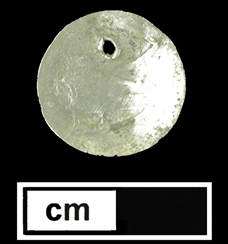 Smith St. Leonard pierced silver coin, front face shows corner of shield and
wreath on the left side . The coin is pierced near the bottom point of the shield.
Smith St. Leonard pierced silver coin, front face shows corner of shield and
wreath on the left side . The coin is pierced near the bottom point of the shield.
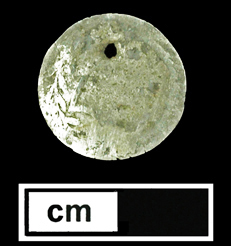 Smith’s St. Leonard pierced silver coin back face, shows shields of St.
George and Ireland with top of shields pointing to the left side of coin.
Smith’s St. Leonard pierced silver coin back face, shows shields of St.
George and Ireland with top of shields pointing to the left side of coin.
Pierced coins are part of both European and African-American folk traditions. Both cultures
use silver, especially coin silver, to ward off witchcraft and also to treat or prevent
diseases and ailments (Fennel 2000: 286, Davidson 2004:27). English use of altered coins
as amulets or charms was a common practice that may go as far back as the Pre-Christian
era, while written sources date the use of pierced coins in England to the 17th century
(Davidson 2004: 27-28). The cross in the center of St. George’s shield was possibly one
reason why the coin was perforated. "The symbol of a cross on a metal medallion was
considered a valid charm form by the Reformation clergy" and could have also held religious
significance to whomever the coin belonged to, especially since the cross was present on
both sides of this type of coin (Davidson 2004:28). Written records of folk practices
among African-Americans during the 19th century suggest that "tying a piece of silver with
a hole in it to one’s leg could create protection from malevolent forces," and also
relieve "“rheumatism, cramps, teething" or provide "general good luck"
(Davidson 2004: 37, Fennel 2000: 286). Pierced silver coins are often recovered from
archaeological contexts associated with enslaved African-Americans including sites such
as the Charles Carroll house in Maryland, and Andrew Jackson's Hermitage plantation in
Tennessee (Fennel 2000: 286, Russell 1997:68). The coins from these sites are often
described as serving a medical or religious purpose by the enslaved people who used them.
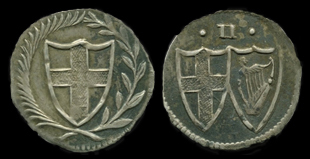 Above: Example of a Commonwealth era two-pence coin (front & back.) St.
George's shield surrounded by wreath on obverse, conjoined shields of St. George
& Ireland on reverse. Below: Smith's St. Leonard pierced silver coin (front & back)
rotated so designs match those of coin example above.
Above: Example of a Commonwealth era two-pence coin (front & back.) St.
George's shield surrounded by wreath on obverse, conjoined shields of St. George
& Ireland on reverse. Below: Smith's St. Leonard pierced silver coin (front & back)
rotated so designs match those of coin example above.
Some researchers believe the use of pierced silver coins is primarily a European practice,
belonging in particular to English culture (Davidson 2004: 27, 30). So, it is possible
that the Smith's St. Leonard coin belonged to a member of the Smith family, or one of
their English servants, since most examples of pierced coins associated with
African-Americans date from the second half of the 18th century and into the early
20th century (Samford, 2010: pers comm). The worn appearance of the coin could also
suggest a significant amount of use, or that the coin had been handed down from one
person to another. While it is difficult, even impossible, to know who this pierced
coin at the Smith's St. Leonard site belonged to, the stories and traditions behind it
are certainly very complex, and provide an interesting way of thinking about people
from the past.
References
Davidson, James M.
2004 "Rituals Captured in Context and Time:
Charm Use in North Dallas Freedman's Town (1869-1907), Dallas, Texas". Historical
Archaeology 38(2):22-54.
Fennel, Christopher C.
2000 "Conjuring Boundaries: Inferring Past Identities
from Religious Artifacts." International Journal of Historical Archaeology 4(4):
281-309.
Russell, Aaron E.
1997 "Material Culture and African-American
Spirituality at the Hermitage." Historical Archaeology 31(2): 63-80.
Mackay, James
1983 A History of Modern English Coinage:
Henry VIII to Elizabeth II. Longman Group Limited, New York.
Samford, Patricia
2010 Personal Communication – Maryland
Archaeological Conservation Laboratory.