Annette Cook, MAC Lab Public Archaeology Asst.
In June, 2010, a summer intern working with Jefferson Patterson Park and Museum staff was digging a
unit in the kitchen area of the Smith's St. Leonard site (18CV91). Upon unearthing a small,
oddly-shaped metal artifact in the plowzone layer, he held it up and announced "I think I found a
goose!" The object was approximately 7 cm long and did, in fact, curve in a manner reminiscent of
a bird's neck. It even had a large head and pronounced "beak." What on earth could this object be?
Closer inspection and cleaning revealed that the object was the hammer, also referred to as the
cock, from a flintlock gun. Furthermore, the gunflint was still firmly locked in place between
the gun cock's jaws. The piece seemed to be in near perfect condition, with only a small chip
missing at the base of the artifact (Figure 1). Appropriately enough, this type of gun hammer
or cock is often referred to as a goose-neck cock (Brown 1980: 182). The flatness of the body,
as well as the slotted jaw screw, match descriptions of both British and French gun
cocks (Peterson 2000: 167, 173).
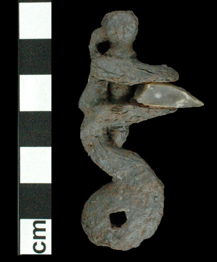 Figure 1. Gun hammer/cock from Smith's St. Leonard site.
Flintlock weapons were so named because the hammer/cock part of the firing mechanism held a piece
of flint. The gun cock was moveable and would be pulled back into the half-cocked position for
loading, or to the fully cocked position in preparation for firing. Ignition was provided by the
pull of a trigger, which caused the cock to spring forward, striking the flint against a steel
plate, called a frizzen, yielding sparks (Figure 2). The sparks fell into a shallow pan containing
a small amount of gunpowder igniting it. This fire traveled through a tiny hole leading into the
barrel of the gun, which would be loaded with gunpowder and ammunition, causing the gun to
discharge (Moore 1967: 4-5). The term "flintlock" may refer to any weapon using that particular
firing mechanism, or to the mechanism itself. Flintlock guns could be long barreled firearms,
such as muskets and rifles, or short barreled pistols, blunderbusses, and carbines.
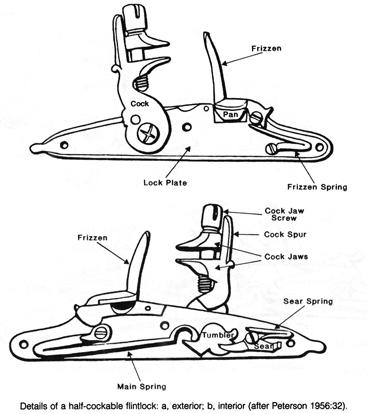 Figure 2. Diagram of a flintlock gun, exterior and interior (McCarthy et al. 1991: 70).
Earlier versions, including wheel-lock and snaphaunce guns, date from the 16th century and were
considered a vast improvement over prior "hand gonnes" requiring the use of wicks or slow burning
matches to fire the weapons (Hogg 1980: 14-23 and Peterson 2000: 159). True flintlock guns were
probably developed in France and came into use in the early 17th century (Hogg 1980: 24). The
flintlock gun was lighter, more balanced, and more dependable in inclement weather conditions
(Hogg 1980: 14 and Peterson 2000: 159). Flintlock weapon technology was the standard for
approximately 200 years, with little variation, until being replaced by percussion cap weapons
in the early 19th century (Brown, 1980: 75).
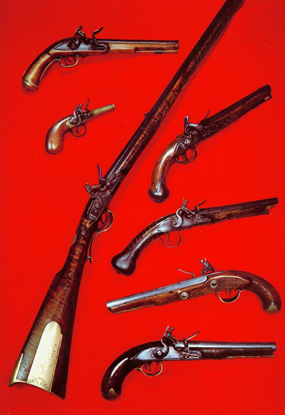 Figure 3. Various American-made flintlock weapons (Moore 1967: 21).
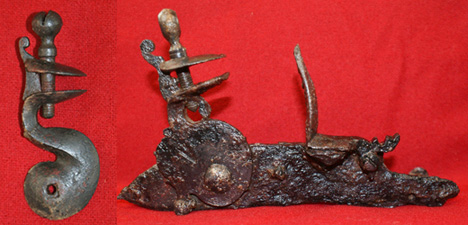 Figure 4. Gun cocks from the Addison site collection.
An expert shooter could load and fire his weapon every 15 seconds. In regimental warfare,
which involved several lines of soldiers lined up shoulder to shoulder, and firing all at
once, this meant that in an average attack, multiple volleys could be fired at a charging
regiment. Although flintlock muskets were not very accurate beyond 80-100 yards, speed and
the sheer number of ammunition fired was more important in regimental battle
(Peterson 2000: 160).
It is not known how or why the gun cock ended up in the Smith's St. Leonard kitchen, nor
have any other known gun parts been found on the site to date. Gunflints, musket balls and
smaller lead shot have been recovered. So why wasn't the rest of the gun found in close
proximity? Perhaps it is because the flintlock mechanism was the most fragile and often
broken component of a flintlock weapon. These parts were also easily replaceable, thus
allowing the repair and continued use of a gun (McCarthy et al. 1991: 72). It is
possible that, with its chipped bottom, the gun cock had been removed and discarded
during repairs to a weapon. Or, possibly, the damage occurred later, and the piece
was being kept as a possible replacement part for a broken gun. At the Addison
Plantation site in Prince Georges County, Maryland, numerous individual gun parts were
found, but no complete weapons. As commander of the county's militia, Thomas Addison
maintained an armory, and useable gun components were undoubtedly kept for future use
(McCarthy et al. 1991: 74).
Although Smith's St. Leonard was not a military post, weapons would have certainly been
available for protection, as well as for the procurement of food. Only time and further
excavation will reveal whether more gun parts are to be found.
References
Brown, M.L.
1980 Firearms in Colonial America.
Smithsonian Institution Press, Washington City.
Hogg, Ian V.
1980 An Illustrated History of Firearms.
Quarto Publishing, Ltd, London.
McCarthy, John P., Jeffrey B. Snyder, and Billy R. Roulette, Jr.
1991 Arms from Addison Plantation and the Maryland
Militia on the Potomac Frontier. Historical Archaeology, Journal for the
Society for Historical Archaeology, Volume 25, Number 1: 66-79.
Moore, Warren
1967 Weapons of the American Revolution.
Funk and Wagnalls, New York.
Peterson, Harold L.
2000 Arms and Armor in Colonial America
1526-1783. Dover Publications, Inc., Mineola, New York.