Sami Allen, MAC Lab Public Archaeology Asst.
Located a mile east of the Potomac River and on the edge of a towering, steep
bluff just outside the District of Columbia's border in Maryland lies an
extraordinary archaeological site called Oxon Hill. Beginning in 1687 this
area was home to John and Rebecca Addison and multiple generations succeeding
them until 1810. This agricultural plantation was still occupied by many different
owners until the early 20th century (Garrow & Wheaton 1986).
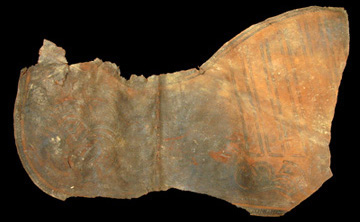 Saddle fragment after conservation.
In 1985 archaeological investigations revealed a 13-meter-deep well that was
deemed useless as a water-source in the early 18th century and served as a
trash disposal thereafter. The area of the well below the water table is
particularly exciting because it was here that a decorated leather saddle
fragment was found among other well-preserved artifacts made of organic
materials such as bone and wood. Based on ceramic and pipe stem analysis
for the level (57) and section (C) where the saddle fragment was found,
archaeologists believe the intact piece of leather dates to the mid-18th
century (Garrow & Wheaton 1986).
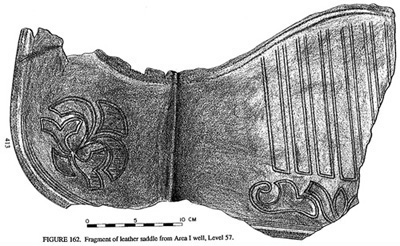 Illustration of leather saddle fragment from Oxon Hill, Area 1 Well,
Level 5.
Illustration of leather saddle fragment from Oxon Hill, Area 1 Well,
Level 5.
The leather saddle fragment, which is on display at Jefferson Patterson Park &
Museum's Visitor Center, was for the most part able to keep its original shape
because of the presence of water and the lack of oxygen in its burial environment.
The absence of oxygen prevented microbes and insects from surviving and assisting
with the deterioration process. Over time, the leather itself has lost its natural
cellular form but when soaked in water for over two centuries, the water acted as
support to fill in the spaces of the leathers' cells and retain its shape (Personal
communication with Nichole Doub).
There is still much we need to learn about this intriguing saddle piece. For instance,
what part of the original, complete saddle did this fragment come from? This can be
hard to determine because so few saddles from the 18th century survive for comparison.
The contour of the leather fragment appears to match the shape of the "rear jockey" from
a 19th century saddle. Even though the Oxon Hill saddle is from an earlier century,
saddles did not change drastically in that period of time (see the labeled picture
from (www.cochiseleather.com) for an example).
In fact, many of the saddles that we
see today greatly resemble those of the 18th and 19th centuries (Personal
communication with Sara Rivers-Cofield). "Jockeys cover the exposed upper sides of
the saddle tree bars. The rear jockey in particular, covers and protects the 'fan,'
the bar from the back of the cantle back towards the end of the saddle" (Beatie 1981).
An illustration of an embellished saddle by Moseman.They serve as a decorative cover-up
instead of bearing the weight of the rider which may explain why there is not much
surface damage or wear to the Oxon Hill fragment. No other saddle fragments have been
identified in the Oxon Hill well, but that makes sense if this fragment was a rear
jockey because rear jockeys tended to be a separate piece from the whole saddle
and were connected by leather ties or a leather connector plate (Beatie 1981).
The piece may not have been connected to the whole saddle when it was discarded.
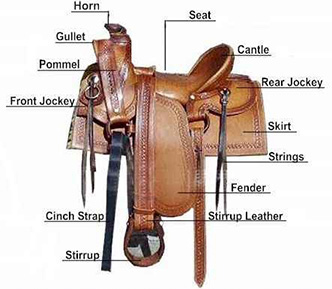 Parts of a saddle
(www.cochiseleather.com
Parts of a saddle
(www.cochiseleather.com
Historically, saddles were a symbol of status, and they could be plain, slightly
decorative, or "embellished with elaborate leather work and embroidery with precious
metals and jewels" (www.cochiseleather.com).
After John's son, Thomas Addison, died
in 1727 a probate inventory of his belongings listed "3 Mens Old Saddles, 1 Womans"
as being worth one pound, which is surprisingly modest considering how wealthy the
Addison's were. The recovered Oxon Hill fragment may very well match up with one of
the saddles mentioned. The distinction between men's saddles and women's saddles at
this time had to do with the women riding side-saddle – on saddles designed to support
both of the women's legs on one side of the horse. It is unknown whether the "rear
jockey" fragment was part of a man or woman’s saddle.
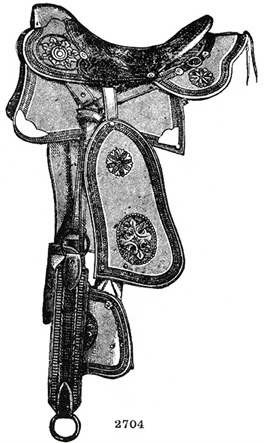 Moseman's example of an embellish saddle.
And there are still more questions to be answered. Where did the design on the
leather originate and does the pattern have any significance? Also, were any of the
unidentifiable wood or iron fragments found in the same level of the well a part of
the saddle-tree that would have formed the saddle's underlying structure? Despite
these unanswered questions, a 250-year old leather saddle fragment has survived the
natural decaying process which is, in itself, incredible!
References
Beatie, Russel H.
1981 Saddles. University of Oklahoma
Press, Norman, Publishing Division of the University. Chapter 15: 119-121. U.S.
Cochise Leather Company
2010 The History of Western Leather Spurs, and
Spur Straps, Cuffs, Chaps, Chinks and Saddles. http://www.cochiseleather.com/leather-history.aspx.
Doub, Nichole
2010 Personal Communication – Maryland
Archaeological Conservation Laboratory.
Garrow, Patrick H.; Wheaton, Jr., Thomas R.
1986 Oxon Hill Manor Archaeological Site
Mitigation Project I-95/MD 210/I-295, Volume 1. Garrow and Associates, Inc., Atlanta,
Georgia.
Rivers-Cofield, Sara
2010 Personal communication – Maryland
Archaeological Conservation Laboratory.