During the summer of 2008, archaeologists working along the Potomac River in Charles
County, Maryland excavated the remains of a brick foundation and cellar hole at the
Bateman Site (18CH354), which dated approximately between 1730-1760. Based on historical
documentation, the Bateman Site was originally part of a larger parcel of land known as
Wollaston Manor, a 2,000-acre tract of land granted to Captain James Neale in 1642 by
Lord Baltimore. Based on a building contract in 1660, Captain Neale and his family
had a manor house constructed on this property the following year. Upon his death in
1684, Neale bequeathed to his eldest son James the portion of the Estate including the
manor house. Family genealogy follows suit until the death of the fourth James Neale
in 1730. By mid-eighteenth century, it is unclear as to who was living on this property.
A 1755 subdivision plat of the Estate of Raphael Neale identified a one-and-a-half story
house in the general vicinity of Site 18CH354. Regardless of ownership, artifacts
recovered from the cellar hole at Site 18CH354 are important to help interpret colonial
ideological change and continuity through the eve of Revolution.
The majority of artifacts recovered from the cellar trash fill included broken pieces
of pottery, animal remains, brick and oyster shell. Mixed among these ordinary every
day objects were objects of personal adornment and use. One object in particular, a
brass alloy flintlock pistol butt cap (Figures 1 and 2) was recovered from levels of
fill (square 6, level 5) thought to be deposited after the original site occupation.
Other diagnostic artifacts found with the butt cap included white salt-glazed stoneware
(1715-1776) and scratch-blue stoneware (1730-1776), as well as a tobacco pipe fragment
dating between 1750-1800 (Hume 1982). Given its provenance, it was originally believed
to have dated between 1750 and 1776.
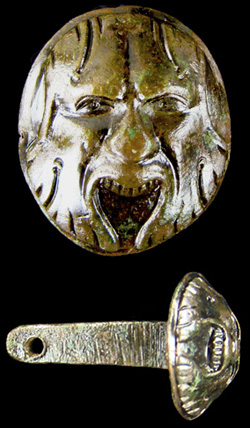 Figures 1 & 2: Image of grotesque mask butt cap design
and profile view.
Figures 1 & 2: Image of grotesque mask butt cap design
and profile view.
The butt cap shank measures 1 ½ inches in length, with the face no more than one inch
in diameter. It is believed that this is just one piece of the larger butt cap that
would have fit on the end of an English or French made flintlock pistol much like the
one in Figure 3. The grotesque face was a typical decorative style made popular on
flintlock muskets during the late Georgian period (1760-1775) (Blackmore 1985).
Elaborately decorated firearms such as the many examples of flintlock muskets
(Gusler & Lavin 1977; Blackmore 1985) were often considered prized possessions of
the gentry (Gusler & Lavin 1977). These pistols were typically used for sporting and
other close shot firing; perhaps their most wide-known usage throughout the eighteenth
and nineteenth centuries was for dueling (Gusler & Levin 1977). By the Revolutionary
War, enlisted soldiers, primarily horse soldiers and sailors carried these pistols,
almost all made in England (Moore 1967). By the close of the Revolutionary War
(1780s), the elaborate decoration on these pistols, including the decorated mask
butt caps were nearly replaced for simple, less artistic designs (Moore 1967).
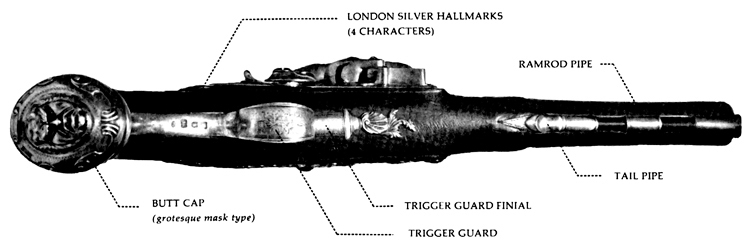 Figure 3: Nomenclature of the Flintlock Pistol, showing butt cap with
grotesque mask type (Moore 1967:2).
Figure 3: Nomenclature of the Flintlock Pistol, showing butt cap with
grotesque mask type (Moore 1967:2).
This artifact, one of the very few of its kind recovered from colonial sites throughout
Maryland, is important not only for what it is, but for what it represents. While no
other gun parts were recovered from Site 18CH354, this grotesque butt cap represents
ideologies and traditions transferred from the old world to the new, and characterized
how these ideas spread up through the Revolution (Gusler & Levin 1977).
References
Blackmore, Howard L.
1985 English Pistols. Arms and Armour
Press, London.
Gusler, Wallace B., and James D. Lavin
1977 Decorated Firearms 1540-1870: From
the Collection of Clay P. Bedford. The Colonial Williasmburg Foundation, Williamsburg,
Virginia.
Moore, Warren
1967 Weapons of the American Revolution and
Accoutrements. Funk & Wagnalls, New York.