A reliquary is something that is designed to hold a sacred relic, such as a piece of the
True Cross or a saint's bone. Anything that has been in contact with Christ or the
saints could qualify as a sacred relic. Some relics are kept in chests or other large
containers, while others are very small and fit into a pendant that can be worn close to
the heart. One such reliquary pendant was discovered by archaeologists in St. Inigoes,
Maryland aboard the Naval Air Station Patuxent River's Webster Field Annex (Figure 1).
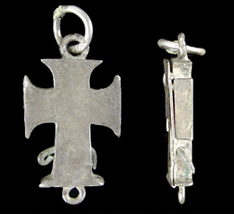 Figure 1: Front and side view of the Webster Field reliquary pendant. The
cross is .078" long, 0.59" wide, and 0.1" thick. Courtesy Naval Air Station
Patuxent River, Webster Field Annex.
Figure 1: Front and side view of the Webster Field reliquary pendant. The
cross is .078" long, 0.59" wide, and 0.1" thick. Courtesy Naval Air Station
Patuxent River, Webster Field Annex.
The Webster Field reliquary was probably lost by a resident of a Jesuit settlement that
had existed at the site from circa 1637-1942. Initially, Jesuits established a plantation
there to raise crops and support Jesuit missions, but after a 1689 uprising overthrew
the Catholic Calvert family's control of Maryland, Protestants marginalized Maryland's
Catholics by passing anti-Catholic Penal Laws, and the plantation at St. Inigoes became
a private base of Jesuit operations. The reliquary was found in a soil layer that had
been disturbed by the plow, but other artifacts found nearby primarily fall into the
circa 1680-1750 date range, indicating that it probably dates to the period after 1689
when St. Inigoes was an important home base for clergy who rode out on horseback to offer
Mass services and hear confessions in small chapels and private homes (Schroth 2007:26;
Sperling and Galke 2001).
The practice of wearing a reliquary pendant has been popular since the 14th century
(Thunø 2002:14). Most of the examples that survive in museums have enameled decoration,
inset jewels, or carved images, as well as built-in hinges so that they can open and
close with ease. The Webster Field cross is more modest. Although it is made primarily
of silver and it has a loop at the bottom for a bauble that might have dressed it up
a bit, there is no decoration, no silversmith's mark, and the lid is held in place by
an unsightly asymmetric pin that prevents archaeologists from opening the pendant
without damaging it. An x-ray taken to see if it had anything inside revealed only
the internal structure of the cross; there is no evidence of the relic it once
held (Figure 2).
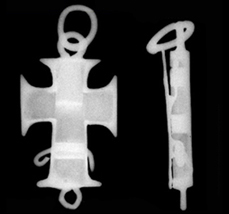 Figure 2: X-ray images of the reliquary pendant. The shadows that can be seen inside
the cross on the x-ray represent a metal insert that holds the top of the lid
in place, and a path for the pin that holds the bottom of the lid shut. No
evidence of a relic is evident in the x-ray. Courtesy Naval Air Station
Patuxent River, Webster Field Annex.
Figure 2: X-ray images of the reliquary pendant. The shadows that can be seen inside
the cross on the x-ray represent a metal insert that holds the top of the lid
in place, and a path for the pin that holds the bottom of the lid shut. No
evidence of a relic is evident in the x-ray. Courtesy Naval Air Station
Patuxent River, Webster Field Annex.
Despite its simplicity, this artifact was probably extremely important to its owner.
Sacred relics were associated with miraculous powers, including healing properties.
Catholics often wore sacred relics as a form of protection, which might be particularly
desirable to colonists facing unknown perils overseas. At least two reliquaries have
been recorded in Maryland's early history. One is a gold reliquary case listed in the
1647 probate inventory of Maryland's first Governor, Leonard Calvert (Archives of
Maryland 1887:321). The other belonged to Father Andrew White, one of the Jesuits who
arrived with the first wave of Maryland colonists (Figure 3). The 1642 annual letter
from Maryland Jesuits to Rome states that Father White used his reliquary to heal
an Indian who was speared in an ambush. White applied "to the wound on each side
the sacred relic of the Most Holy Cross, which he carried in a case around his
neck," and the man miraculously recovered by the next day (Curran 1988:70-71).
A reliquary pendant therefore acted as both a symbol of one's faith and a protection
against harm. Such an object might have become even more desirable when Catholics were
oppressed after 1689. A small pendant could be easily concealed under one's clothing,
offering the comfort and security of belief in its power without fear of persecution.
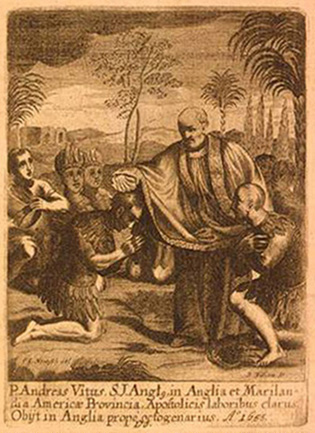 Figure 3: Engraving depicting Father Andrew White ministering to Maryland's Indians.
The engraver, G.G. Heinsch, made the image in 1655 without having been to Maryland, so
the depiction of how the Indians looked and dressed should be treated with skepticism,
especially considering the presence of palm trees in the background. Image from
Tanner (1694:803).
Figure 3: Engraving depicting Father Andrew White ministering to Maryland's Indians.
The engraver, G.G. Heinsch, made the image in 1655 without having been to Maryland, so
the depiction of how the Indians looked and dressed should be treated with skepticism,
especially considering the presence of palm trees in the background. Image from
Tanner (1694:803).
References
Archives of Maryland
1887 Volume IV: Judicial and Testamentary Business of
the Provincial Court 1637-1650. Edited by William Hand Brown. Baltimore: Maryland Historical
Society.
Curran, Robert Emmett, ed.
1988 American Jesuit Spirituality: The Maryland
Tradition, 1634-1900. New York: Paulist Press.
Schroth, Raymond A.
2007 The American Jesuits: A History. New
York: New York University Press.
Sperling, Christopher I., and Laura J. Galke
2001 Phase II Archaeological Investigations of 18ST233
and 18ST329 Aboard Webster Field Annex, Naval Air Station, Patuxent River, St. Mary's
County, Maryland. Report prepared for the Department of Public Works, Naval Air Station,
Patuxent River. Manuscript on file, Maryland Archaeological Conservation Laboratory, Jefferson
Patterson Park and Museum, St. Leonard.
Tanner, Mathias
1694 Societas Jesu apostolorum imitatrix Prague: Typis
Universitatis Carolo-Ferdinandeae. Special Collections Division, Georgetown University
Library. Accessed online November 17, 2010 via the Library of Congress
http://www.loc.gov/exhibits/religion/rel01-2.html.
Thunø, Erik
2002 Image and Relic: Mediating the Sacred in
Early Medieval Rome. Rome, Italy: L’erma Di Bretschneider.