Games have always been an integral part of human culture. Throughout history, games have been used to
teach new skills, provide an escape from the rigors and stress of daily life, as well as to solidify
social and political bonds within a particular group, clan, or tribe.
Native American cultures have a long tradition of gaming. Early European accounts of contact with Native
Americans describe a variety of games. Many required physical skill and dexterity, such as ball games —
e.g. Lacrosse — or snow-snake, a spear throwing game played on the ice or snow (George 2001: 1).
Others were games of chance, such as the “moccasin game”, similar to the ball and cup game still popular
today, or "dice" games played with an assortment of stones or seeds marked with notches or pictures
(Hudson 1976: 426).
One of the most popular, games among Native American tribes was called "chunkey" (or, alternatively, "chunkee"
or "t-chung-kee"), which was played with polished, disc-shaped stones (Figure 1). Chunkey stones have
convex edges and concave sides and were occasionally perforated in the center. Played by men on courts of
smooth, hard packed dirt, chunkey was a two player version of a hoop and stick game (Figure 2). It was
played by rolling the chunkey stones across the ground and throwing or sliding sticks at them in an
attempt to place the spear as close to where the stone stops as possible (Hudson 1976: 423).
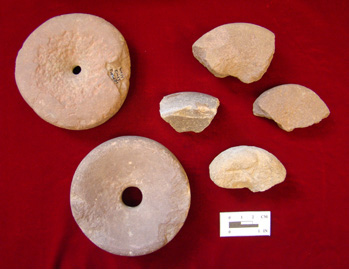 Figure 1. Gaming or "chunkey" stones from sites in Frederick and Montgomery
Counties in Maryland.
Figure 1. Gaming or "chunkey" stones from sites in Frederick and Montgomery
Counties in Maryland.
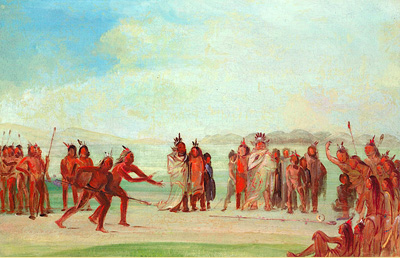 Painting Tchung-kee, a Mandan Game Played with a Ring and Pole by George Catlin,
1832 (Smithsonian American Art Museum).
Painting Tchung-kee, a Mandan Game Played with a Ring and Pole by George Catlin,
1832 (Smithsonian American Art Museum).
For the players, chunkey was a game of skill. However, for the spectators, it was a game of chance, as
they frequently bet on the game, with some wagering everything they owned on the outcome. They were even
known to bet their wives, children or their own freedom. Some losers were even known to
commit suicide (Figure 3).
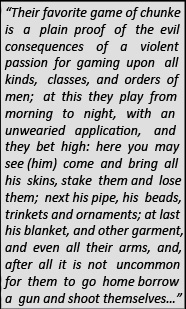 Quote from 18th century Dutch navigator, surveyor, and naturalist Captain Bernard Romans. Published
in Games of the North American Indians by Stewart Culin, 1907.
Quote from 18th century Dutch navigator, surveyor, and naturalist Captain Bernard Romans. Published
in Games of the North American Indians by Stewart Culin, 1907.
Chunkey is believed to have originated around 600 A.D. in the ancient Native American city of Cahokia, in the
area of now modern day St. Louis, Missouri (Pauketat 2009: 54). In Cahokia, chunkey was played in large
arenas and brought together people from the surrounding region. Even after the city of Cahokia fell
in c. 1500 A.D., variations were played throughout North America. Some Native American tribes continued
playing the chunkey game long after European contact, as witnessed by the artist George
Catlin in 1832 (Figure 2).
In Maryland's archaeological collections, these stones (Figure 1), only seem to be found at sites in Frederick
and Montgomery Counties. They are also rarely recovered from sites in Virginia (George 2001: 4). It is
unclear whether the Middle Atlantic sites where chunkey stones have been recovered simply represent the
outer limits of the game’s range, or if these stones may have had a use other than for gaming. Further
research is necessary to understand why their distribution in the Middle Atlantic is not more widespread.
References
Culin, Stewart
1907 Games of the North American Indians.
Twenty-fourth Annual Report of the Bureau of American Ethnology. Washington DC,
Smithsonian Institution.
DeBoer, Warren R.
1993 Like a Rolling Stone: The Chunkey Game and
Political Organization in Eastern North America. Southeastern Archaeology 12 (2):
83-92.
George, Richard L.
2001 "Of Discoidals and Monongahela: A League of Their Own?"
in Archaeology of Eastern North America 29: 1-18.
Hudson, Charles
1976 The Southeastern Indians. University of Tennessee
Press.
Pauketat, Timothy R.
2009 Cahokia: Ancient America’s Great City of the
Mississippi. New York: Viking.
Smithsonian American Art Museum
Electronic Document. http://americanart.si.edu/collections/search/artwork/?id=4407, accessed December 7, 2010.