In the late 17th and early 18th centuries, the Zekiah Swamp was a sparsely settled frontier region on
Maryland's western shore in what is today Charles County. In the mid-1990s, a late 17th-century
plantation known as Westwood Manor (18CH621) was discovered during modern house construction.
Archaeological and documentary evidence suggests the house at Westwood was an elite residence with
a porch tower, brick chimneys, plastered walls, and glazed windows (Chaney n.d.) and was owned by
planter John Bayne and his wife Anne between 1688 and 1702 (King 2010:7-8). At the time of his
death in 1701, Bayne owned nearly 2,500 acres of land and his real and personal estate placed him
economically within the top tier of the population in southern Maryland (Carr, Menard and Walsh 1991).
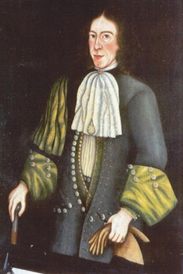 Late 17th-century portrait of an unknown American gentleman showing clothing popular in this period. Artist unknown.
Illustration accessed at http://en.allexperts.com/q/U-S-History-672/2010/5/17th-century-art-Massachusetts.htm
Late 17th-century portrait of an unknown American gentleman showing clothing popular in this period. Artist unknown.
Illustration accessed at http://en.allexperts.com/q/U-S-History-672/2010/5/17th-century-art-Massachusetts.htm
Included among the Bayne household artifacts found at Westwood Manor was a decorated ivory walking stick
handle. The bell-shaped knob was inlaid with hollow silver pins in an elaborate design of overlapping
C-scrolls and flowers. This decorative technique, known as "piquework" was extremely fashionable between
the mid-17th century and the early decades of the 18th century (De Vecchio 1994:23). Surviving dated
canes date between 1667 and 1717 (Klever 1996:82; Snyder 1993:4), although most seem to cluster in the
1670s to 1690s period. These canes are generally around three feet in length, with shafts of exotic
foreign woods, like Malaysian rattan, often joined to the knob with a silver collar. The Westwood
Manor cane contained an eyelet hole, through which was passed a cord for hanging the cane from the
wrist (Snyder 1993:11). Piquework walking sticks were made in France and England; the use of silver
rather than gold pins indicates that the Westwood cane was of English manufacture (Kadri 2011). Lists
of store goods stocked by Maryland merchants during this period do not list walking sticks; John
Bayne would have acquired this object either during a trip to England or through a special order
with an agent.
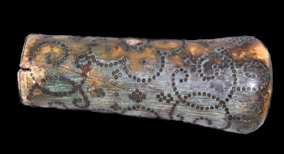 The Westwood Manor walking stick handle. The eyelet hole forms the center of the flower
on the left center portion of the handle in this photograph.
The Westwood Manor walking stick handle. The eyelet hole forms the center of the flower
on the left center portion of the handle in this photograph.
Before the turn of the fifteenth century, walking sticks served either a purely functional purpose as
an aid to walking or as a symbol of authority (De Vecchio 1994:13-15). Their transformation into
elegant fashion accessories and statements of power and status began in Europe and continued over the
next several hundred years (Snyder 2004:49). The same connotations of status and power held true for
the American colonies as well. While Bayne certainly could have used his stick as a purely functional
walking aid, the elaborately decorated stick would have also been an impressive fashion accessory and very
much at home as a prop in the social setting of a parlor or a tavern, or wielded as its owner made an
appearance in front of the Maryland Assembly. The polished white of the ivory knob set with flashing
silver pins would have provided a striking contrast to the deep orange patina of the rattan shaft.
This walking stick, used in combination with stylish clothing in expensive fabrics, wigs and jewelry,
would have confirmed John Bayne as a gentleman to anyone who saw him.
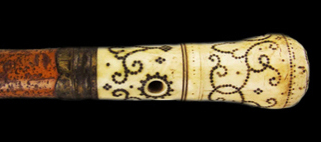 This surviving piquework cane bears a floral and C-scroll motif very similar to that of the Westwood
Manor cane.
This surviving piquework cane bears a floral and C-scroll motif very similar to that of the Westwood
Manor cane.
Despite the semi-isolated nature of the Zekiah Swamp at the end of the 17th century, its wealthy inhabitants
were living elite lifestyles in which their social and economic standing was readily visible through
their homes and furnishings, as well as their clothing and accessories. Fashion trends gleaned from
England and Europe were put to work along the borders of Maryland's colony in the late 17th century
and used by the social elite to signal their authority and status.
Acknowledgements
The author would like to thank Sandra and Phillip Harrison for graciously allowing me to make the
Westood Manor walking stick the subject of a Curator's Choice essay.
References
Carr, Lois Green, Russell R. Menard, and Lorena S. Walsh
1991 Robert Cole's World; Agriculture
and Society in Early Maryland. University of North Carolina Press, Chapel Hill.
Chaney, Edward
1996 Harrison's Westwood Manor—Summary Report.
Unpublished report on file at the Maryland Archaeological Conservation Laboratory.
De Vecchi, Paolo
1994 Walking Sticks. BE-MA, Milan, Italy.
Kadri, Youssef
2011 Cane Quest. http://www.canequest.com/pique.asp.
King, Julia, editor
2010 The Westwood Manor Archaeological Collection:
Preliminary Interpretations. Report prepared by the Archaeology Practicum Class, St. Mary's College
of Maryland.
Klever, Ulrich
1996 Walkingsticks: Accessory, Tool, and Symbol.
Schiffer Publications, Atglen, PA.
Snyder, Jeffrey B.
1993 Canes from the Seventeenth to the Twentieth
Century. Schiffer Publications, Atglen, PA.
2004 Canes and Walking Sticks; A Stroll Through Time
and Place. Schiffer Publications, Atglen, PA.