Nancy S. Shippen, MAC Lab Conservator
Currently being conserved by the Maryland Archaeological Conservation Lab for the National Park
Service (NPS) at the South Florida Collection Management Center Everglades National Park is a
16th century harquebus barrel (Fig. 1). While it is an interesting artifact, little is known
about its history. Donated to or purchased by the old NPS Museum Lab, the gun barrel was later
acquired by the Everglades National Park in May 1968. The only record for the object is the
catalogue record at the time of its acquisition: 16TH CENTURY, METAL GUN BARREL, LETTERS IB ON
ONE EDGE, SIDE POWDER PAN.
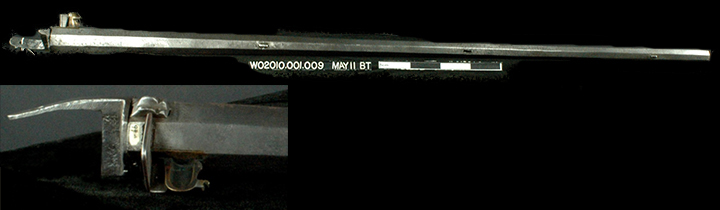
Fig. 1 – Harquebus Barrel, South Florida Collection Management Center Everglades
National Park, before treatment.
The harquebus, a precursor to the rifle, was the first gun to be fired from the shoulder. Invented
in Spain in the mid-15th century, this gun was a smoothbore matchlock and was loaded from the
muzzle end (Encyclopedia Britannica, 2010). Its name derives from the Old German hakenbuschse or
the Dutch hakebusse meaning "hooked gun," because a hook or spur was cast beneath the barrel to
hook over a parapet to absorb recoil thrust (Hogg, 1980: 9). The matchlock firearms were ignited
by a "slow match," a hemp cord wick impregnated with saltpeter solution that would smolder slowly
and ignite gunpowder when the burning end was applied. This mechanical ignition device was developed
due to the impossibility of aiming the gun while applying the match by hand. The matchlock had an
arm that secured the match and moved it against the pan holding the powder when the long trigger was
pulled. At the time the slow match was in use, gunsmiths were working on self-igniting devices that
resulted in the invention of the wheellock mechanism. The first wheellock was invented in Germany
in the early 16th century, but was used sparingly for the harquebus due to its cost, its complicated
construction and the difficulty of repair when broken (Nickel, 1969: 84-85). By the middle of the
17th century the harquebus was largely replaced in Europe by a lighter musket as a military weapon
due to its hitting power, and the matchlock ignition device was later replaced by the snaphaunce,
the first flintlock mechanism (Tunis, 1954:92). However, the harquebus, introduced in Japan by Portuguese
traders in the 16th century, remained in wide use and the snapping matchlock was their normal
ignition system until the 19th century (Hogg, 1980:13).
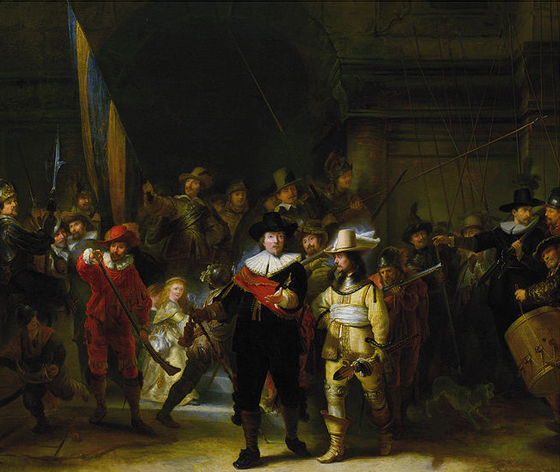 Fig. 2 - Images of harquebusiers can be found in The Night Watch, the famous
painting by Rembrandt.
Fig. 2 - Images of harquebusiers can be found in The Night Watch, the famous
painting by Rembrandt.
Not known for its accuracy, the advantage of the harquebus was the mass production of ammunition and
the ease of proficiency by anyone in a short period of time, requiring little training and skill.
As a harquebus could weigh up to 20 lbs or more, it was often fired from a support, a long rest
forked on the upper end (Fig. 3). As with all matchlocks, the harquebus was vulnerable to heavy
fog and rain, the harquebusier needing to keep his slow match lit. Other disadvantages were the
heaviness of the weapon and the general helplessness of the harquebusier after his shot was fired.
Strategies and tactics were employed to compensate for these weaknesses, including the use of an
assistant to carry the gear and keep the fire lit. Reloading tactics placed the harquebusiers in
lines of three so that when the front line fired it would then move to the back and reload. To
compensate for the weapon's inaccuracy, harquebusiers were lined several men abreast to shoot at
the same time (http://firearmshistory.blogspot.com/2010/04/matchlock-technology-arquebus.html, 2010).
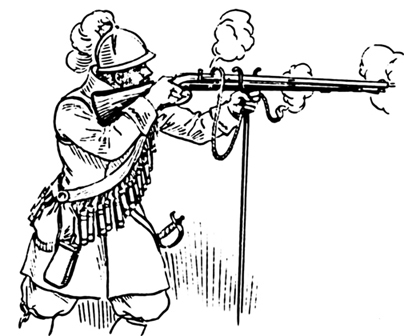 Fig. 3 – Harquebus.
While there is information in general on the history and use of the harquebus, there is little
information to be gained from the object in treatment at the MAC Lab. Because the proper records
and identification were not included when the harquebus was acquired by the NPS, relevant information
is lost. As a result, while this object is a fine example of the harquebus, all specific information
about previous owners and how the object came to Florida and the NPS Museum Lab remain unknown.
References
harquebus
2011 In Encyclopædia Britannica. Retrieved from
http://www.britannica.com/EBchecked/topic/255834/harquebus,
http://firearmshistory.blogspot.com/2010/04/matchlock-technology-arquebus.html.
Hogg, Ian V.
1980 An Illustrated History of Firearms. London:
Quarto Publishing Limited.
Nickel, Helmut
1969 Warriors and Worthies, Arms and Armor Through
the Ages. New York, NY: Atheneum.
Peterson, Harold L.
1962 The Treasury of the Gun. New York, NY:
Golden Press.
Tunis, Edwin
1954 Weapons, A Pictorial History. New York,
NY: The World Publishing Company.