Caitlin E.R. Shaffer, MAC Lab Conservator
Pottery has been made for many thousands of years by cultures all over the world, each group developing
their own styles, technologies, and traditions. In Maryland, the first ceramics were developed by
Native Americans around 1000 B.C., and were unglazed, low-fired earthenware vessels used for storing
and preparing food. The earliest pots had flat bottoms with short, hand-molded edges, which later
developed into larger conoidal-shaped containers (Egloff and Woodward 1992:23). Ceramic pots proved
to have great advantages over the previously used animal skin or stone vessels; the raw materials
were readily available, and the pots kept food dry, were efficient for cooking, and were easily
replaced when broken (Gardner 1986:66, Egloff and Woodward 1992:23).
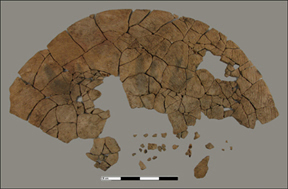 Image of pottery pieces from site 51SW7 in the beginnings of mending before
reconstruction.
Image of pottery pieces from site 51SW7 in the beginnings of mending before
reconstruction.
An excellent example of prehistoric Maryland pottery was discovered in 2009 during investigations of
archaeological site 51SW7, which is situated near the confluence of the Anacostia and Potomac Rivers.
This Early Woodland site is thought to have been a camp, possibly related to seasonal fishing, where
cooking was a central activity (Katz 2011). Over 150 sherds of pottery from a single vessel were
recovered and identified as Accokeek type pottery, dating from 1000-600 B.C.
Accokeek pottery was made throughout Maryland and into Virginia. The iron-rich clay was mixed with
sand or quartz temper to prevent shrinking and breaking during firing, and produced red, orange,
tan or buff colored ware with black, brown or gray oxidized areas. Accokeek vessels were formed with
hand-modeled bases and coil-constructed sides. The pots were shaped, smoothed and strengthened by
striking the exterior walls with a paddle wrapped in cording made from plant fibers, which resulted
in distinctive striated surface markings. It has been suggested that the cord was used during
production to prevent the paddle from sticking to the wet clay, and that the rough texture of the
finished pot was beneficial because it provided a good grip, and it increased the surface area
of the pot's exterior, resulting in quicker cooking times (Lynn 2003). The interiors were smoothed.
Pots were made conoidal, semi-conoidal or globular because these shapes were strong, conducted heat
well and could easily be propped up in a cooking fire (Egloff and Woodward 1992:23).
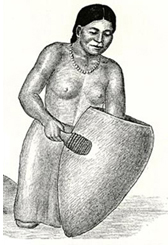 Image of Indians cooking over fire using pots.
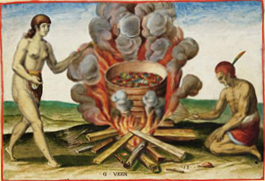 Illustration of a indian woman making pottery.
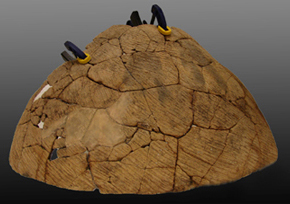 Image of Accokeek pot after reconstruction was done at the MAC Lab.
The vessel excavated from 51SW7 is an exciting find. Although Accokeek sherds are often recovered at
archaeological sites in the region, finding such a complete vessel is rare. It is typical of its
type with buff, orange and gray coloring, and a cord-marked surface. It is semi-conoidal in shape,
and it measures approximately sixteen inches in diameter by eight inches deep. Although the pot is
missing its base and roughly 40% of one side, it was possible to reconstruct the sherds using an
acrylic adhesive, support fills, clamps, and counterweights. The reconstruction has allowed for a
better understanding of how the vessel would have originally looked, and gives us an appreciation
for the craftsmanship of its maker. After nearly 3,000 years underground, this vessel has been
reincarnated from everyday cooking vessel to show-stopping artifact!
For more information on prehistoric pottery, please visit the Maryland Archaeological Conservation
Laboratory's Diagnostic Artifacts Website at http://www.jefpat.org/diagnostic/PrehistoricCeramics/index-prehistoric.html
Photographs courtesy of Joint Base-Anacostia Bolling (JBAB), Naval District Washington.
Illustration of
cord-wrapped paddling courtesy of the Frank H. McClung Museum.
References
Egloff, Keith, and Deborah Woodward
1992 First People: The Early Indians of Virginia.
University Press of Virginia, Charlottesville, VA.
Gardner, Wililam M.
1986 Lost Arrowheads & Broken Pottery: Traces of
Indians in the Shenandoah Valley. Thunderbird Publications, Manassas, VA.
Katz, Gregory
2011 Bellevue's Telltale Heart (51SW7): Accokeek
Under the Floorboards. Paper presented at Middle Atlantic Archaeological Conference, Ocean
City, MD.
Lynn, Alvin
2003 Making Cordmarked Pottery. Online document,
http://www.texasbeyondhistory.net/theme/cordmarked/, accessed June 23, 2011.