Alex GLass, MAC Lab Public Archaeology Asst.
In the kitchen area plowzone at the Smith's St. Leonard archaeological site, located at Jefferson Patterson Park
and Museum, Calvert County, MD, archaeologists discovered a very small copper alloy square with an incised mark
on the surface. After some research the archaeologists were able to determine that the object was a
small apothecary's weight. The weight measures only .293" tall x .285" wide and .065" thick, and weighs .6
grams. The weight of the object, combined with the incised mark on its surface, suggests that it would have
been called a half scruple; the lightest weight of a set of 6. The actual weight of a half scruple
is .648 grams, but because the archaeologists did not have access to a scale that measures in increments of
less than .1 grams, we have to assume that it is close to that weight.
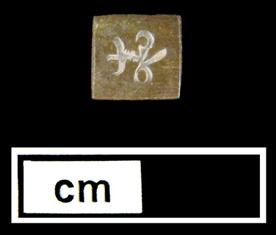 Apothecary's weight found at the Smith's St. Leonard site, possibly a half scruple, the
lightest weight of a set of 6.
Apothecary's weight found at the Smith's St. Leonard site, possibly a half scruple, the
lightest weight of a set of 6.
An apothecary was similar to a pharmacist during the colonial period. If a person was sick they could purchase
ingredients to help ease their symptoms from an apothecary in the colonies or they could have them imported
from Europe. Many patrons would have different ingredients shipped to the colonies unmixed and then blend
the components themselves (Steele 1977; 288). This practice, and the fact that many ingredients for medicines
during this period involved different herbs, spices and plants sometimes also used for cooking, could explain
why the weight was found in the kitchen area (Wilson and Savacool 2001: 47-59). Its size could also suggest
that because it was so small, it could have been easily lost.
Another apothecary weight was found at the Bennett's Point site in Queen Anne's County, MD. Bennett's Point
dates from between 1700 and 1749, making it roughly contemporary with Smith's St. Leonard (A
Comparative Archaeological Study of Colonial Chesapeake Culture 2009). This weight found during the
1960's and 70's was larger than the one found at Smith's St. Leonard. It was catalogued as possibly
weighing 3.7 grams, and it measures 0.540" tall x 0.491" wide x 0.125" thick. The Bennett's Point weight
also has an incised mark on its surface along with a stamped flower design. Archaeologists were unable to
identify what the symbol signified, but we can speculate that because it weighs 3.7 grams that it was meant
to be a drachm or dram. This size weight would have been the 4th heaviest in the apothecary's set.
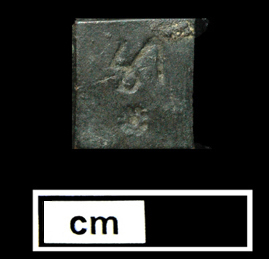 Apothecary weight found at the Bennett's Point site in Queen Anne's County, MD, dates
between 1700 & 1749.
Apothecary weight found at the Bennett's Point site in Queen Anne's County, MD, dates
between 1700 & 1749.
Small artifacts such as these often lead to many bigger questions. Once archaeologists figure out what the object
is they start to wonder about more personal aspects of the artifacts such as: What types of ingredients were
these weights being used to measure? Who was using them? Were they lost or left behind? Through understanding
the artifact's background, we can try and understand the people who it belonged to.
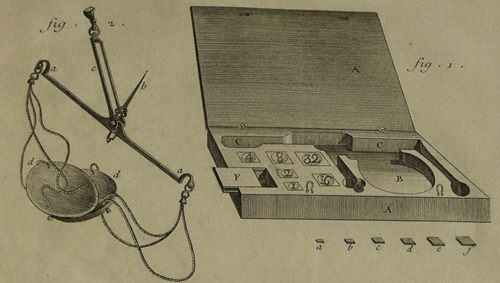 Apothecary scales and weighs were used to measure out small, exact amounts of different
ingredients. The actual scale would have looked similar to the one illustrated and would have come
with a set of 6 weights. The image is a plate from Diderot, from the Robert Charles Lawrence Fergusson
Collection, the Society of the Cincinnati, Washington DC.
Apothecary scales and weighs were used to measure out small, exact amounts of different
ingredients. The actual scale would have looked similar to the one illustrated and would have come
with a set of 6 weights. The image is a plate from Diderot, from the Robert Charles Lawrence Fergusson
Collection, the Society of the Cincinnati, Washington DC.
References
Bennett’s Point Site Summary
2009 A Comparative Archaeological Study of Colonial Chesapeake Culture:
Bennett’s Point Site Summary. Maryland Archaeological Conservation Laboratory. Website,
http://www.chesapeakearchaeology.org/SiteSummaries/BennettsPointSummary.aspx, accessed July 27, 2011.
Diderot, Denis, and Jean Le Rond d'Alembert
1751-65 Encyclopédie, ou Dictionnaire raisonné des sciences:
des arts et des métiers. Paris: Chez Braisson, David, Le Breton, Durand.
Steele, I.K.
1977 A London Trader and the Atlantic Empire: Joseph Cruttenden,
Apothecary, 1710 to 1717. William and Mary Quarterly, Vol 34 (2):281-297.
Wilson, Renate, and Savacool, Woodrow J.
2001 The Theory and Practice of Pharmacy in Pennsylvania:
Observations on Two Colonial Country Doctors. Pennsylvania History, Vol. 68 (1):31-65.