All consumers want assurances as to the quality of products and may prefer one manufacturer over
another. This is as true historically as it is today. Cloth seals or bale seals are one method
of assurance. These lead seals were attached to the outside corner on a bolt of cloth and were
often impressed with a variety of marks including dates, symbols and hand scratchings. Historically,
these seals indicated that the product being traded had undergone some form of inspection both for
quality control and taxation purposes (Egan; 1994, 1-3). Cloth seals came into use in the
early 1300s in England after King Edward I ordered the official supervision of manufactured woolen
cloth (Endrei and Egan 1982,64). This practice, called alnage, was abandoned by the British
government in 1724 (Luckenbach and Cox; 2003, 17). Knowing this, cloth seals can be useful to
archaeologists both as a dating tool and for identifying trade sources.
The most common type of commercial cloth seal is the riveted form, whereby the seal was attached by
folding two lead disks, connected by a thin strip, around either side of a corner of cloth so that
the rivet could be pushed through the cloth and the corresponding hole in the other disk (Figure 1).
The seal was then hammered with one die, or between two dies, to close it in place and to register
the necessary information on its surface (Egan; 1994, 4). The symbols on the seals can include
information about the date and region of production/inspection as well as a wide range of makers'
marks, personal initials and notes for length, width and weight. Symbols indicating alnage include
the crown, coats of arms, griffins or lions rampart, heads of royalty, etc. (Luckenbach and Cox; 2003, 18).
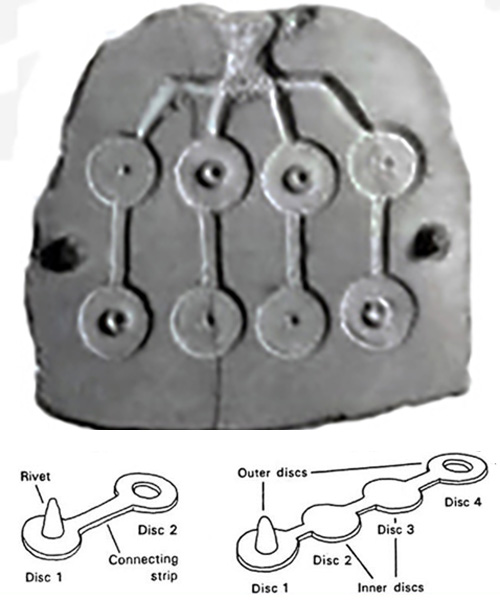 Above: Figure 2. Half of a mold for making single-faced lead cloth seals.
Below: Figure 1. Diagrams of a single and double-faced riveted cloth seal.
Above: Figure 2. Half of a mold for making single-faced lead cloth seals.
Below: Figure 1. Diagrams of a single and double-faced riveted cloth seal.
A number of lead cloth seals were recovered from the Angelica Knoll site (c. 1677-1735) excavation in
Calvert County, MD. Of the Angelica Knoll cloth seals, two show clear striking/impression marks.
The seal in Figure 3 has a clear impression of an "I" and "S." It is unusual that the impression has
been made on the second disk rather than the blank first disk. The alnage seal in Figure 4 shows the
head of a monarch on the inner disk, which often bears governmental symbols, while the outer disk
is impressed with local information, in this case a scratched "N."
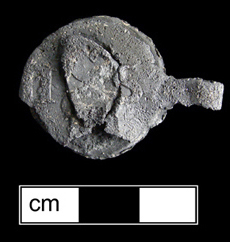 Figure 3. Lead cloth seal recovered from the Angelica Knoll site shows a clear impression
of an "I" and "S".
Figure 3. Lead cloth seal recovered from the Angelica Knoll site shows a clear impression
of an "I" and "S".
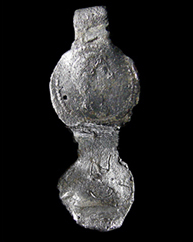 Figure 4. Lead cloth seal recovered from the Angelica Knoll site shows the head of a monarch
on the inner disk.
Figure 4. Lead cloth seal recovered from the Angelica Knoll site shows the head of a monarch
on the inner disk.
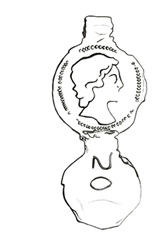 Figure 5. Illustration of the cloth seal shown on left from the Angelica Knoll site.
Objects like these lead cloth seals can provide valuable information to archaeologists. However, lead
does not always survive well in the archaeological record. When lead deteriorates, unlike iron or
copper, its original surface is not retained in the corrosion products. This means that no amount of
cleaning can reveal the lost information. There is a chemical method which is sometimes successful in
retrieving surface detail, but it is rarely used by conservators. This is because it permanently alters
the chemical composition of a lead object and prevents future chemical analysis. In the case of these
seals, it was determined that chemical intervention was appropriate as the information obtained from
the surface decoration was more valuable than the material composition of the lead from which the objects
are made. Fortunately, it was possible to recover the images visible on these two lead seals and with
further research add to the archaeologists’ knowledge of the Angelica Knoll site.
References
Adams, Diane L.
1989 Lead Seals for Fort Michilimackinac, 1715-1781. Archaeological
Completion Report Series #14., Mackinac State Historic Parks, Mackinac Island, MI.
Egan, Geoff
1994 Lead Cloth Seals and Related Items in the British Museum.
[with Mike Cowell and HeroGranger Taylor]. British Museum Occasional Paper #93., British Museum
Press, London.
Endrei, W., and Egan, G.
1982 The sealing of cloth in Europe, with special reference
to the English evidence. Textile History 13.
Luckenbach, Al, and Cox, C. Jane
2003 17th century lead cloth seals from Anne Arundel
County, Maryland. Maryland Archaeology, Vol. 39.