One of the most popular ways for wealthy people of the 17th and 18th centuries to flaunt their
status and fashion sense was to dress themselves in clothes and accessories that were made of
fine cloth and embellished with metal trims. This finery was not just shiny thread that looked
metallic by a trick of the eye, it was actual metal wire wound around silk to make thread, or
tiny ribbons of metal that were sewed onto fabric in elaborate patterns.
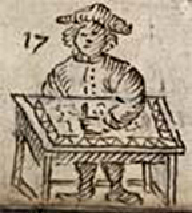 Illustration of a professional embroider at work from Randall Holme's
Academy of Armory 1688.
Illustration of a professional embroider at work from Randall Holme's
Academy of Armory 1688.
Pre-made metallic trims, such as fringe, ribbon, and lace, could be purchased for sewing on
to clothes at home, but metal embellishments also included embroidery done by needle workers in
Europe. These embroiderers were professionals who used skill and specialized tools to sew metallic
threads to fabric panels without touching them so that they wouldn't tarnish. Once the embroidery
was complete, the garment could be cut and sewn, but care had to be taken with this, too. Metallic
bands had sharp edges and wore through threads and fabric more easily than wool or silk embroidery.
The effort that these artisans put into the look was worth it though. The embroidery dazzled the
eye as threads twinkled in candlelight and impressed onlookers.
Evidence for the presence of this look in colonial Maryland has been recovered by archaeologists at
the Charles' Gift site, which is located on what is now the Naval Air Station Patuxent River in St.
Mary's County. The Charles' Gift site was the home of Nicholas Sewall, his wife Susanna, their
eleven children, and their descendants. The Sewalls founded a plantation at the site when Nicholas came
of age around 1676. In 1999, archaeologists from R. Christopher Goodwin and Associates recovered some
very fragile metal threads from a feature there that dated to the early occupation of the site,
circa 1675-1700. Although they are quite fragmentary, the threads include both wire and ribbon
forms. Some twisted fragments look like they might have acted as a fringe, and in one case, there is
a knot such as might be seen on a tassel.
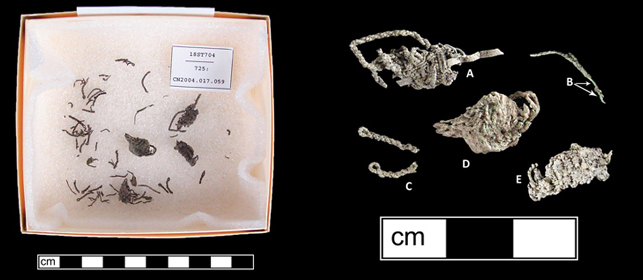 Metal threads from Charles' Gift (18ST704). Left: The fragile metal threads after they were removed
from the soil that surrounded them. Right: Close-up of exemplary pieces of the thread. A) Woven
metal threads with a metal ribbon running through them. B) This fragment still has the original silk
thread that the metal was wrapped around thanks to the copper corrosion around it. C) These twisted
threads may be from a fringe. D) A knot like one might see on a tassel. E) Another fragment of
woven threads with a metal ribbon running through it. Photos by Cait Shaffer, courtesy Naval
Air Station Patuxent River, Naval District Washington.
Metal threads from Charles' Gift (18ST704). Left: The fragile metal threads after they were removed
from the soil that surrounded them. Right: Close-up of exemplary pieces of the thread. A) Woven
metal threads with a metal ribbon running through them. B) This fragment still has the original silk
thread that the metal was wrapped around thanks to the copper corrosion around it. C) These twisted
threads may be from a fringe. D) A knot like one might see on a tassel. E) Another fragment of
woven threads with a metal ribbon running through it. Photos by Cait Shaffer, courtesy Naval
Air Station Patuxent River, Naval District Washington.
It is rare for Maryland's archaeologists to get an opportunity to study textiles because organic
materials like leather, wool, silk, and linen are subject to rot unless they are deposited in
special conditions, like a water-logged well that promotes preservation. In the case of metallic
embroidery, however, there is a slightly more durable material involved. The green corrosion on
the metal threads found at Charles' Gift indicates that they contain copper, though they may
originally have been covered with a thin layer of silver or gold. Copper alloys usually survive
well on colonial sites in Maryland, and they have a special skill; their corrosion kills. Copper
ions are toxic to the little bugs and microbes that live in soil, feeding on tasty organics like
silk. As copper corrodes, it releases poisonous ions that keep the organisms that damage organics
away. In this case, the threads encased in copper ribbons are preserved so that archaeologists can
study how the threads might have originally looked.
This find is remarkable because there are many factors that prevent metal threads from surviving in
the archaeological record. First, metal trim and embroidery was expensive, so only a fraction of
Maryland's population could afford it. Even small amounts of silver or gold in the thread can add
up on a garment, and the metal itself had value. Many gentlewomen earned "pin money" in the 18th
century by picking precious metal trims off of old garments for recycling. Second, when garments
with metallic embroidery were not picked apart and recycled, then it might have been because they
represented special garments worthy of being passed down. There are many examples of 17th and
18th-century clothing in museums that exhibit metallic embroidery because such special garments
were more likely to be saved, and therefore less likely to end up in the trash pit where
archaeologists might find them.
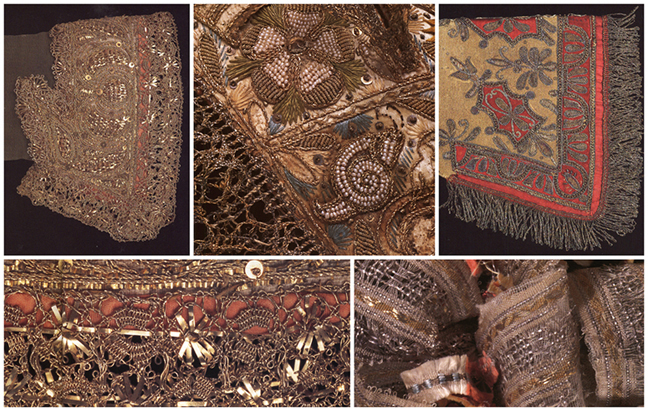 Metallic threads are featured on all of the 17th-century gloves shown here. Above left: Glove
cuff ca. 1660s. Bottom Left: Detail from the latter. Above Center: Detail of a ca. 1603-1625
glove with metallic lace trim and metal embroidery with seed pearls. Top Right: Ca. 1610-1625
glove cuff with metal fringe. Bottom Right: Detail of metal thread ribbons adorning a ca.
1660-1680 glove. All images from the Victoria & Albert Museum collections as published in
Hart and North 1998.
Metallic threads are featured on all of the 17th-century gloves shown here. Above left: Glove
cuff ca. 1660s. Bottom Left: Detail from the latter. Above Center: Detail of a ca. 1603-1625
glove with metallic lace trim and metal embroidery with seed pearls. Top Right: Ca. 1610-1625
glove cuff with metal fringe. Bottom Right: Detail of metal thread ribbons adorning a ca.
1660-1680 glove. All images from the Victoria & Albert Museum collections as published in
Hart and North 1998.
So what does the discovery of metal threads at Charles' Gift say about the status of the Sewall
family or their guests? Thankfully, historical records exist to help us put the Sewall family
and their showy threads in context. Nicholas Sewall was the stepson of Charles Calvert, the
governor of Maryland from 1661-1676. Charles Calvert became the 3rd Lord Baltimore after his
father died in 1675. In 1684, Charles Calvert returned to England, leaving trusted Calvert
loyalists, such as his stepson Nicholas Sewall, in charge of the colony. It is therefore not
surprising to find such threads at the site. The Sewalls were colonial elites, and they most
likely hosted other elites like Charles Calvert, creating many opportunities for individuals
in fine duds to drop a tassel or two.
The family's fortunes turned, however, when the Calvert proprietary government was overthrown
in 1689, forcing Nicholas Sewall to flee to Virginia. This left his plantation unmanaged and
vulnerable to invasion by his enemies. By the time it was safe for him to return years later,
the plantation had fallen into ruin and he had to rebuild.
The feature that archaeologists were excavating when they found the metallic threads was a
large pit created to get brick clay for the foundation of the Sewall's new 1690s home. This pit
was gradually filled with construction debris and household refuse as the new house went up,
and when the old house was torn down, that rubble went into the pit, too. Perhaps by then,
Sewall's finest clothes were worn out, damaged by people who had raided the plantation, chewed
by mice, or just really out of style. The family was so far removed from the European embroidery
industry, that the effort of saving metal threads to sell back to manufacturers may not have
been worthwhile. As a result, these metal threads ended up in the refuse pit.
When excavators hit the fragile threads, they carved out the soil that held them and put this
soil in a vial. MAC Lab conservator Cait Shaffer later picked the threads out of the dirt and
carefully cleaned them, making it possible for a curator like me to look at them under a
microscope and get a much better picture of the great finery that the people who walked around
Maryland over 300 years ago might have displayed.
References
Alcock, N.W., and Nancy Cox
2000 Living and Working in Seventeenth Century England:
Descriptions and drawings from Randle Holme's Academy of Armory. CD-Rom. London: The
British Library Board.
Hart, Avril, and Susan North
1998 Historical Fashion in Detail: The 17th and 18th
Centuries. London: V&A Publications.
Hornum, Michael, Andrew Madsen, Christian Davenport, John Clarke,
Kathleen Child, and Martha Williams
2001 Phase III Archaeological Data Recovery at Site
18ST704, Naval Air Station Patuxent River, St. Mary’s County, Maryland. Report Prepared for
Tams Consultants, Inc., Arlington, Virginia.
Marsh, Gail
2006 18th Century Embroidery Techniques.
East Sussex, UK: Guild of Master Craftsman Publications Ltd.
Rivers-Cofield, Sara
2007 17th- and Early 18th-Century Architecture along
the Patuxent River, Maryland. http://www.jefpat.org/IntroWeb/Introduction.htm.