During the Civil War, a state-of-the-art Federal military hospital was built at Point Lookout
in St. Mary’s County. In 1995, the Naval Air Station Patuxent River hired Jefferson
Patterson Park and Museum to conduct an archaeological investigation on the US Navy
installation located there, so we kept our eyes peeled for artifacts associated with the
hospital. A modern paved road runs through the site, and asphalt from the road
was uncovered in large quantities. But strangely, the quantities did not diminish as
you went farther from the road. Upon closer examination, it was clear that we actually
had two types of black, asphalt-like material. One was thick and chunky, with gravel
throughout. It was mostly found close to the road, and was identical to pieces of
asphalt we removed from the road bed for comparison. The other was thinner, and
lacked the gravel inclusions. It was smooth on one side, while the other side had
a coating of sand and pebbles. What was this unusual material?
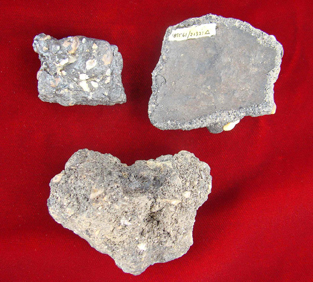 Three pieces of roofing material found at Pt. Lookout.
We learned that the hospital had been built with "composition roofing," a technique that was
popular in the mid-19th century as a way to waterproof flat-roofed buildings. Composition
roofing consisted of cloth felt that was saturated with coal tar or something similar,
and then nailed to roofing boards. The roof was then covered with more layers of tar,
and finished off with a coat of sand or gravel. The "asphalt" we were finding at Point
Lookout was actually composition roofing — you could even see the felt impressions
on the underside of the fragments!
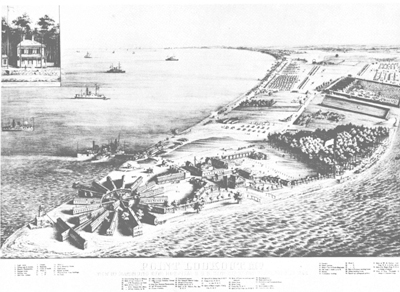 Bird's-eye view of Point Lookout, c. 1863. The hospital is in foreground.
When we plotted out the locations on the site where we found the composition roofing, we
noticed that there were numerous small clusters. Using historical maps, we compared these
clusters to the assumed location of the hospital. It was clear that the roofing material
was concentrated at the end of each of the hospital wards, which were arrayed like
spokes on a wheel (half of the hospital site has been lost to erosion along the Chesapeake
shoreline). At the war's end, the hospital was torn down and sold for scrap. The
building constituents were carted off, except for the composition roofing, which
could not be recycled. Evidently, this material was scraped off the ends of the
buildings before they were disassembled. Because the hospital site had been so
thoroughly scavenged after the war, only the composition roofing allowed us to confirm
the accuracy of the historical maps in regards to the facility's exact location.
Careful analysis of this seemingly mundane material had given us important information
about the past. As JPPM's former director, Michael Smolek, once jokingly said, it
was "much ado about asphalt."
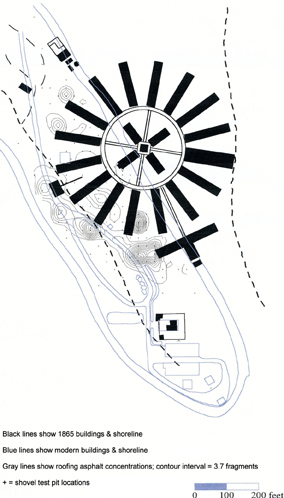 Distribution of composition roofing material at the Point Lookout hospital site. The
hospital outline is shown in black. From Leeson and Breckenridge 1999:45.
Distribution of composition roofing material at the Point Lookout hospital site. The
hospital outline is shown in black. From Leeson and Breckenridge 1999:45.
References
Leeson, Christy E., and S. Curtis Breckenridge
1999 Phase I Archaeological Survey of Point
Lookout Tracking Station and Adjunct Theodolite Stations, Naval Air Station Patuxent
River, St. Mary's County, Maryland. Report prepared for Natural Resources Branch,
Department of Public Works, Naval Air Station Patuxent River. JPPM Occasional
Papers Number 7.