While sorting English earthenwares from a nineteenth-century privy in Baltimore, a
staff member at the Maryland Archaeological Conservation Lab discovered an unusual carved
ivory object (Figure 1). No one at the lab had ever seen anything quite like it. Jump
forward several months and sharp-eyed curator Sara Rivers-Cofield, never one to forget
an object, spotted a similar item in an early nineteenth-century French peddler's
catalog in the Winterthur Museum Library. Unfortunately, objects in the catalog were
not labeled, since presumably everyone ordering from it would already know what all
the items were! A little further digging, however, revealed that the object was part
of a traveling writing kit.
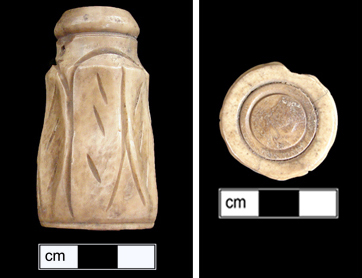 Figs 1 & 2 Side and base views of Baltimore City inkhorn.
The Oxford English Dictionary defines penner as "a case or sheath for pens, of metal,
horn, leather, etc., formerly carried at the girdle, often together with an inkhorn."
The earliest citation for the use of the term is Chaucer's The Canterbury Tales,
from about 1386, although there is evidence they were in use as early as the twelfth
century (Scribal Tools 2011). In addition to the case for carrying pens, these kits
also included one or two small containers for holding ink and pounce (sand used to dry
the inked pages). The carved object from Baltimore appears to have been the part of the
kit known as the inkhorn.
A dark residue resembling dried ink is adhered to the interior bottom and lower sides
of the inkhorn and it is stained in several places along the interior lip, suggesting that
excess ink was removed from pens by wiping the quills along the edge. The base of the inkhorn
is plugged with a separate carved ivory disk; close examination reveals the seal to be
watertight (Figure 2).
Fifteenth- and sixteenth-century paintings and prints depicting writing kits usually show the
kit components held together with a cord and hung at the waist, with the inkhorn on one side
of the belt and the penner along the other (Figure 3). There is a small (1 mm diameter)
hole underneath the carved lip of the Baltimore inkhorn. This hole may have been used for
attaching the cord that held the components of the penner together, similar to this
sketch (Figure 4) created from the c. 1480 trompe l’oeil marquetry in the The Liberal Arts
Studiolo from the Ducal Palace at Gubbio, by Francesco di Giorgio Martini (Metropolitan Museum
of Art). The components of surviving eighteenth- and nineteenth-century kits usually fit
together into a long cylinder (Figure 5).
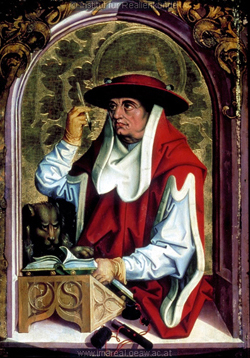 Figure 3. This circa 1500 painting of St. Jerome by George Stäber shows a penner set up
for use. Illustration accessed at http://tarvos.imareal.oeaw.ac.at/server/images/7004644.JPG.
Figure 3. This circa 1500 painting of St. Jerome by George Stäber shows a penner set up
for use. Illustration accessed at http://tarvos.imareal.oeaw.ac.at/server/images/7004644.JPG.
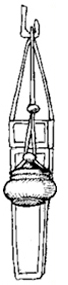 Figure 4. Sketch of a penner taken from The Liberal Arts Studiolo from the Ducal Palace at
Gubbio, by Francesco di Giorgio Martini. Illustration accessed at
http://www.threadsofhistory.com/Eowyn/EowynsEncheiridion/ScribalTools.html.
Figure 4. Sketch of a penner taken from The Liberal Arts Studiolo from the Ducal Palace at
Gubbio, by Francesco di Giorgio Martini. Illustration accessed at
http://www.threadsofhistory.com/Eowyn/EowynsEncheiridion/ScribalTools.html.
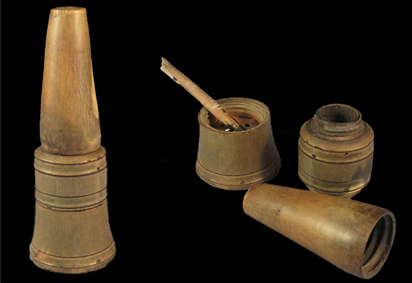 Figure 5. Mid-eighteenth-century writing kit consisting of a penner, pounce pot, and inkhorn.
Illustration accessed at http://www.hydroponicsonline.com/store/RARE-GEORGIAN-PENNER-QUILL-DIP-PEN-HOLDER-INKWELL-1700s_330563362068.html.
Figure 5. Mid-eighteenth-century writing kit consisting of a penner, pounce pot, and inkhorn.
Illustration accessed at http://www.hydroponicsonline.com/store/RARE-GEORGIAN-PENNER-QUILL-DIP-PEN-HOLDER-INKWELL-1700s_330563362068.html.
The interior lip of the inkhorn does not have any threads, indicating that it was closed by
plugging, perhaps with the pen case. Damage along the interior of the lip supports this conclusion.
Although we solved the mystery of the function of this interesting artifact, the question of who
owned it still remains.
References
French peddler's catalogue. Ca. 1806–13. 2 vols.: col. ill.; 41 cm.
Folio 89. Joseph Downs Collection, Winterthur Museum, Winterthur, Delaware.
Metropolitan Museum of Art
Studiolo from the Ducal Palace in Gubbio, 15th century (ca. 1479–82).
Possibly designed by Francesco di Giorgio Martini (Italian, Sienese, 1439–1501/2);
Executed by Giuliano da Maiano (Italian, 1432–1490).
http://www.metmuseum.org/toah/works-of-art/39.153.
Scribal Tools
2011 http://www.threadsofhistory.com/Eowyn/EowynsEncheiridion/ScribalTools.html. Page accessed on December 8, 2011.
Stäber, George
St. Jerome. Circa 1495-1500. Copyright by the Institut fur Realienkunde.
http://tarvos.imareal.oeaw.ac.at/server/images/7004644.JPG