In the mid- to late nineteenth century, the neighborhood west of Baltimore's Inner Harbor
was typical of the city's mixed business and working class residential areas and often
home to first and second generation European immigrants. Residents lived in row houses
that fronted directly onto the city streets and included tiny backyards containing privies,
henhouses, wells and work yards.
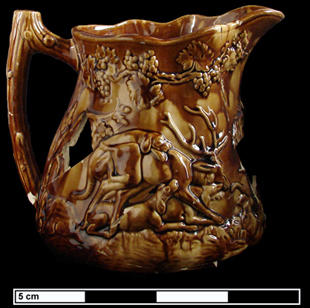 Skillful application of the mottled Rockingham glaze serves to highlight the
stag and boar hunt motifs on this Bennett pitcher. Side 1 of the pitcher image
shows the stag hunt.
Skillful application of the mottled Rockingham glaze serves to highlight the
stag and boar hunt motifs on this Bennett pitcher. Side 1 of the pitcher image
shows the stag hunt.
During the 1980 archaeological excavation done prior to the construction of the Federal
Reserve Bank, archaeologists excavated the contents of a number of these wells and privy
pits. One of these privies had become the final resting place for a magnificent example
of Baltimore's nineteenth-century pottery industry. Although discovered in numerous pieces,
the pitcher was mended by lab technician Erin Wingfield, restoring this vessel to much
of its former glory.
This Rockingham pitcher, molded in a detailed hunting scene depicting hounds attacking a
stag and a boar, was manufactured around 1855 by E. & W. Bennett of Baltimore (Claney 2004).
Edwin Bennett's firm, in production between 1846 and 1936, was one of the best known
North American manufacturers of Rockingham glazed wares (Ketchum 1987:21). This firm's
wares are known for their finely detailed molded patterns, as well as quality of their
mottled glazing (Brooks 2005).
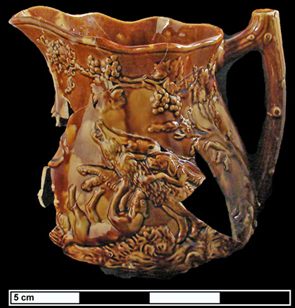 Rockingham glazed Bennett pitcher showing side 2, with the detail of the boar hunt.
Rockingham glazed vessels were inexpensive, mass-produced wares of the
mid-nineteenth to the early twentieth centuries, manufactured in both England and
North America (Claney 2004). Characterized by brown mottled and streaked glaze, Rockingham
wares were often molded with elaborate designs, incorporating naturalistic motifs with vines,
corn, flowers, grapes, and seashells. Rockingham glazes adorned a variety of vessel forms
for kitchen, dining and ornamental use, including pitchers, teapots, mugs, bowls, candlesticks,
coffee pots, doorknobs and spittoons. Perhaps the iconic Rockingham vessel is the
"Rebekah at the Well" teapot, molded with a scene of a woman holding a jug at an open
well. Introduced by Edwin Bennett in 1851, this pattern quickly became popular and was
produced by numerous manufacturers (Claney 2004:81, Liebeknecht 2000).
Pitchers with hunting motifs were viewed as appropriate gifts for men, serving to reinforce
nineteenth-century concepts of masculinity (Claney 2004). This pitcher may have been used
to serve beer—a beverage that was becoming popular at this time, particularly with
the influx of German immigrants into Baltimore. Although Rockingham wares produced by
E. & W. Bennett were doubtless sold all over North America, this pitcher never made it
more than a mile from the factory where it was produced!
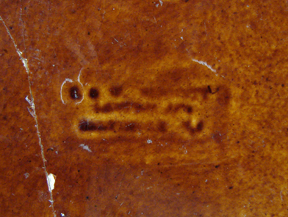 Since the dark glaze obscured printed or impressed marks, Rockingham-glazed wates were
generally not marked by their manufacturers. This vessel is unusual in that it has a manufacturer's
mark; the barely legible impressed mark read "E & W BENNETT/CANTON AVENUE/BALTIMORE."
Since the dark glaze obscured printed or impressed marks, Rockingham-glazed wates were
generally not marked by their manufacturers. This vessel is unusual in that it has a manufacturer's
mark; the barely legible impressed mark read "E & W BENNETT/CANTON AVENUE/BALTIMORE."
References
Brooks, Lauren
2005 The Story of Baltimore Pottery. Chesapeake Home.
http://www.chesapeakehome.com/2005/08/11/collecting-antique-local-pottery/ Website accessed 12-5-2011.
Claney, Jane Perkins
2004 Rockingham Ware in American Culture, 1830-1930; Reading
Historical Artifacts. University Press of New England, Hanover.
Ketchum, William C., Jr.
1987 American Country Pottery; Yellowware & Spongeware.
Alfred Knopf, New York.
Liebeknecht, William B.
2000 Joseph Mayer's Arsenal Pottery Dump. Part 1: Yellow
ware. Trenton Potteries: Newsletter of the Potteries of Trenton Society. April/May 2000,
Volume 1: Issue 2.