The side saddle parts were found at the end of the passage where it met the cellar. The saddle burned
in the house fire at some point before 1730.The Addison/Oxon Hill plantation was founded by John
Addison and his family in the late 1680s. By 1730, the original dwelling at the site, which had
a large underground cellar with a sloping passageway for access, had burned down. The fire caused
the collapse of the passageway and cellar ceilings, whichwere filled with debris from the
destruction. The Addisons were living in a bigger house elsewhere on the property by then, so
they never rebuilt on the site. This is great for archaeologists because whole objects were left
where they had been when people originally put them away. Based on the artifacts recovered, it
seems that one of the things the Addisons had stored where the passageway entered the cellar
was a side saddle.
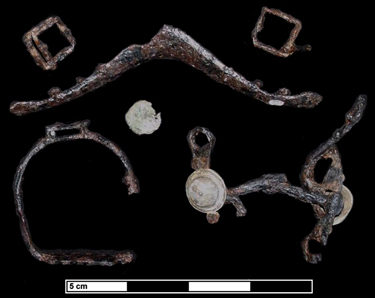 The artifacts recovered that probably came from a side saddle include iron buckles
(top right and top left), a saddle tree plate (top center), a small stirrup (bottom left),
a brass ornament (bottom center), and a curb bit with two brass bosses (bottom right).
The artifacts recovered that probably came from a side saddle include iron buckles
(top right and top left), a saddle tree plate (top center), a small stirrup (bottom left),
a brass ornament (bottom center), and a curb bit with two brass bosses (bottom right).
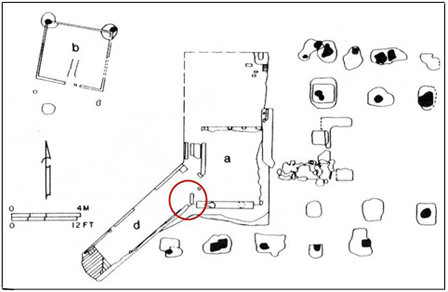 The side saddle parts were found at the end of the passage where it met the cellar
(shown in the site map on left indicated with a red circle). The saddle burned in the
house fire at some point before 1730.
The side saddle parts were found at the end of the passage where it met the cellar
(shown in the site map on left indicated with a red circle). The saddle burned in the
house fire at some point before 1730.
A side saddle is a saddle made for female riders to allow them to ride facing forward, but with
both legs on the same side of the horse to retain modesty while wearing a long skirt. In
the 17th and 18th centuries, these saddles were made with many materials. They had a wooden
base known as a saddle tree, and metal brackets might be used to strengthen the tree. Layers
of padding and leather were then secured to the tree with metal nails and brass tacks,
depending on the style of saddle. Various iron buckles allowed you to attach straps to the
saddle to secure it on the horse or hang holsters or luggage. Leather straps for the saddle
and bridle might be decorated with brass ornaments, and the bridle bit that went in the
horse's mouth to allow the rider to guide the horse could have brass bosses for decoration
as well. Archaeologists are not likely to find the leather, padding, or wood, because these
organic materials rot or get eaten by organisms that live in the soil. But we do find the
metal parts, and when we find them all together, as is the case with this saddle, it can
indicate that they were once part of one larger object. There is a small jointed curb bit
with two brass bosses, a metal plate that strengthened the saddle tree, a brass ornament,
an assortment of buckles, and a stirrup.
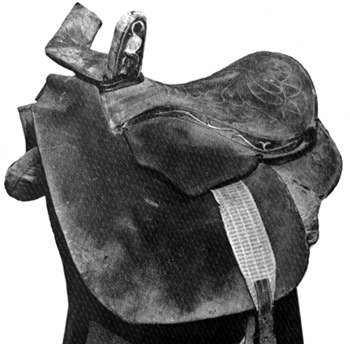 Early 19th-century side saddle. From Beatie 1981
Why do we think this is a side saddle and not just a regular saddle? Well if this was a whole
saddle that burned in a fire, then we should have most of the pieces, but there is only one
stirrup. A man’s saddle would need two stirrups, one for each foot, but women who rode
side-saddle had one foot in a stirrup whole the other leg folded over the front of the
saddle and hooked around a special saddle horn. Also, the one stirrup present is relatively
small, so it would not have fit a grown man’s foot.
So even without the whole object, we can infer that this was probably either a side-saddle
or a child’s saddle with a stirrup missing. Either way, this artifact tells us a lot about
the people who lived at the site. Not all women and children learned how to ride a horse
because you had to have specialized horse furniture, time to practice and take lessons, and
usually a small, compliant, and well trained horse. Social norms at the time dictated that
only men could handle more feisty steeds, and women and children of lesser means probably
had work and chores that would prevent the serious pursuit of horsemanship. We already knew
that the Addisons were a wealthy family who could afford the hobbies deemed appropriate for
the upper classes, but there were many options for the gentry as they sought to enjoy
their leisure time, and it is not always possible to figure out what people actually did.
Thanks to this find, we now know that at least one member of the family chose to ride.
References
Beatie, Russel H.
1981 Saddles. University of Oklahoma Press,
Norman, Publishing Division of the University. Chapter 15: 119-121. U.S.