In the spring of 1980, the Mid-Atlantic Archaeological Research Inc. excavated a site of former row
houses and their backyards in Baltimore City, where construction was going to break ground for a
Federal Reserve Bank. Within five weeks, all of the excavations were completed, revealing wells,
privies, and other areas where structures used to exist. Recent analysis on one of the privy
features, Feature 17, revealed a printed white earthenware plate that yielded clues about the
early copying of drawings in the United States. The pieces of ceramic not only mend together to
show a depiction of a mountain lake scene, but a maker's mark and the name of the scene were
also present on the back side of the plate.
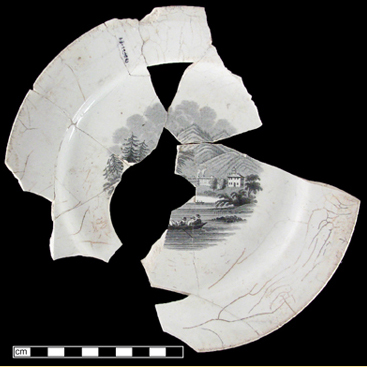 Mended plate from the Federal Reserve Bank site depicting Lake George.
The back of the plate had a printed mark of an eagle and two boxes as well as a partial impressed
mark of a lion. One of the boxes contains the printed words "Caldwell, Lake George" while the
other box contains "W.R.". With the maker's mark of a "W.R.," it has been determined that the
Staffordshire pottery firm of William Ridgway manufactured this ceramic vessel between the years
of 1830-1834 (Godden 1964:538). The words "Caldwell, Lake George" give the name of a town and
lake in the Adirondack Mountains of New York. The other partial mark of the lion suggests that
the plate was impressed with the British royal seal of a lion and unicorn.
After the War of 1812, many Staffordshire potters appealed to the American market by creating
scenes depicting North American landmarks, like churches, government buildings and hotels and
resorts as well as city vistas (Samford 1997:65). Published prints were the primary sources for
these American views; since no copyright laws were in existence prior to 1842, it was legal
and acceptable for the Staffordshire potters to copy book and other printed illustrations
(Samford 1997). For the Lake George plate, the question becomes "what engraving or print did
William Ridgway copy in order to make this plate?" Other questions explored here include who
first created the illustration and the publication date of the original print.
The earliest depiction found so far comes from a plate, decorated with a gold border and
landscape design identical to the Ridgway pattern, manufactured by the Coalport Factory during
a ten-year span of 1820-1830. The title of the porcelain plate was "Caldwell, Lake George,
America" (Plate Caldwell). The Coalport firm produced high-end expensive British porcelain
that was embellished with lots of gold gilt. By the time William Ridgway's firm produced
the "Caldwell, Lake George" pattern, they used much less expensive white earthenware and no gilt.
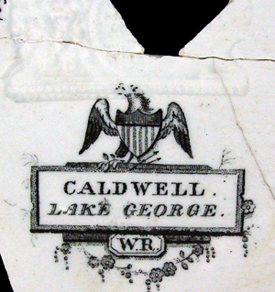 Back side of plate showing the makers mark shows a printed mark of an eagle and two boxes as
well as a partial impressed mark of a lion. One of the boxes contains the printed
words "Caldwell, Lake George" while the other box contains "W.R."
Back side of plate showing the makers mark shows a printed mark of an eagle and two boxes as
well as a partial impressed mark of a lion. One of the boxes contains the printed
words "Caldwell, Lake George" while the other box contains "W.R."
In 1840, Nathaniel P. Willis published American Scenery: Or Land, Lake, and River Illustrations
of Transatlantic Nature (Willis 1840). One of the illustrations in this book was British
landscape artist William H. Bartlett's (1809-1854) 1837-1838 drawing of "Caldwell,
Lake George" (William H. Bartlett Prints 2010). In 1846-1847, Kellogg and Thayer published a
lithograph of the same engraving with some minor differences (Views of the… 2012). The question
comes to when the print of Caldwell, Lake George was first produced.
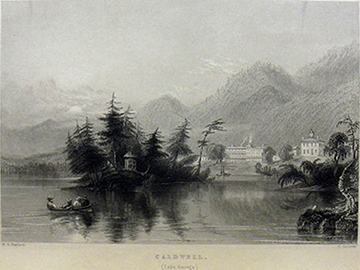 Image of lithograph depicting Caldwell, Lake George.
Since no copyright acts existed before 1842, it is almost impossible to tell when the first
depiction was produced and who produced it. If William H. Bartlett was the first person to
create a drawing of Caldwell, Lake George, then the dates assigned to the William Ridgway and
the Coalport plates are incorrect and too early by one or more decades. Then, Kellogg's
and Thayer's 1846-1847 lithograph could have the correct date and they probably received
permission to create the lithograph. If the dates for both pieces of pottery are correct,
then it might be a mystery about who produced the picture first, because the possibility
exists of Bartlett copying his drawing from someone else. Hopefully, new sources in the
future will become known and help solve this mystery.
References
Godden, Geoffrey A.
1964 Encylopaedia of British Pottery and Porcelain
Marks. London: Barrie and Jenkins.
"Plate Caldwell, Lake George, America." The AMICA Library. Accessed July 10, 2012.
http://amica.davidrumsey.com/luna/servlet/detail/AMICO~1~1~44892~77680:Plate-Caldwell,-Lake-George,-Americ?sort=INITIALSORT_CRN%2COCS%2CAMICOID&qvq=q:AMICOID%3DFASF.138480%2B;sort:INITIALSORT_CRN%2COCS%2CAMICOID;lc:AMICO~1~1&mi=0&trs=1.
Samford, Patricia
1997 "Response to a Market: Dating English Underglaze
Transfer-Printed Wares." Historical Archaeology 31, no. 2:1-30.
"Views of the Adirondack Region of New York." The Philadelphia Print Shop, LTD. Last modified May 24, 2012.
http://www.philaprintshop.com/adirondack.html.
"William H. Bartlett Prints 1837-1842." New York State Library. Last modified April 06, 2010.
http://www.nysl.nysed.gov/msscfa/pri5584.htm.
Willis, Nathaniel Parker
1840 American Scenery; Or, Land, Lake, and River Illustrations of
Transatlantic Nature. London: George Virtue.