Erin Wingfield, MAC Lab Collections Asst.
During the 1980s, while excavating a series of late 18th and early 19th century rowhouses at the
Queen's Street site in Fell’s Point, Baltimore City, Maryland, archaeologists recovered an unusual,
and slightly creepy, group of artifacts. These artifacts are fragments of both the top and bottom
portions of a full set of dentures (Figure 1). The denture's main body is made from an early
vulcanized rubber known as "vulcanite," with porcelain teeth attached to it by metal pins. Dentures
may seem like a common item affordable and available for anyone; however, this was not always the case.
They only became widely accessible in the late 1800s, after many years of patent infringement lawsuits
that may have, ultimately, ended in murder.
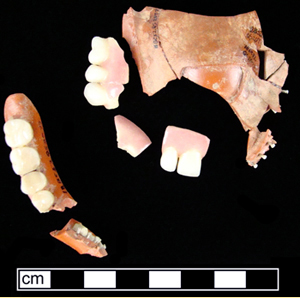 Figure 1: Fragments of a set of vulcanite dentures found at the Queen's Street site in Baltimore City.
White and pink colored porcelain "teeth" and "gums" were held in place by metal pins, which can be
seen in the right side of the photograph.
Figure 1: Fragments of a set of vulcanite dentures found at the Queen's Street site in Baltimore City.
White and pink colored porcelain "teeth" and "gums" were held in place by metal pins, which can be
seen in the right side of the photograph.
The earliest dentures were considered a luxury item and were constructed of wood with teeth carved
from bone or hippopotamus ivory. The highest quality dentures used an ivory base and what were
referred to as Waterloo teeth (Figure 2). These were actual human teeth either removed from the
dead or extracted from living, destitute individuals looking to make some money. Barrels of
Waterloo teeth scavenged from battlefields during the American Civil War were even shipped back to
England (British Dental Association, Wynbrant 2000: 151). These early dentures were typically created
by a craftsperson, not a doctor or dentist, and fit very poorly often causing further pain and
discomfort. Also, because of the time and materials needed to construct dentures, they were
only available to the upper classes. Members of the middle class, who also had poor dental health,
would have gone without (British Dental Association).
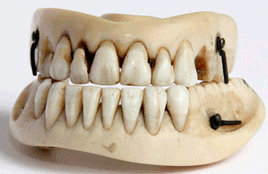 Figure 2: A set of dentures using Waterloo teeth from the British Dental Association Dental
Museum. These still required metal hardware to function and fit correctly.
Figure 2: A set of dentures using Waterloo teeth from the British Dental Association Dental
Museum. These still required metal hardware to function and fit correctly.
However, this all changed with the invention of vulcanite, a soft rubber material that could be
easily molded and then hardened. Charles Goodyear perfected this process in 1839 and received patents
for related vulcanite products in 1851 (Wynbrant 2000: 166). Dentists discovered this rubber could
be molded to fit the mouth of each individual and then cured for more comfortable fitting
dentures. Since vulcanite dried into an unnatural looking, dark reddish brown color it was only
used for the main body of dentures. The "teeth' and surrounding "gums" were created out of
porcelain and colored to appear more lifelike (British Dental Association).
When dentists first began making vulcanite dentures, Goodyear chose not to enforce its patent.
One dentist even made a set of vulcanite dentures for Charles Goodyear himself. Goodyear's original
patent expired in 1861, but was reacquired specifically for vulcanite dentures in 1864. Unlike
years earlier when dentists who used vulcanite were ignored, this time an officer with the
company, Josiah Bacon, made it his personal mission to collect fees from every dentist. He was
referred to as the, "engineering Mephistopheles of the whole skinning raid upon the dentists"
(Wynbrant 2000:168). Dentists were charged an annual fee based on the size of their practice,
as well as royalties for each denture produced. Bacon would sue any dentist choosing not to pay
the fees and then collect the monetary damages for his own use. Bacon even utilized spies in
his search for offending dentists. He became known for sending beautiful ladies to pose as
potential clients, bribing servants, and resorting to intimidation to collect his fees
(Wynbrant 2000:166-169).
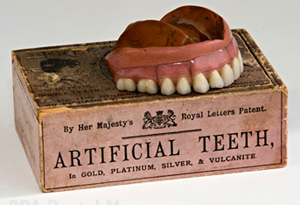 Figure 3: One portion of a complete vulcanite denture with sales box. From the collection of
the British Dental Association Dental Museum.
Figure 3: One portion of a complete vulcanite denture with sales box. From the collection of
the British Dental Association Dental Museum.
In 1879, Bacon traveled across the country from Boston to San Francisco filing law suits along
the way and pocketing the rewards. After reaching San Francisco, he made a special effort to track
down dentist Samuel Chalfant. Chalfant had twice previously avoided paying fees by choosing
instead to close his practice and move elsewhere. When Bacon brought Chalfant to court again,
Chalfant was found guilty of patent infringement (Wynbrant 2000:169). What happened afterwards
is unclear. One version of this tale recounts that the next day, Easter Sunday, Chalfant came
to Bacon's hotel room distraught, seeking a settlement and offering to pay whatever he could.
They argued and Bacon threatened to have Chalfant imprisoned. At the height of the argument,
Chalfant pulled out his gun, which he claimed went off accidently. In his fear he fled the
hotel. All that is really known is that Bacon was found dead in his room, drilled with lead
from Chalfant's pistol. Chalfant hid in a cheap boarding house in the city for a few
days before turning himself over to the police (99% Invisible).
After Bacon's death, the Goodyear Company continued to call infringing dentists petty pirates and
tried to redeem Bacon's image as an honorable gentleman protecting the rights of legitimate licensed
dentists everywhere (Goodyear Dental Vulcanite Company). However after the murder, Goodyear decided
it was no longer in its best interests to continue enforcing the patent for vulcanized
dentures (99% Invisible, Wynbrant 2000:169). This allowed denture prices to drop and ushered
in a period of comfortable, good quality dentures for everyone, greatly impacting the lives of
ordinary individuals.
References
99% Invisible
2012 Episode 46 – Vulcanite Dentures,
http://99percentinvisible.org/episode46vulcanitedentures, accessed September 26, 2012.
British Dental Association
2010 BDA Museum Collections: Teeth and Dentures,
http://www.bda.org/museum/collections/teeth-and-dentures, accessed September 26, 2012.
Goodyear Dental Vulcanite Company
1879 "The Murder of Josiah Bacon."
http://query.nytimes.com/mem/archivefree/pdf?res=FB0617FF385A137B93C6A9178ED85F4D8784F
New York Times, accessed September 26, 2012.
Wynbrant, James
2000 The Excruciating History of Dentistry:
Toothsome Tales and Oral Oddities from Babylon to Braces. St. Martin's Press, New York.