Taw, boulder, bumboozer, commies, masher, popper, marrididdles, shooter, bumbo,
crock, bowler, tonk, godfather, tom bowler and biggie. All of these words—some
commonplace, everyday nouns and the others quite curious terms—are part of a
lexicon that has largely disappeared from our language. They are names once used
to describe marbles.
In this age of fast-paced digital entertainment, games with marbles must seem archaic
to today's plugged-in youth. This was not always the case, though. Marbles are one
of the most common children's toys found on colonial and post-colonial archaeological
sites in North America. Paintings and prints of children—usually boys kneeling in
a circle in the dirt playing ringers or standing in a group trading their finest
specimens—abound in western art, starting as early as Pieter Brueghel the
Elder's painting Children's Games (1560). Marbles were used in a variety of games;
the only game that seemed to have been played primarily by girls was five stones, a
game similar to jacks that involved a marble and four sheep talus (ankle)
bones (Gartley and Carskadden 1998:23).
Over the years, marbles were made from a number of materials, including stone, unglazed
earthenware, glazed stoneware, porcelain, and glass (Block 1999; Gartley and Carskadden
1998; Randall and Webb 1988). Many marbles were made and imported from Germany, but
North American production really took off in the early twentieth century (Carskadden
and Gartley 1990:55).
A nice collection of stoneware marbles was found among the collapsed timbers filling a late
19th-century cellar at the Federal Reserve Site (18BC27) in Baltimore. These white bodied
stoneware marbles, finished with a colorful glaze, are what collectors call
"Benningtons" or "Bennies." Benningtons were produced during last three decades of
nineteenth century and first decade of twentieth century (Gartley and Carskadden 1998:135).
Typical of Benningtons, the Federal Reserve marbles have circular bare spots in the glaze,
caused by the marbles resting against one another in the kiln. Some of them display
pock marks on their glazed surfaces; damage typical of heavy use. They range in
diameter from .5" to 1.5", with the larger marbles probably serving as shooters.
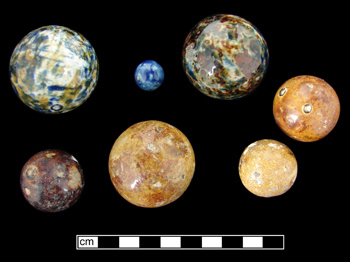 Collection of stoneware marbles was found among the collapsed timbers filling a late
19th-century cellar at the Federal Reserve Site (18BC27) in Baltimore.
Collection of stoneware marbles was found among the collapsed timbers filling a late
19th-century cellar at the Federal Reserve Site (18BC27) in Baltimore.
While marbles are a relatively common find on nineteenth-century archaeological sites,
what makes these marbles a bit unusual is that all seven of them were all found together.
It is easy to imagine them nestled in a leather or cloth bag, awaiting their next game.
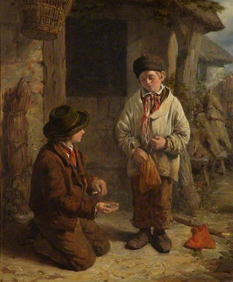 David Hardy 1855. Boys Playing Marbles. Victoria Art Gallery,
Bath, England.
David Hardy 1855. Boys Playing Marbles. Victoria Art Gallery,
Bath, England.
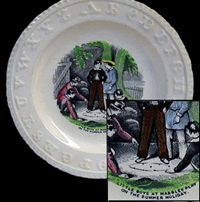 A British alphabet plate, probably last quarter of the 19th century, showing boys
playing marbles on summer holiday. 6" in diameter. Private collection.
A British alphabet plate, probably last quarter of the 19th century, showing boys
playing marbles on summer holiday. 6" in diameter. Private collection.
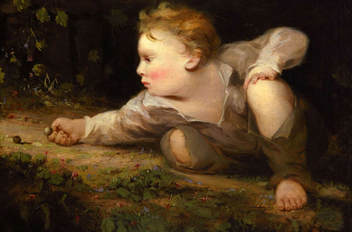 Boy Playing Marbles. David Gilmout Blythe, ca. 1858. National Museum of American Art,
Washington, DC.
Boy Playing Marbles. David Gilmout Blythe, ca. 1858. National Museum of American Art,
Washington, DC.
References
Block, Robert
1999 Marbles Illustrated; Prices at Auction.
Schiffer Publishing, Atglen, Pennsylvania.
Carskadden, Jeff, and Richard Gartley
1990 A Preliminary Seriation of 19th-Century Decorated
Porcelain Marbles. Historical Archaeology 24(2):55-69.
Gartley, Richard, and Jeff Carskadden
1998 Colonial Period and Early 19th-Century
Children's Toy Marbles; History and Identification for the Archaeologist and Collector.
The Muskingum Valley Archaeological Survey, Zanesville, Ohio.
Randall, Mark E., and Dennis Webb
1988 Greenberg's Guide to Marbles.
Greenberg Publishing Company, Sykesville, Maryland.