A German jeton (Figure 1) was excavated at the Bond Street Site in Baltimore, Maryland in
late 1984. Leased by Edward Fell in the latter half of the 18th century, the site's
functions included a lumber yard, a coffee house, and a laundry operation. The site was
also the residence of Captain George Wells and his family members from 1779 to 1787
(Anonymous 2001).
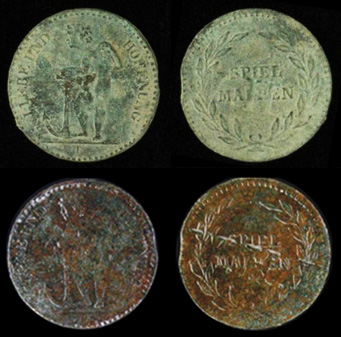 Figure 1: A German jeton found at the Bond Street Site. Obverse (left) and reverse (right).
German jeton from Bond Steet. Before treatment (above) and after treatment (below)
Figure 1: A German jeton found at the Bond Street Site. Obverse (left) and reverse (right).
German jeton from Bond Steet. Before treatment (above) and after treatment (below)
Long before the dawn of modern calculators, items such as seeds and pebbles were used to
represent numerical values and to provide people with visual aids to help them perform
simple calculations. In the 13th century, the French introduced counting pieces
called "jetons" that looked like coins. The term "jeton" came from the French word
"jeter" — "to throw" — because they were commonly tossed onto a counting
board. The idea spread to the rest of Europe, and thus counting boards and jetons became
the Western counterpart of the abacus (Newman 1966).
In the 16th century, two clever minting masters from Nuremberg, Krauwindel and Schultes,
designed special jetons to use as teaching tools (Figure 2). Their handiwork was
ultimately a success and sold well (Newman 1966). In the two centuries that followed,
people began to use jetons less often as mathematical tools. German jetons were sold as
accompaniments to popular board, card, and dice games (Aschoff 2009). More and more
jetons were marked with the inscription "spiel marke/spiel marken," or "game/play money,"
by the early 19th century (Mitchiner 1988).
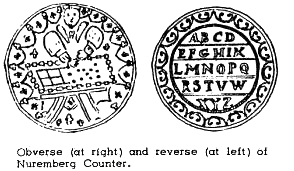 Figure 2. A drawing of a Nuremberg jeton designed to help children learn the
alphabet (Newman 1966:2).
Figure 2. A drawing of a Nuremberg jeton designed to help children learn the
alphabet (Newman 1966:2).
In the 19th century, the Lauer firm of Nuremberg produced miniature imitations of real
currency from fourteen different European countries (Figure 3). In order to discourage
people from using them in place of real money, the Lauer firm and others placed
manufacturer's marks on many of these toy miniatures. The imitations enjoyed such
popularity in Europe that they became favorite collectible items (Aschoff 2009).
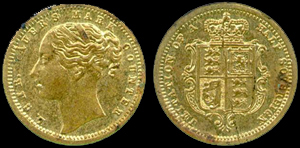 Figure 3: The obverse (left) and reverse (right) of a Lauer miniature imitation jeton
in the Fitzwilliam Museum's Rogers Toy Coin Collection. Thought to have been struck
around 1880, it is a toy replica of a half sovereign featuring the profile of Queen
Victoria (The Fitzwilliam Museum 2012).
Figure 3: The obverse (left) and reverse (right) of a Lauer miniature imitation jeton
in the Fitzwilliam Museum's Rogers Toy Coin Collection. Thought to have been struck
around 1880, it is a toy replica of a half sovereign featuring the profile of Queen
Victoria (The Fitzwilliam Museum 2012).
Sadly, the demand for "spiel marke/spiel marken" jetons and imitation miniatures did
not last, and a decrease in popularity began in the early 20th century. By the
1950s, the Lauer firm had stopped producing them altogether (Mitchiner 1988).
The jeton found on Bond Street is made from copper alloy. Jetons such as this one
can be difficult to date due to their lengthy period of popularity (R. Guth,
personal communication, November 26, 2012). However, the closest match can be
found in a series of brass jetons manufactured by the Lauer firm between 1814 and
1827 (Figure 4). The jeton found at Bond Street, however, is not an exact match
in design. An upper case letter "I" or Roman numeral one can be seen on the
obverse side. Perhaps it is a damaged manufacturer's mark, as Lauer jetons of
this period are commonly marked with a telltale "L" (Mitchiner 1988). Curiously,
the initials "WHI" have been stamped into the reverse side of the jeton.
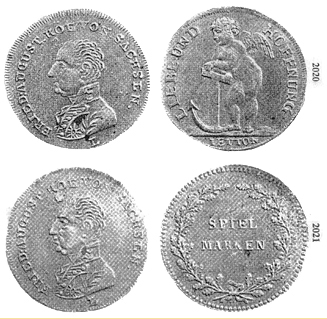 Figure 4: Two jetons with similar designs to the Bond Street jeton, both of which
were minted between 1814 and 1827 by the Lauer firm in Nuremberg, Germany. The
obverse of each depicts Friederick Augustus I, King and later Elector of Saxony, who
ruled from 1763 until 1827 (Mitchiner 1988: 563).
Figure 4: Two jetons with similar designs to the Bond Street jeton, both of which
were minted between 1814 and 1827 by the Lauer firm in Nuremberg, Germany. The
obverse of each depicts Friederick Augustus I, King and later Elector of Saxony, who
ruled from 1763 until 1827 (Mitchiner 1988: 563).
The inscription on the obverse side of the jeton reads "LIEBE UND HOFFNUNG," or "love and hope."
The two heraldic symbols traditionally associated with love and hope are depicted: a cherub
and an anchor (The Institute of Heraldry 2012). The reverse side features the words
"SPIEL MARKEN" enclosed in a laurel wreath, a common symbol of victory.
The Bond Street jeton may be the remnant of a German game played at the coffee house in
the 1770s, a toy misplaced by a child, or a lost collectible. However, the jeton's
ownership and the year it was minted remain uncertain.
References
Aschoff, G.
2012 Deutsches Kinderspielgeld: Ein numismatisches
Randgebiet. Battenberg Verlag, Munich.
Anonymous
2001 History of the London Coffee House. 1985.016,
Bond Street – Misc. (Unpublished report). Jefferson Patterson Park and Museum,
St. Leonard, MD.
The Fitzwilliam Museum
Fitzwilliam Museum Collections Explorer – Object CM.2605-2003 (Id: 158632),
http://www.fitzmuseum.cam.ac.uk/explorer/index.php?qu=lauer&oid=158632, accessed November 21, 2012.
Institute of Heraldry
2012 USS Shoup (DDG 81) coat of arms,
http://www.tioh.hqda.pentagon.mil/Heraldry/Navy/NavalShip.aspx?u=2834, accessed November 27, 2012.
Magnay, D.
2006 Toy coins and boxes,
http://www.tokensociety.org.uk/topics/toycoins.shtml, accessed November 19, 2012.
Michtiner, Michael
1988 Jettons, Medalets & Tokens: The Medieval Period
and Nuremberg. B.A. Seaby, Ltd, London, United Kingdom.
Newman, E.P.
1966 The Nuremberg counter. Miniature Book News
4: 2.