Alex Glass, MAC Lab Public Archaeology Asst.
Archaeological excavations in the kitchen area at the 18th century Smith's St.
Leonard site, located at JPPM, recovered a high volume of food related artifacts.
In particular, the brick-capped cellar in front of one of the kitchen hearths
provided many charred seed remains for analysis. Studying botanical remains can
add further information about diet, agricultural practices, trade and environment
(Miller 1989:50). Some of the seed and nut remains identified in the cellar fill
include corn, black walnut, wheat, grape, peas, and beans. Most of these were
probably unintentionally burnt, but could have been dropped during food preparation
and later deposited into the nearby hearth.
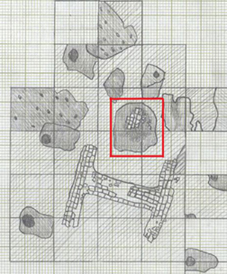 Planview of Smith's St. Leonard Kitchen features. Cellar is outlined in red with
brick "H" shaped hearth below.
Planview of Smith's St. Leonard Kitchen features. Cellar is outlined in red with
brick "H" shaped hearth below.
During the early ownership of the site, several land disputes occurred; two of which
describe locations where fields, gardens, barns and even grape vines existed
(MDhR 50,082-16-11, MD; King and Winnik 1994). A 1773 deposition given by Roger
Johnson1, a former servant or slave of landowner Walter Smith, indicates that
near a fence was "ground to be tended in corn" (King and Winnik 1994: Appendix II).
On a survey plat drawn for the same case a "cornhouse" is marked as standing near
the Smith's main dwelling (MdHR 50,082-92. A cornhouse was used as "a storage
building for shelled corn or for ears of corn," and 30 barrels of corn
are listed in Walter Smith's 1748 probate inventory (Lounsbury 1994: 94;
MSA, Inventories, 45-37). The kernels and cobs found in the kitchen cellar
could be remains of corn grown in the field near the fence, and stored in the
cornhouse.
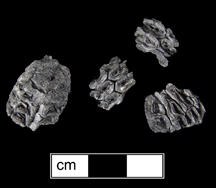 Corn cob fragments on left and corn kernel fragments on right from Smith St. Leonard
Site.
Corn cob fragments on left and corn kernel fragments on right from Smith St. Leonard
Site.
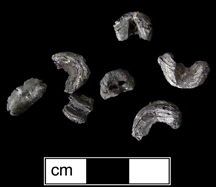 Pea (left) and bean (right) fragments from Smith St. Leonard.
A wheat house was also identified on the 1773 plat, and would
have been used similarly to the cornhouse. Once wheat has matured in the field
it must be cut, bundled and then taken to a sheltered place, dried and threshed
(Perry 1977: 17). Fifty-four bushels of wheat are listed in Walter Smith's probate
inventory, possibly waiting to be ground at his nearby mill for use as bread flour.2
The complete grains found in the kitchen cellar could have been stored or processed
there.
A few bean and pea fragments were also found in the kitchen cellar. These were often
dried for later use rather than eaten fresh, and at his death in 1714 Richard Smith
had 20 bushels of "Indian peas"3 (Leach 1985; MSA, Inventories & Accounts,
36c-1). The 1773 plat and depositions have no suggestion of where these legumes were
cultivated, but they could have been grown in Walter Smith’s slaves' "truck patch"4,
mentioned in a 1768 court deposition by Benjamin Mackall (MDhR 50,082-16-11).
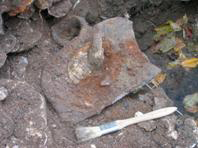 One of three hoe fragments recovered in the kitchen cellar fill. Could this hoe, watering pot, and garden
shoes listed in Richard's inventory have been used to grow the peas found in the cellar?
One of three hoe fragments recovered in the kitchen cellar fill. Could this hoe, watering pot, and garden
shoes listed in Richard's inventory have been used to grow the peas found in the cellar?
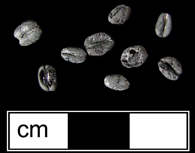 Charred Wheat grains from Smith St. Leonard site.
Food in the 18th century colonies was limited to season, storage, cultivation, and what
imported goods could be afforded. Consequently, most rural families depended on the
foodstuffs they produced on the land themselves. The seed and nut remains found in
the Smith family's kitchen cellar, together with the site’s historical documents
demonstrate the relationship between the Smith’s land and their food.
Footnotes
1 Possibly the "mulatto man named Roger with 3 ½ years left to serve" listed on
Walter Smith's 1748 inventory.
2 In 1714 Walter Smith is bequeathed land "called Blinkhorn together with the mill
that is therin" (MSA,Wills,14-83).
3 Possibly cowpeas or black eyed peas. These were a staple in slave gardens and
diet, but mostly used as field beans by plantation owners (Colonial Williamsburg
Foundation 2013)
4 "a small area devoted to the production of vegetables usually for domestic
use" (Merriam-Webster 2013)
References
Colonial Williamsburg Foundation
2013 Gardening: Research: Peas III. Varieties,
H. Cowpeas. Electronic Document,
http://174.143.19.147/history/cwland/resrch10.cfm, accessed March 28, 2013.
King, Julia A. and Winnik, Aliza R.
1994 Smith versus Johnson: The 1771 Boundary Dispute
at St. Leonards. Jefferson Patterson Park and Museum Occasional Papers, Appendix II. St.
Leonard, Maryland.
Leach, Charles
1985 Colonial American Food Legumes. National Colonial
Farm Research Report, No. 24, The Accokeek Foundation, Inc. Accokeek, Maryland.
Merriam-Webster Dictionary
2013 Truck-patch. Electronic Document,
http://www.merriam-webster.com/dictionary/truck%20patch, accessed March 28, 2013.
Miller, Naomi F.
1989 What Mean These Seeds: A Comparative Approach to
Archaeological Seed Analysis. Historical Archaeology 23(2): p.50-59.
Percy, David O.
1977 English Grains along the Colonial Potomac. National
Colonial Farm Research Report, No. 3, The Accokeek Foundation, Accokeek, Maryland.