Annette Cook, MAC Lab Public Archaeology Asst.
Two unusual lead artifacts were found during the 2011 excavation of a kitchen
cellar at the Smith's St. Leonard site (18CV91) on Jefferson Patterson Park
and Museum in Calvert County, MD. They are flattened, roughly rectangular in
shape and each has a cross hatch pattern hand-incised onto both surfaces,
similar to a grid or calendar. While most of the squares within the grids
are empty, some have a single slash mark through them, and others have two
slash marks forming an X. Single slash marks may be forward or backward slashes.
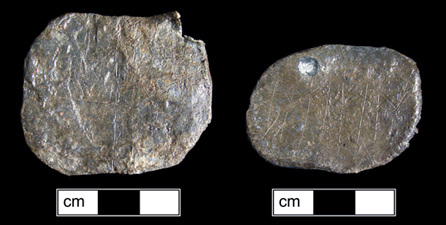 Unusual lead objects bearing hand scratches from Smith St. Leonard Site.
The smaller of the objects is .75 inches long, 1.25 inches wide and weighs 40.9
grams. The larger is 1.75 inches long, 1.50 inches wide, and is thicker and
heavier, weighing 82.3 grams. The smaller of the two bears an almost complete
grid pattern, 7 squares across and 6 squares high, on one side. The other
side is worn and corrosion hides part of the surface, but a partial grid is
visible. A hole is bored on each side, though neither goes entirely through
the object, and they are offset and do not line up with each other. The
markings on the larger of the two objects are less clear due to corrosion and
wear. One surface bears a grid design, while the second surface bears a much
more haphazard pattern of some grid lines and radiating diagonal lines in no
apparent pattern. In this case the markings seem almost like scribbles and
less purposeful.
In researching these objects, no close comparisons have been found, except for
one very similar item on an artifacts-for-sale website, describing it as a
flattened musket ball from somewhere around Charleston, South Carolina.
Unfortunately, due to its lack of context and proper study, this artifact
cannot be useful for research purposes.
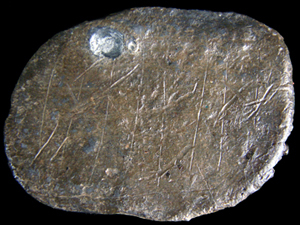 Detail of grid markings on smaller lead object.
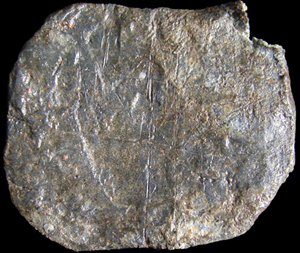 Detail of less organized markings on larger object.
So, what might the Smith's St. Leonard mystery objects be? Due to their small
size it is almost certain that they were privately utilized by an individual,
rather than being displayed for others. Possibilities include some sort of
tally keeper, game pieces, calendars, or weight markers. Interestingly the
weight of the larger object is almost exactly double that of the smaller.
Is this coincidental? Or could the measurements have been used in some
sort of kitchen related activity? Neither weight seems to match to any
known increment of measure used by apothecaries or others.
While the exact nature of these items remains a mystery, it is obvious that for
some person at Smith’s St. Leonard, they served a specific function. The
grids were carefully scratched onto the surfaces, and markings were placed
according to their purpose. If you have an idea or can help us solve this
mystery, please contact the Maryland Archaeological Conservation Laboratory.