The harmonica is a free reed wind instrument. As the player exhales (blows) and
inhales (draws) air into evenly-spaced air channels, the reeds within produce a
musical tone by vibrating when air is applied. Because it is small, compact,
pre-tuned, very affordable and transportable, the harmonica has reached a wide
popularity throughout the world in every musical genre.
Also called "French harp," "pocket piano" or "mouth organ," it has become an
iconic instrument in the United States since the end of the nineteenth century,
featured in American folk music. It was played by soldiers at the front lines
during the Civil War (1861–1865) and even by Abraham Lincoln, president of the
United States. A letter addressed to the head of the Hohner Harmonica Company
reveals his hobby: "Two of my favorite things are sitting on my front porch
smoking a pipe and playing my Hohner harmonica."
The history of the harmonica goes back to Asia thousand years ago from the
Chinese sheng (Figure 1), a sacred instrument introduced in Europe in the
late eighteenth century. The harmonica, as we know it today, first became
prominent in the early nineteenth century in Trossingen, Germany. In 1857,
a German clock maker, Matthias Hohner, started mass production and in 1862
he began to supply North America. It propelled the Hohner Company to reach
the status of world leader in harmonicas by 1887, with the production of more
than one million harmonicas annually (Figure 2).
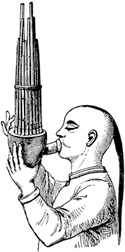 Figure 1: Chinese musician playing the sheng instrument (3000 BC).
http://etc.usf.edu/clipart/56400/56475/56475_sheng.htm.
Figure 1: Chinese musician playing the sheng instrument (3000 BC).
http://etc.usf.edu/clipart/56400/56475/56475_sheng.htm.
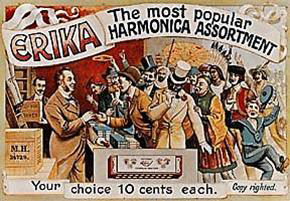 Figure 2: Matthias Hohner selling harmonicas to eager worldwide buyers, © National
Music Museum (NMM), South Dakota.
Figure 2: Matthias Hohner selling harmonicas to eager worldwide buyers, © National
Music Museum (NMM), South Dakota.
Every type of harmonica consists of three essential components: one body or
comb, two reed plates and two cover plates (Figure 3), held together with nails
or screws. Harmonicas can be made from wood and metal (and plastic for the recent
ones), or a combination of these materials, to create specific tonal
characteristics and aesthetic features. Bells, horns or metal side plates were
added by makers on the exterior of the instrument in an effort to develop
innovation in a competitive market. Harmonica holders were also produced to
allow the musician to play another instrument at the same time.
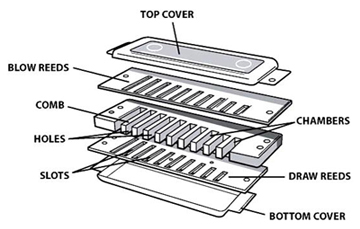 Figure 3: Basic construction of a harmonica, http://www.netplaces.com/harmonica/the-basics/
Archaeological examples of harmonicas (Figure 4) often consist of corroded
copper alloy reed plates and cover plates, fragmented and deformed. The
original surface appearance is lost, transformed into green-colored patinas or
crusts. Remains of inscriptions can be preserved, revealing the date of
production and the manufacturer. Also, when fragments of the wooden comb
are found, their structure has shrunken and warped in response to environmental
moisture content. Sometimes, they are still held to the metal parts by corroded
iron nails or adhered to the metal surface by copper salts. Since copper is
a biocide material, it likely decreases the biodeterioration of the wooden components
(Cronyn 1990: 219-220). Copper salts frequently impregnate their structure,
staining them green. Historical sources such as American store catalogues
[The Montgomery Ward & Company (1872–2000) or The Sears, Roebuck & Company
(1888-1993)] and harmonicas gathered by collectors (Peter Kassan, Alan G.
Bates, Figure 5) provide precious information for archaeologists confronted
by harmonicas disfigured through use and then aged in a burial environment.
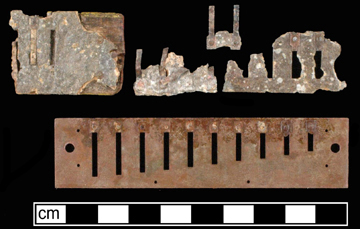 Figure 4: Archaeological harmonicas parts in different conditions: copper reed plates and wooden
comb still adhered with a nail, its top surface shows remains of yellow painting. Recovered from Jackson
Homestead, ca. 1820-1916, © JPPM.
Figure 4: Archaeological harmonicas parts in different conditions: copper reed plates and wooden
comb still adhered with a nail, its top surface shows remains of yellow painting. Recovered from Jackson
Homestead, ca. 1820-1916, © JPPM.
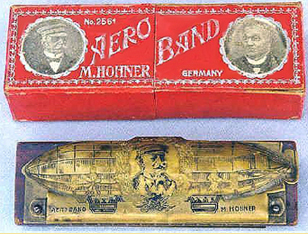 Figure 5: Aero Band Zeppelin Harmonica by M. Hohner, Trossingen, ca. 1909-1924, © National Music
Museum, South Dakota.
Figure 5: Aero Band Zeppelin Harmonica by M. Hohner, Trossingen, ca. 1909-1924, © National Music
Museum, South Dakota.
With a great variety of types and tunings, harmonicas allow the player freedom of
expression in all forms of music, from classical and blues, to country and rock,
to the music of people worldwide, deeply in harmony with the spirit of the
American Independence Day, celebrated on July 4th. So, "Please, love me do…"
References
Cronyn, J.M.
1990 The Elements of Archaeological
Conservation. Routledge. London.
Harter, J.
1980 Music, a Pictorial Archive of
Woodcuts & Engravings: 841 Copyright-free Illustrations for Artists & Designers.
Dover Publications. New York.
Montgomery Ward
1969 Montgomery Ward & Company Catalogue
and Buyers' Guide 1895. Dover Publications. New York.
Sears, Roebuck and Company
1986 The 1902 Edition of the Sears Roebuck
Catalogue. Bounty Books. New York.
1970 The 1927 Edition of the Sears Roebuck
Catalogue. Bounty Books. New York.
Harmonica history and construction:
http://www.patmissin.com/history/history.html
http://www.ksanti.net/free-reed/essays/mouthful.html
http://www.bluzkat.com/harphist.htm
http://orgs.usd.edu/nmm/
Recommended Museums:
National Music Museum, South Dakota;
Alan G. Bates Harmonica Collection; http://orgs.usd.edu/nmm/
National Museum of American History, Washington D. C.;
Peter Kassan Harmonica Collection
The Music Man Square, Meredith Willson Museum, Iowa;
Alan G. Bates Harmonica Collection; http://www.themusicmansquare.org/
The Deutsches Harmonika Museum, Trossingen, Germany;
http://www.harmonika-museum.de/