Ever since the birth of the first human, women have been devising ways to
get out of the sole responsibility of breastfeeding their young. After
all, it's time-consuming, can be painful, distracting, and includes
leaking, which can be embarrassing. While there are several reasons why
some women may be unavailable or unable to breastfeed, such as death,
stress, bad health, etc., there are also some women who consider it just
too unfashionable or beneath them. Such was the opinion of wealthy
European women during the 1600s, where they believed that breastfeeding
"spoilt the figure… was noisesome to one's clothes'… and interfered
with gadding about" (Greiner 1998).
For all these reasons and more, people have created various alternative methods
to feeding infants. The most common method during ancient times was to hire
a wet-nurse, which was the practice of leaving the infant to another woman
for nursing. However, in later years expressed great criticism of the practice and
it rapidly declined in favor, disappearing almost completely by the turn of the
19th century (Greiner 1998). Instead, with the advancement of mass production of
glass and ceramics and the greater availability of animal milk, feeding vessels began
to be used, even by the wealthy, to store and dispense infant food (Stevens 2009).
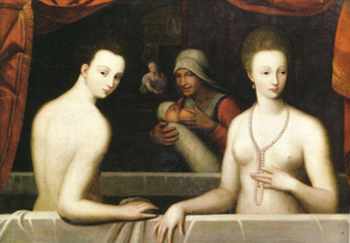 Painting of "Gabrielle d'Estees, Duchess of Beaufort (right), in the
bath, with her sister Giulia d'Estrees, Duchess of Villars," with
wet nurse beyond. Image source: https://www.altesses.eu/
Painting of "Gabrielle d'Estees, Duchess of Beaufort (right), in the
bath, with her sister Giulia d'Estrees, Duchess of Villars," with
wet nurse beyond. Image source: https://www.altesses.eu/
Nineteenth-century baby bottles were used to store either animal milk, or, in
conjunction with a breast pump, store the mother’s own milk. Pap-boats on the
other hand, contained a soft gruel-like "pap" substance which was often a mixture of
bread, flour, water, and sometimes cornmeal and crushed walnuts (Bogucki 2007).
The oldest example of such an artificial feeding vessel dates back to more
than 4,000 years ago with the discovery of a teacup-shaped earthenware "feeding
cup" from Phoenikas, Cyprus (Baby Bottle Museum 2011). Except for size, not a
lot has changed in the basic design of these feeding vessels.
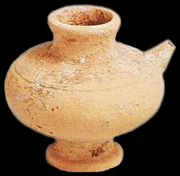 Phoenikas feeding cup from the Baby Bottle Museum in UK.
http://babybottle-musuem.co.uk/early.htmdoctors
Phoenikas feeding cup from the Baby Bottle Museum in UK.
http://babybottle-musuem.co.uk/early.htmdoctors
During a 1980 excavation in Baltimore, Maryland, archaeologists found a more recent
example of a glass baby bottle dating from around 1850 to 1870. It was unusual
because it was a hollow vessel that was unable to be placed vertically on a flat
surface, instead laying flat on its side. This shape allowed a baby’s small
hands to hold it comfortably on its own so that the mother could leave the
child to feed unattended (Stevens 2009). Based on my research, this bottle is
most likely a torpedo-shaped baby bottle that would have had two holes: one
on the "top" which would be plugged with a cork and where the milk would be
poured, and another hole at the end of a thin glass bottle neck which would be
dubbed "the business end" and have an attached rag, leather piece, or preserved
cow teat to act as a nipple for suckling the milk (Baby Bottle Museum 2011). Often
there was also a lip on the bottle neck that would flare out, over which a
rubber nipple would be stretched (Bogucki 2007). My conclusions about
the Baltimore bottle are based on a picture of a similar shaped glass bottle
found on a collections website that specializes in early baby feeders.
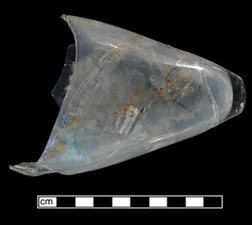 Possible baby bottle found at an excavation in Baltimore, MD.
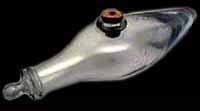 Torpedo-shaped baby bottle from the Baby Bottle Museum in UK.
http://babybottle-musuem.co.uk/early.htm
Torpedo-shaped baby bottle from the Baby Bottle Museum in UK.
http://babybottle-musuem.co.uk/early.htm
References
Baby Bottle Museum
2011 "The History of the Feeding
Bottle." Baby Bottle Museum. http://babybottle-museum.co.uk/articles.htm
Bogucki, Ed
2007 "History of Nursing Bottles." The
American Collectors of Infant Feeders. http://acif.org/home.html.
Greiner, Ted
1998 Nutrition Papers. Dec. 1998.
http://www.tedgreiner.info/?m=199812.
Stevens, Emily E., Thelma E. Patrick, and Rita Pickler
2009 "A History of Infant Feeding."
Journal of Perinatal Education 18.2:32-39.