Sometimes curators are delighted to discover that they are wrong, and this
Curator's Choice is devoted to just such a case. I recently pulled a number
of artifacts for a gathering of colleagues on the topic of needlework, and
one of the artifacts in question was a lovely turned bone item that has
been interpreted as an 18th-century needle case since it was recovered in
1981. The hollow bone cylinder has two threaded ends, one of which has a lid
that can still be screwed onto it. I wanted to know what went on the other
end; after all why would a needle case need to open on two sides? A
Google image search for bone needle cases resulted in a lot of hits, but
they were either elaborately decorative or too skinny to match my example.
So I made a more generic search for "18th-century turned bone." This time
I found my object, but it wasn’t a needle case at all — it was a
telescope!
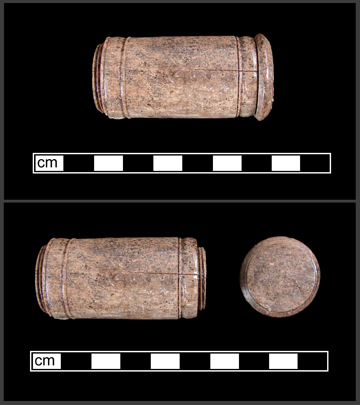 Turned bone telescope from Upper Notley Hall (18ST75). The cylinder is
threaded at both ends for attachment to other bone pieces like the lens cap shown attached
(top) and removed (bottom)
Turned bone telescope from Upper Notley Hall (18ST75). The cylinder is
threaded at both ends for attachment to other bone pieces like the lens cap shown attached
(top) and removed (bottom)
Five similar telescopes have been recovered in Amsterdam, where they were
presumably manufactured and sold. Our supposed needle case looked just like
the Amsterdam telescopes, right down to the dimensions and the lid. The
telescopes are made from the metatarsal bone of the cow, which only allowed
up to 10 cm of bone suitable for turning. Any telescope intended to be
longer could be threaded at the middle to fit another piece. Each end
would have a glass lens held in place with a metal ring and an end cap
to protect the lens when not in use. One lens was concave and the other
was convex. This arrangement achieved relatively weak magnification, but
unlike more powerful telescopes of the period, the image you saw would
not appear upside down (Rijkelijkhuizen 2011).
Such short telescopes would not be strong enough for use in astronomy or
ship navigation, but their small size and versatility made them handy
for personal use. In some cases the telescope function was only one of
many tools ingeniusly nested into a compact bone cylinder. In addition
to the telescope, multi-purpose compendiums might include small lenses
that acted as a microscope or "flea glass," compasses, sundials, and
"live" boxes to hold a small specimen for viewing. Each portion of the
instrument could be accessed or put away simply by screwing or unscrewing
different sections of the compendium (for more examples,
see Chrisites.com, fleaglass.com, and vanleesantiques.com).
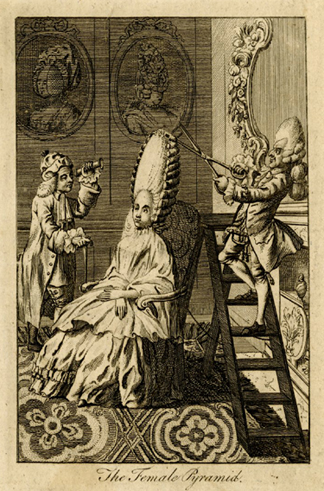 This 1771 satirical print mocks the height of ladies’ wigs by showing a man using a spyglass
similar to our bone telescope to observe a hairdresser atop a ladder as he works on his lady's
coiffure. ©Trustees of the British Museum
This 1771 satirical print mocks the height of ladies’ wigs by showing a man using a spyglass
similar to our bone telescope to observe a hairdresser atop a ladder as he works on his lady's
coiffure. ©Trustees of the British Museum
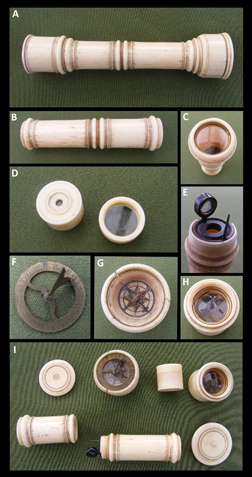 A telescope compendium with many tools, c. 1690. A) The compendium fully assembled and closed,
B) the telescope portion, side view, C) the telescope portion, top view, D) a "live" box, presumably
for looking at moving specimens, E) flea glass microscope, F) brass sundial, G) compass,
H) polyprism viewer (dragonfly glass), I) all of the pieces shown separated. Adapted
from fleaglass.com.
A telescope compendium with many tools, c. 1690. A) The compendium fully assembled and closed,
B) the telescope portion, side view, C) the telescope portion, top view, D) a "live" box, presumably
for looking at moving specimens, E) flea glass microscope, F) brass sundial, G) compass,
H) polyprism viewer (dragonfly glass), I) all of the pieces shown separated. Adapted
from fleaglass.com.
The telescope in our collection was excavated from the south yard of a
late 18th-century house that still stands in St. Mary's County (Site 18ST75,
Upper Notley Hall). Archaeologists located an earlier foundation that was
probably constructed after 1720 and demolished by around 1775 when the
current structure was built. The telescope was in an undisturbed trash
deposit that is believed to represent demolition debris from the earlier
house (Pogue 1981). Unfortunately, little is known of the occupants of
Notley Hall in the 18th century because an 1831 courthouse fire destroyed
the early property records (Pogue 1981).
Since we can't connect the telescope to any particular people, it is hard
to say what this object means in the context of Maryland history. Certainly
it is indicative of the rise of scientific thinking that led the 18th
century to be nicknamed the "Age of Reason" and "The Enlightenment." We
know that other Maryland settlers took an interest in science. For
example, one late 17th-century resident of Calvert County was an avid
astronomer who grew up in the same household as Isaac Newton and contributed
data from his astronomical observations to Newton’s works (Rose and Marti
1984). Perhaps the inhabitants of Notley Hall were participants in similar
scientific endeavors and they bought a relatively small and versatile tool
to aid their efforts. Then again, maybe they just wanted to spy on each
other. Either way, we can say that this telescope was probably not used
to store pins or needles, so at least we’ve corrected that decades-old
conclusion. Furthermore, my curatorial instincts will no longer jump to
the terms "needle case" or "utensil handle" every time I see a hollow
bone object. I won't go straight to "telescope" as an ID either though.
Instead, I will go to library books, Google images, antique store
websites, and any other resource that can show me old objects as
they looked when they were whole. I'm looking forward to being wrong
more often, since sometimes that means an artifact is so much more
exciting than we originally thought.
References
Christies.com
2013 An Unusual Late 18th-Century [?]
English Turned Bone Telescope, Flea Glass and Live Box Compendium. Web resource,
http://www.christies.com/lotfinder/lot/an-unusual-late-18th-century-english-turned-bone-3103884-details.aspx?from=salesummary&intObjectID=3103884&sid=b6c48a49-4373-4903-bcc1-a88cbd968dbd,
accessed 8/26/2013.
Fleaglass.com
2011 Early Bone Compendium. Web resource,
http://www.fleaglass.com/index.php?a=2&b=7526, accessed 8/26/2013.
Pogue, Dennis
1981 Archaeological Investigations at Notley
Hall (18ST75), St. Mary's County, Maryland. Maryland Historical Trust Manuscript Series, No. 21.
Rijkelijkhuizen, Marloes J.
2011 Bone Telescopes from Amsterdam. Journal of
Archaeology in the Low Countries 3-1 (November 2011). Web resource,
http://dpc.uba.uva.nl/jalc/03/nr01/a05, accessed 8/26/2013.
Rose, Lou and Michael Marti
1984 Arthur Storer of Lincolnshire, England, and
Calvert County, Maryland: Newton's Friend, Star Gazer, and Forgotten Man of Science in
Seventeenth-Century Maryland. Calvert County Historical Society. Maryland Printing
and Graphics, Inc.: Dunkirk, Maryland.
Vanleesantiques.com
n.d. Fleaglass Microscope and Telescope
Compendium. Web resource, http://www.vanleestantiques.com/object.php?id=1266, accessed 8/26/2013.