An unusually large tombstone was once located on what is now the Naval Air Station
Patuxent River in St. Mary's County, MD. This 1,000-pound limestone slab once marked
the grave of Christopher Rousby and his brother John (Desmon 2005). The epitaph
lists not only their names and dates but also describes the stabbing that led to
Christopher Rousby's death. The story of Rousby's murder was once notorious in
St. Mary's County. However, by the 1940s, when the Navy altered the landscape
and the tombstone was moved, this tale had faded into obscurity.
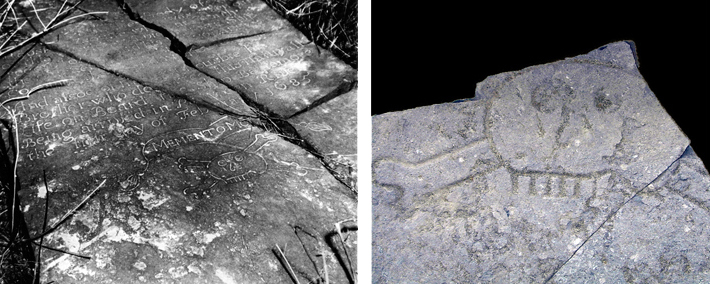 Tombstone in situ with closeup of skull and crossbones depicted on
tombstone.
Tombstone in situ with closeup of skull and crossbones depicted on
tombstone.
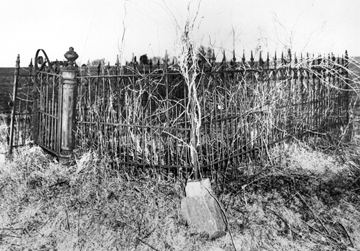 Graveyard where Rousby's tombstone was found.
Christopher Rousby was appointed King's Tax Collector in 1676 (King 2012:33). His
position and abrasive personality often brought him into conflict with the
Governor of Maryland, Lord Baltimore. Baltimore called Rousby "Evill" and a
"Devill," accused him of harassing merchants, padding his pockets, demanding
gifts, and speaking treason (Browne 1887:274-276; Galke 2000:21; King 2012:33).
In turn, Rousby accused Baltimore of cheating the King, hindering tax collection,
trying to paint his character "as black as hell," and "throwing dirt to see what
sticks" (Browne 1887:290, 303). Baltimore even requested Rousby be replaced by
more evenhanded collectors, his own sons-in-law (Browne 1887:286). However, his
request was denied. Instead, Baltimore was charged 2,500 pounds for interfering
with the tax collector's duties (Galke 2000:22; Browne 1887:305). Even after
Baltimore returned to England, the ill will between the King's men and the
colonists continued. Lord Baltimore's cousin, Colonel George Talbot, continued
to keep an eye on affairs in his absence. While staying in St. Mary's City, Talbot
grew angry listening to merchants' and shippers' complaints and decided to
confront Rousby with these accusations (Pogue 1968:324).
On October 31, 1684, All Hallows Eve, these disputes took a darker turn. That
night, Rousby was having dinner with Captain Thomas Allen of the Royal Navy
aboard his ship, the Quaker. Allen had gained a similar reputation
for harassing and mocking the people of Maryland. Talbot rowed to meet them and
after declining their invitation to dinner, began to argue over the King's
authority in Maryland. There are varying accounts of this confrontation. Some
portray Talbot as a drunken hothead yelling accusations at Rousby. Others
describe Talbot making unwelcome passes at Allen before losing his
temper, pulling out a dagger, and stabbing Rousby in the chest. Rousby
died soon after (Galke 2000:22; King 2012:34).
Allen had Talbot arrested and placed in irons. Fearing Talbot would escape
justice if brought to Maryland, Allen instead took him to Virginia. However,
while both governments were arguing over jurisdiction, Talbot, assisted by his
jailers, wife and friends, escaped from prison. The jailors were subsequently
arrested but escaped the following day (Browne 1887:453). Accounts of
Talbot's flight describe him wearing disguises and eating food brought
by trained falcons. Informants also stated Talbot was hiding at home in
Maryland, protected by friends and neighbors (King 2012:34-35). Eventually,
he was caught and brought to trial in Virginia where the jury convicted
him of murder, describing Talbot as being, "moved and seduced by the
Instigation of the Divel" (Browne 1887:479). Talbot was sentenced to
death but later pardoned by the King after paying 1,000 pounds and
offering an apology (Browne 1898:480; Pogue 1968:325).
When the Navy began constructing the Naval Air Station Patuxent River in
the 1940s, the house that stood nearby the Rousby tombstone was offered
to the Henry Ford Museum for their Greenfield Village exhibit. Believing
the house to be Rousby's, the Museum accepted and the building was moved
to Dearborn, Michigan (King 2012:21-22, 88). The workmen also collected the
broken pieces of Rousby's tombstone and "a bag of bones" found underneath
it. Many years later, researchers determined the house was not
actually Rousby's and instead was constructed about 150 years after
his death. The Henry Ford Museum changed their interpretation of the
house and placed the tombstone in storage. The bones were also examined
and determined to be from three separate individuals; none Caucasian
male. Since none of these individuals could have been Christopher
Rousby or his brother, John, the remains were cremated and reinterred.
The location of the remains of both Rousbys is still a mystery (Desmon
2005).
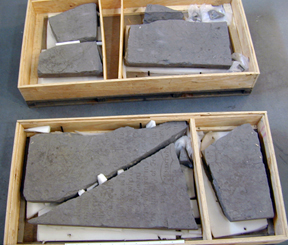 Crated tombstone after arriving at MAC Lab.
The Rousby tombstone sat in storage for almost 20 years before a local
individual in Southern Maryland made inquiries and requested its return.
The MAC Lab was contacted and worked with the Henry Ford Museum to have
it shipped back to Maryland. In 2002, two large crates arrived at the
lab containing fragments of the tombstone. The hope is that one day the
tombstone can be displayed to remind visitors of this wicked, but
noteworthy, event in Maryland's history (Desmon 2005).
References
Browne, William Hand, Ed.
1887 Archives of Maryland Volume V:
Proceedings of the Council of Maryland 1667-1687. Maryland
Historical Society, Baltimore, MD.
1898 Archives of Maryland Volume XVII:
Proceedings of the Council of Maryland 1681-1685. Maryland Historical
Society, Baltimore, MD.
Desmon, Stephanie
2005 "Lost Soul." Baltimore Sun.
June 21, 2005.
Galke, Laura J., and Michael W. Kell
2000 Phase I Archaeological Resources
Inventory of the Harper's Creek Area Naval Air Station Patuxent River, St.
Mary's Country, Maryland.
King, Julia A.
2012 Archaeology, Narrative, and
the Politics of the Past. University of Tennessee Press, Knoxville, TN.
Pogue, Robert E.T.
1968 Yesterday in Old St. Mary's
County. Robert E.T. Pogue, Bushwood, MD.